Rehnberg Maria, Amu Sylvie, Tarkowski Andrej, Bokarewa Maria I, Brisslert Mikael
Department of Rheumatology and Inflammation Research, Sahlgrenska Academy at University of Gothenburg, Guldhedsgatan 10A, Gothenburg, Sweden.
Arthritis Res Ther. 2009;11(4):R123. doi: 10.1186/ar2789. Epub 2009 Aug 17.
In the present study we evaluated changes in the B cell phenotype in peripheral blood and bone marrow (BM) of patients with rheumatoid arthritis (RA) following anti-CD20 treatment using rituximab.
Blood and BM samples were obtained from 37 patients with RA prior to rituximab treatment. Ten of these patients were resampled 1 month following rituximab, 14 patients after 3 months and the remaining 13 patients were included in the long-term follow up. B cell populations were characterized by CD27/IgD/CD38/CD24 expression.
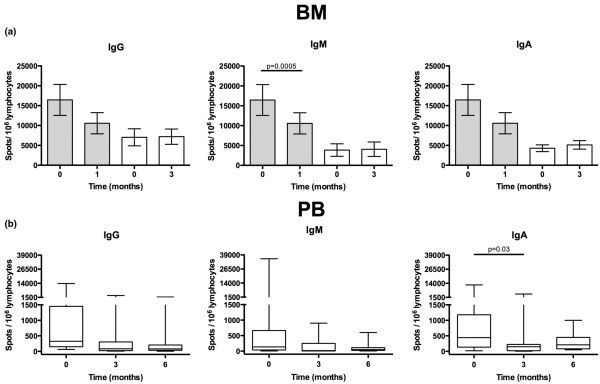
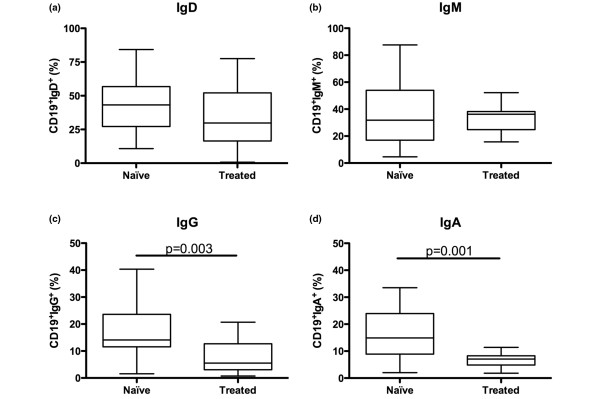
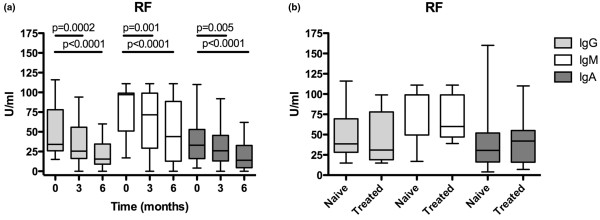
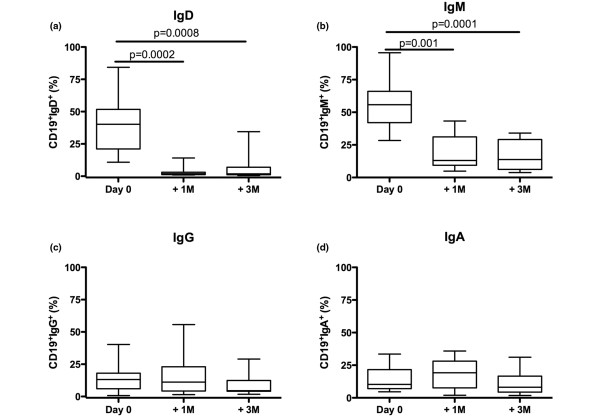
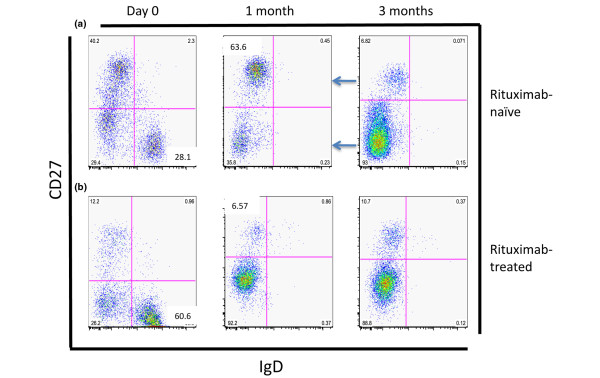
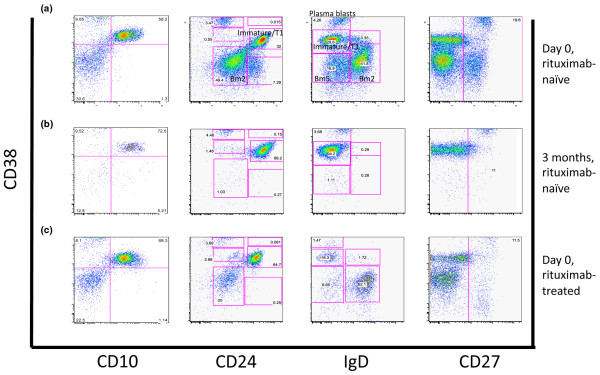
One and three months following rituximab BM retained up to 30% of B cells while circulation was totally depleted of B cells. Analysis of the remaining BM B cells showed prevalence of immature and/or transitional B cells (CD38++CD24++) and CD27+IgD- memory cells, while IgD+ cells were completely depleted. A significant reduction of CD27+ cells in BM and in circulation was observed long after rituximab treatment (mean 22 months), while levels of naive B cells in BM and in circulation were increased. The levels of rheumatoid factor decline after rituximab treatment but returned to baseline levels at the time of retreatment.
Anti-CD20 treatment achieves a depletion of IgD+ B cells shortly after the treatment. At the long term follow up, a reduction of CD27+ B cells was observed in blood and BM. The prolonged inability to up-regulate CD27 may inhibit the renewal of memory B cells. This reduction of CD27+ B cells does not prevent autoantibody production suggesting that mechanisms regulating the formation of auto reactive clones are not disrupted by rituximab.
在本研究中,我们评估了类风湿关节炎(RA)患者使用利妥昔单抗进行抗CD20治疗后外周血和骨髓(BM)中B细胞表型的变化。
从37例接受利妥昔单抗治疗前的RA患者中获取血液和BM样本。其中10例患者在利妥昔单抗治疗后1个月重新采样,14例患者在3个月后重新采样,其余13例患者纳入长期随访。通过CD27/IgD/CD38/CD24表达来表征B细胞群体。
利妥昔单抗治疗后1个月和3个月,骨髓中保留了高达30%的B细胞,而循环中的B细胞则完全耗尽。对剩余骨髓B细胞的分析显示,不成熟和/或过渡性B细胞(CD38++CD24++)和CD27+IgD-记忆细胞占优势,而IgD+细胞则完全耗尽。在利妥昔单抗治疗后很长时间(平均22个月),观察到骨髓和循环中CD27+细胞显著减少,而骨髓和循环中幼稚B细胞的水平则增加。利妥昔单抗治疗后类风湿因子水平下降,但在再次治疗时恢复到基线水平。
抗CD20治疗在治疗后不久即可实现IgD+B细胞的耗竭。在长期随访中,观察到血液和骨髓中CD27+B细胞减少。长期无法上调CD27可能会抑制记忆B细胞的更新。CD27+B细胞的这种减少并不能阻止自身抗体的产生,这表明调节自身反应性克隆形成的机制未被利妥昔单抗破坏。