Casanova Jean-Laurent, Abel Laurent
Laboratory of Human Genetics of Infectious Diseases, Rockefeller Branch, The Rockefeller University, New York, New York 11065, USA.
J Exp Med. 2009 Aug 31;206(9):1839-43. doi: 10.1084/jem.20091683. Epub 2009 Aug 17.
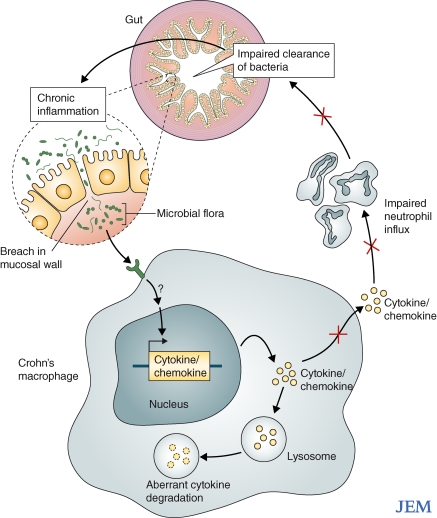
Despite two decades of mouse immunology and human genetics studies, the pathogenesis of Crohn's disease (CD) remains elusive. New clinical investigations suggest that CD may be caused by inborn errors of macrophages. These errors may result in impaired attraction of granulocytes to the gut wall, causing impaired clearance of intruding bacteria, thereby precipitating the formation of granulomas. This theory paves the way for a macrophage-based Mendelian genetic dissection of CD.
尽管经过二十年的小鼠免疫学和人类遗传学研究,克罗恩病(CD)的发病机制仍然难以捉摸。新的临床研究表明,CD可能是由巨噬细胞的先天性缺陷引起的。这些缺陷可能导致粒细胞向肠壁的趋化受损,从而导致入侵细菌的清除受损,进而促使肉芽肿的形成。这一理论为基于巨噬细胞的CD孟德尔遗传学剖析铺平了道路。