Fox Chase Cancer Center, Philadelphia, Pennsylvania, USA.
PLoS One. 2009 Aug 18;4(8):e6661. doi: 10.1371/journal.pone.0006661.
Hepatitis C virus (HCV) is a plus-strand RNA virus that replicates by amplification of genomic RNA from minus strands leading to accumulation of almost one thousand copies per cell under in vitro cell culture conditions. In contrast, HCV RNA copy numbers in livers of infected patients appear to be much lower, estimated at a few copies per cell.
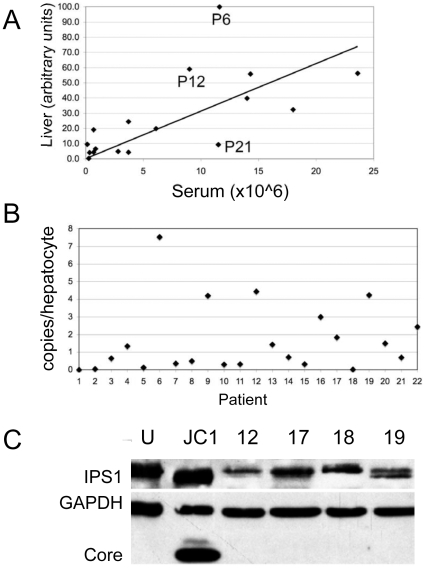
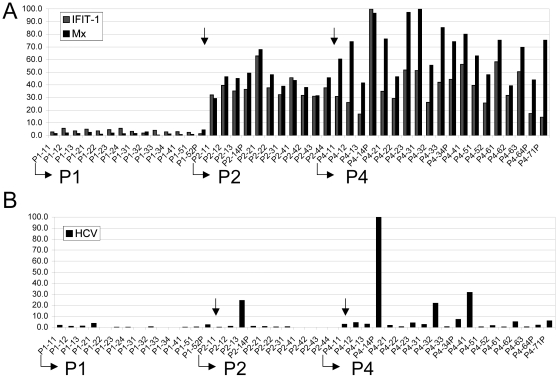
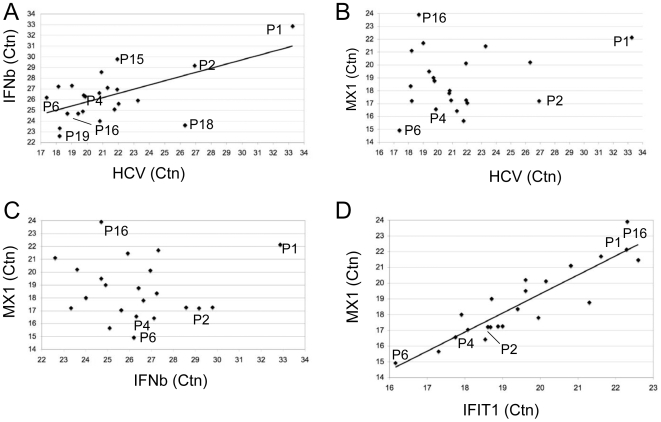
METHODOLOGY/PRINCIPAL FINDINGS: To gain insights into mechanisms that control HCV replication in vivo, we analyzed HCV RNA levels as well as expression of interferon beta (IFNbeta) and several interferon stimulated genes (ISGs) from whole liver sections and micro-dissected subpopulations of hepatocytes in biopsy samples from 21 HCV-infected patients. The results showed that intrahepatic HCV RNA levels range form less than one copy per hepatocyte to a maximum of about eight. A correlation existed between viral RNA levels and IFNbeta expression, but not between viral RNA and ISG levels. Also, IFNbeta expression did not correlate with ISGs levels. Replication of HCV RNA occurred in focal areas in the liver in the presence of a general induction of ISGs.
CONCLUSION/SIGNIFICANCE: The low average levels of HCV RNA in biopsy samples can be explained by focal distribution of infected hepatocytes. HCV replication directly induces IFNbeta, which then activates ISGs. The apparent lack of a correlation between levels of IFNbeta and ISG expression indicates that control of the innate immune response during HCV infections depends on multiple factors.
丙型肝炎病毒(HCV)是一种正链 RNA 病毒,通过从负链扩增基因组 RNA 进行复制,导致在体外细胞培养条件下每个细胞积累近千个拷贝。相比之下,感染患者肝脏中的 HCV RNA 拷贝数似乎要低得多,估计每个细胞只有几个拷贝。
方法/主要发现:为了深入了解体内控制 HCV 复制的机制,我们分析了来自 21 例 HCV 感染患者活检样本中整个肝组织切片和微分离的肝细胞亚群中 HCV RNA 水平以及干扰素β(IFNβ)和几种干扰素刺激基因(ISGs)的表达。结果表明,肝内 HCV RNA 水平范围从每个肝细胞不到一个拷贝到最大约 8 个拷贝。病毒 RNA 水平与 IFNβ表达之间存在相关性,但与 ISG 水平之间不存在相关性。此外,IFNβ表达与 ISGs 水平也不相关。在 ISGs 普遍诱导的情况下,HCV RNA 复制发生在肝脏的局灶区。
结论/意义:活检样本中 HCV RNA 的平均低水平可以通过感染肝细胞的局灶分布来解释。HCV 复制直接诱导 IFNβ,然后激活 ISGs。IFNβ 和 ISG 表达之间缺乏相关性表明,HCV 感染期间固有免疫反应的控制取决于多种因素。