Johansen Kirsten L, Zhang Rebecca, Huang Yijian, Chen Shu-Cheng, Blagg Christopher R, Goldfarb-Rumyantzev Alexander S, Hoy Chistopher D, Lockridge Robert S, Miller Brent W, Eggers Paul W, Kutner Nancy G
USRDS Rehabilitation/QoL Special Studies Center, Emory University, Atlanta, Georgia 30322, USA.
Kidney Int. 2009 Nov;76(9):984-90. doi: 10.1038/ki.2009.291. Epub 2009 Aug 19.
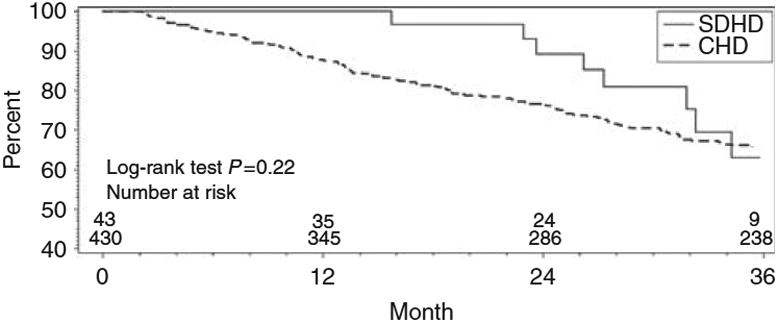
We estimated the survival and hospitalization among frequent hemodialysis users in comparison to those patients undergoing thrice-weekly conventional hemodialysis. All patients had similar characteristics and medical histories. In this cohort study of frequent hemodialysis users and propensity score-matched controls, the collaborating clinicians identified 94 patients who used nocturnal hermodialysis (NHD) and 43 patients who used short-duration daily hemodialysis (SDHD) for a minimum of 60 days. Ten propensity score-matched control patients for each NHD and SDHD patient were identified from the United States Renal Data System database. Primary outcomes were risk for all-cause mortality and risk for the composite outcome of mortality or major morbid event (acute myocardial infarction or stroke) estimated using Cox proportional hazards models. Risks for all-cause, cardiovascular-related, infection-related, and vascular access-related hospital admissions were also studied. Nocturnal hemodialysis was associated with significant reductions in mortality risk and risk for mortality or major morbid event when compared to conventional hemodialysis. There was a reduced but non-significant risk of death for patients using SDHD compared to controls. All-cause and specific hospitalizations did not differ significantly between NHD and SDHD patients and their matched control cohorts. Our study suggests that NHD may improve patient survival.
我们比较了频繁进行血液透析的患者与每周进行三次常规血液透析的患者的生存率和住院情况。所有患者的特征和病史相似。在这项针对频繁进行血液透析的患者和倾向评分匹配对照组的队列研究中,合作的临床医生确定了94例使用夜间血液透析(NHD)的患者和43例使用短程每日血液透析(SDHD)至少60天的患者。从美国肾脏数据系统数据库中为每位NHD和SDHD患者确定了10名倾向评分匹配的对照患者。主要结局是使用Cox比例风险模型估计的全因死亡风险以及死亡或重大疾病事件(急性心肌梗死或中风)复合结局的风险。还研究了全因、心血管相关、感染相关和血管通路相关住院的风险。与传统血液透析相比,夜间血液透析与死亡风险以及死亡或重大疾病事件的风险显著降低相关。与对照组相比,使用SDHD的患者死亡风险降低但不显著。NHD和SDHD患者及其匹配的对照队列之间的全因和特定住院情况没有显著差异。我们的研究表明,NHD可能会提高患者生存率。