Ragg Hermann, Kumar Abhishek, Köster Katharina, Bentele Caterina, Wang Yunjie, Frese Marc-André, Prib Natalie, Krüger Olaf
Department of Biotechnology, Faculty of Technology and Center for Biotechnology, University of Bielefeld, D-33501 Bielefeld, Germany.
BMC Evol Biol. 2009 Aug 22;9:208. doi: 10.1186/1471-2148-9-208.
Intron gains reportedly are very rare during evolution of vertebrates, and the mechanisms underlying their creation are largely unknown. Previous investigations have shown that, during metazoan radiation, the exon-intron patterns of serpin superfamily genes were subject to massive changes, in contrast to many other genes.
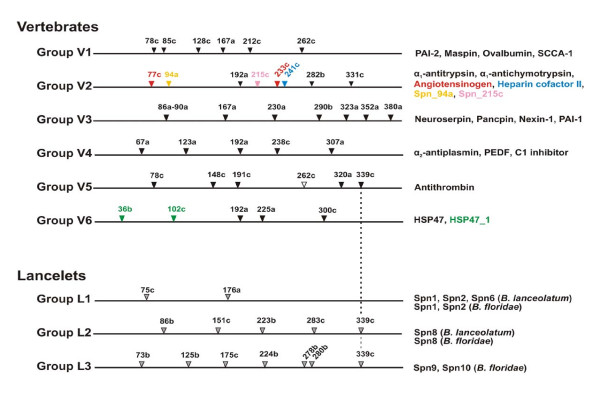
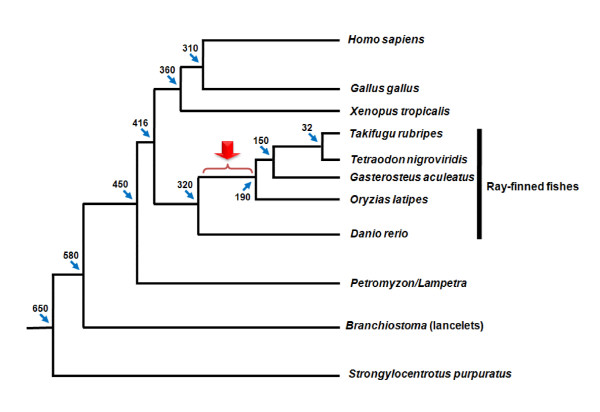
Here we investigated intron dynamics in the serpin superfamily in lineages pre- and postdating the split of vertebrates. Multiple intron gains were detected in a group of ray-finned fishes, once the canonical groups of vertebrate serpins had been established. In two genes, co-occurrence of non-standard introns was observed, implying that intron gains in vertebrates may even happen concomitantly or in a rapidly consecutive manner. DNA breakage/repair processes associated with genome compaction are introduced as a novel factor potentially favoring intron gain, since all non-canonical introns were found in a lineage of ray-finned fishes that experienced genomic downsizing.
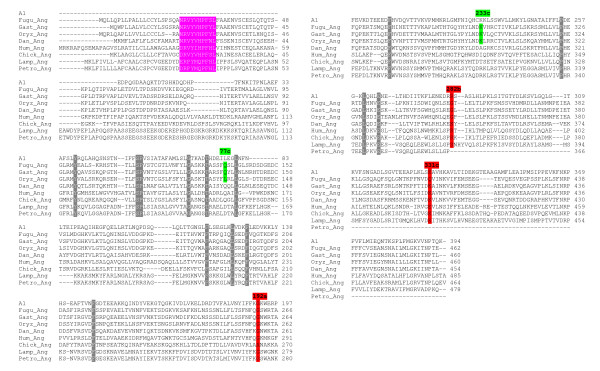
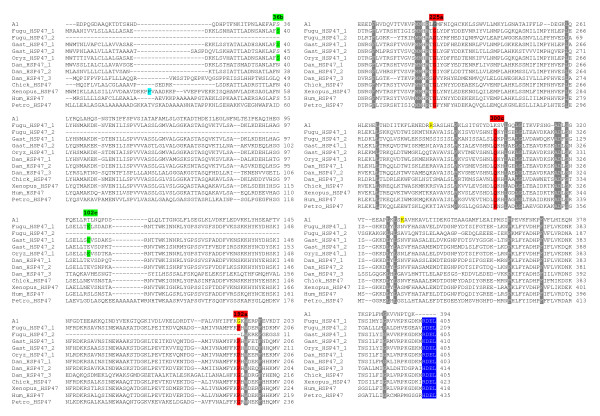
Multiple intron acquisitions were identified in serpin genes of a lineage of ray-finned fishes, but not in any other vertebrates, suggesting that insertion rates for introns may be episodically increased. The co-occurrence of non-standard introns within the same gene discloses the possibility that introns may be gained simultaneously. The sequences flanking the intron insertion points correspond to the proto-splice site consensus sequence MAG upward arrowN, previously proposed to serve as intron insertion site. The association of intron gains in the serpin superfamily with a group of fishes that underwent genome compaction may indicate that DNA breakage/repair processes might foster intron birth.
据报道,内含子的获得在脊椎动物进化过程中非常罕见,其产生的机制在很大程度上尚不清楚。先前的研究表明,在后生动物辐射期间,与许多其他基因相比,丝氨酸蛋白酶抑制剂超家族基因的外显子 - 内含子模式发生了巨大变化。
在这里,我们研究了脊椎动物分化前后谱系中丝氨酸蛋白酶抑制剂超家族的内含子动态。一旦脊椎动物丝氨酸蛋白酶抑制剂的典型类别确立,在一组硬骨鱼中检测到多个内含子的获得。在两个基因中,观察到非标准内含子的共现,这意味着脊椎动物中的内含子获得甚至可能同时发生或以快速连续的方式发生。由于在经历基因组缩小的硬骨鱼谱系中发现了所有非标准内含子,因此与基因组压缩相关的DNA断裂/修复过程被引入作为可能有利于内含子获得的新因素。
在硬骨鱼谱系的丝氨酸蛋白酶抑制剂基因中鉴定出多个内含子的获得,但在任何其他脊椎动物中均未发现,这表明内含子的插入率可能会偶尔增加。同一基因内非标准内含子的共现揭示了内含子可能同时获得的可能性。内含子插入点两侧的序列对应于先前提出用作内含子插入位点的原剪接位点共有序列MAG向上箭头N。丝氨酸蛋白酶抑制剂超家族中内含子获得与一组经历基因组压缩的鱼类之间的关联可能表明DNA断裂/修复过程可能促进内含子的产生。