Veterinary Research Institute, Hudcova 70, 621 00 Brno, Czech Republic.
Cell Div. 2009 Sep 2;4:19. doi: 10.1186/1747-1028-4-19.
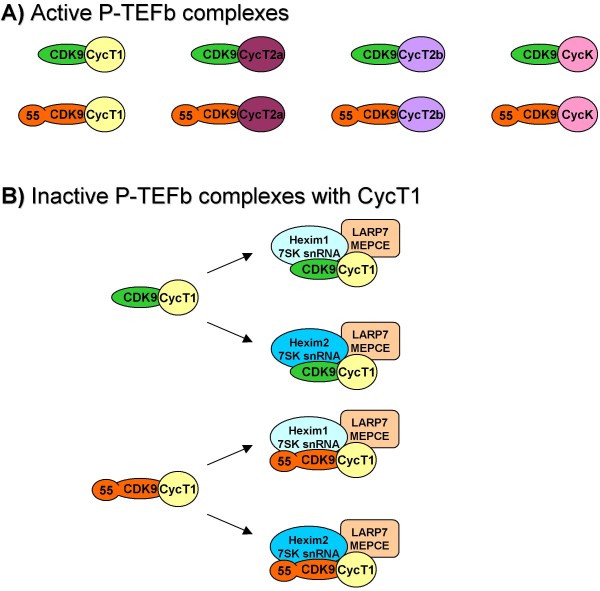
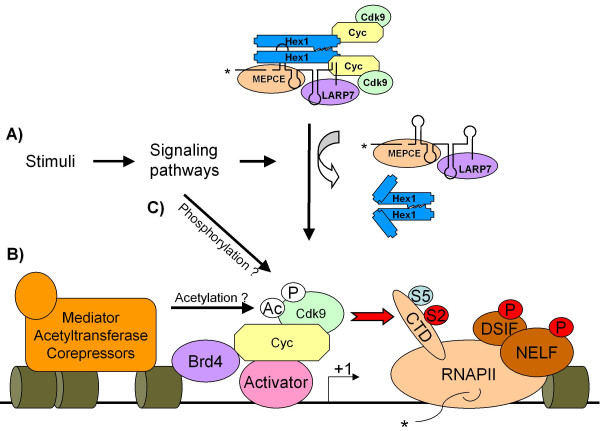
Regulation of gene expression is essential to all aspects of physiological processes in single-cell as well as multicellular organisms. It gives ultimately cells the ability to efficiently respond to extra- and intracellular stimuli participating in cell cycle, growth, differentiation and survival. Regulation of gene expression is executed primarily at the level of transcription of specific mRNAs by RNA polymerase II (RNAPII), typically in several distinct phases. Among them, transcription elongation is positively regulated by the positive transcription elongation factor b (P-TEFb), consisting of CDK9 and cyclin T1, T2 or K. P-TEFb enables transition from abortive to productive transcription elongation by phosphorylating carboxyl-terminal domain (CTD) in RNAPII and negative transcription elongation factors. Over the years, we have learned a great deal about molecular composition of P-TEFb complexes, their assembly and their role in transcription of specific genes, but function of P-TEFb in other physiological processes was not apparent until just recently. In light of emerging discoveries connecting P-TEFb to regulation of cell cycle, development and several diseases, I would like to discuss these observations as well as future perspectives.
基因表达的调控对于单细胞和多细胞生物的生理过程的各个方面都是至关重要的。它最终赋予细胞有效地响应参与细胞周期、生长、分化和存活的细胞内外刺激的能力。基因表达的调控主要在 RNA 聚合酶 II(RNAPII)转录特定 mRNA 的水平上进行,通常分为几个不同的阶段。其中,转录延伸由正转录延伸因子 b(P-TEFb)正向调节,P-TEFb 由 CDK9 和 cyclin T1、T2 或 K 组成。P-TEFb 通过磷酸化 RNAPII 的羧基末端结构域(CTD)和负转录延伸因子,使转录从无效率延伸转变为有效率延伸。多年来,我们已经了解了 P-TEFb 复合物的分子组成、组装及其在特定基因转录中的作用,但直到最近,P-TEFb 在其他生理过程中的功能才变得明显。鉴于新兴的发现将 P-TEFb 与细胞周期、发育和几种疾病的调节联系起来,我想讨论这些观察结果以及未来的展望。