Sackley Catherine M, van den Berg Maayken E, Lett Karen, Patel Smitaa, Hollands Kristen, Wright Christine C, Hoppitt Thomas J
School of Health and Population Sciences, Primary Care Clinical Sciences, University of Birmingham, Edgbaston, Birmingham B15 2TT.
BMJ. 2009 Sep 1;339:b3123. doi: 10.1136/bmj.b3123.
To compare the clinical effectiveness of a programme of physiotherapy and occupational therapy with standard care in care home residents who have mobility limitations and are dependent in performing activities of daily living.
Cluster randomised controlled trial, with random allocation at the level of care home.
Care homes within the NHS South Birmingham primary care trust and the NHS Birmingham East and North primary care trust that had more than five beds and provided for people in the care categories "physical disability" and "older people."
Care home residents with mobility limitations, limitations in activities of daily living (as screened by the Barthel index), and not receiving end of life care were eligible to take part in the study.
A targeted three month occupational therapy and physiotherapy programme.
Scores on the Barthel index and the Rivermead mobility index.
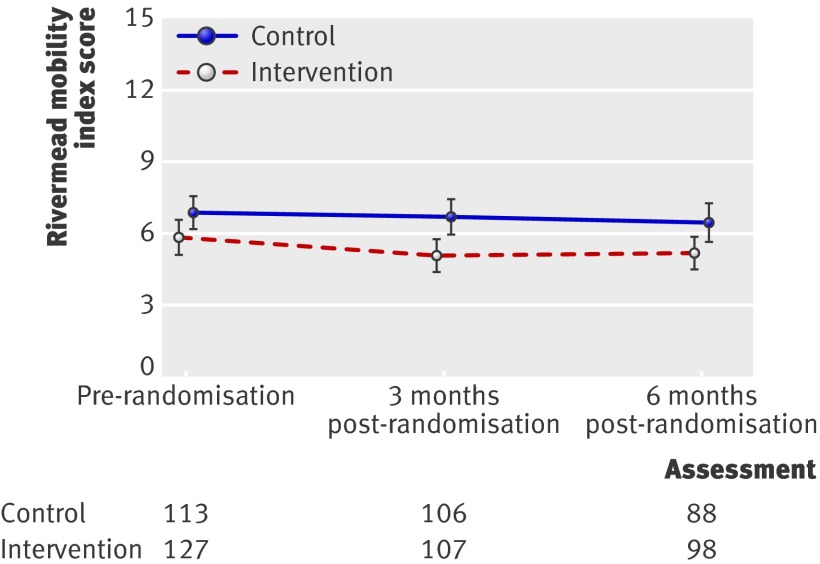
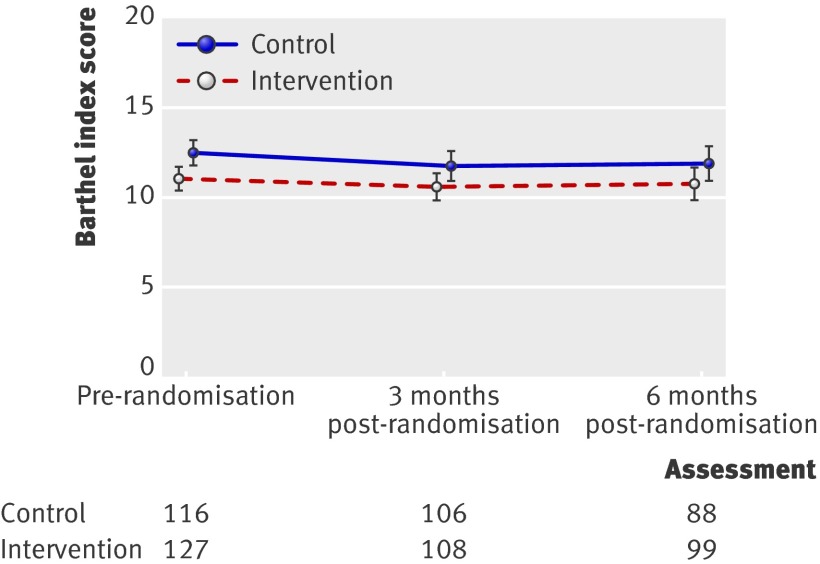
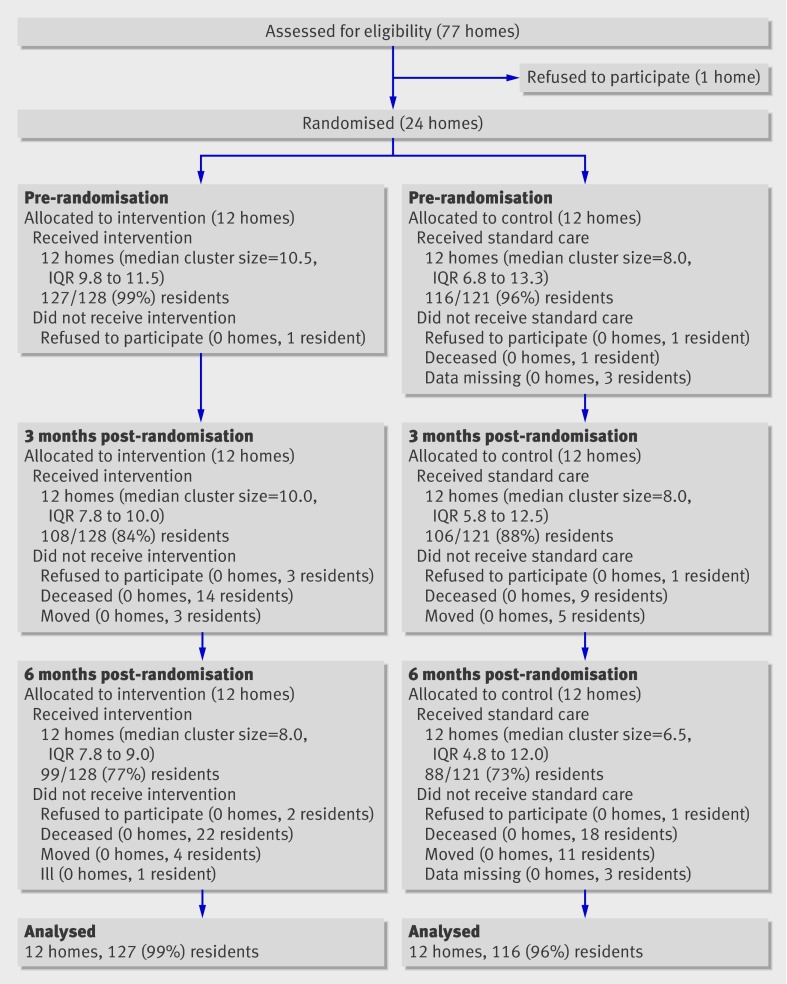
24 of 77 nursing and residential homes that catered for residents with mobility limitations and dependency for activities of daily living were selected for study: 12 were randomly allocated to the intervention arm (128 residents, mean age 86 years) and 12 to the control arm (121 residents, mean age 84 years). Participants were evaluated by independent assessors blind to study arm allocation before randomisation (0 months), three months after randomisation (at the end of the treatment period for patients who received the intervention), and again at six months after randomisation. After adjusting for home effect and baseline characteristics, no significant differences were found in mean Barthel index scores at six months post-randomisation between treatment arms (mean effect 0.08, 95% confidence interval -1.14 to 1.30; P=0.90), across assessments (-0.01, -0.63 to 0.60; P=0.96), or in the interaction between assessment and intervention (0.42, -0.48 to 1.32; P=0.36). Similarly, no significant differences were found in the mean Rivermead mobility index scores between treatment arms (0.62, -0.51 to 1.76; P=0.28), across assessments (-0.15, -0.65 to 0.35; P=0.55), or interaction (0.71, -0.02 to 1.44; P=0.06).
The three month occupational therapy and physiotherapy programme had no significant effect on mobility and independence. On the other hand, the variation in residents' functional ability, the prevalence of cognitive impairment, and the prevalence of depression were considerably higher in this sample than expected on the basis of previous work. Further research to clarify the efficacy of occupational therapy and physiotherapy is required if access to therapy services is to be recommended in this population.
ISRCTN79859980.
比较理疗和职业治疗方案与标准护理对行动不便且日常生活依赖他人照料的养老院居民的临床效果。
整群随机对照试验,在养老院层面进行随机分配。
英国国民健康保险制度(NHS)南伯明翰初级保健信托基金以及NHS伯明翰东和北初级保健信托基金内拥有超过五张床位、为“身体残疾”和“老年人”护理类别患者提供服务的养老院。
行动不便、日常生活活动受限(通过巴氏指数筛查)且未接受临终护理的养老院居民有资格参与本研究。
为期三个月的针对性职业治疗和理疗方案。
巴氏指数和Rivermead行动指数得分。
选取了77家为行动不便及日常生活依赖他人照料的居民提供服务的护理院和养老院中的24家进行研究:12家被随机分配至干预组(128名居民,平均年龄86岁),12家被分配至对照组(121名居民,平均年龄84岁)。在随机分组前(0个月)、随机分组后三个月(接受干预的患者治疗期结束时)以及随机分组后六个月,由对研究组分配不知情的独立评估人员对参与者进行评估。在对养老院效应和基线特征进行调整后,随机分组后六个月时,治疗组之间的平均巴氏指数得分无显著差异(平均效应0.08,95%置信区间-1.14至1.30;P = 0.90),各项评估之间(-0.01,-0.63至0.60;P = 0.96),或评估与干预之间的交互作用(0.42,-0.48至1.32;P = 0.36)均无显著差异。同样,治疗组之间的平均Rivermead行动指数得分在各项评估之间(-0.15,-0.65至0.35;P = 0.55),或交互作用(0.