Section of Molecular Hematology and Therapy, Department of Stem Cell Transplantation and Cellular Therapy, The University of Texas M.D. Anderson Cancer Center, Houston, TX 77030, USA.
Mol Cancer Ther. 2009 Sep;8(9):2509-16. doi: 10.1158/1535-7163.MCT-09-0386. Epub 2009 Sep 1.
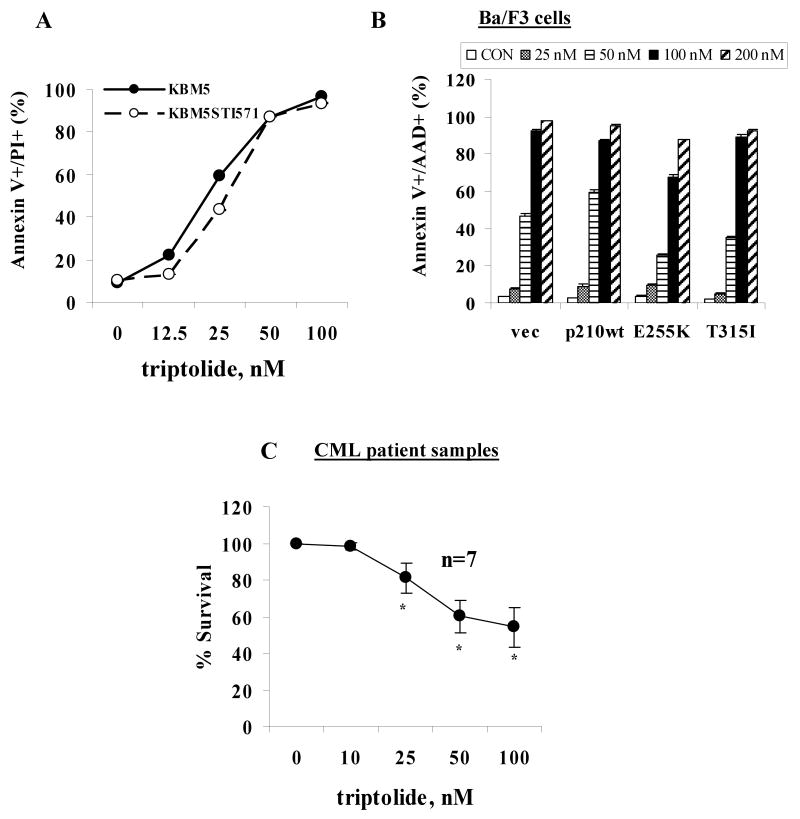
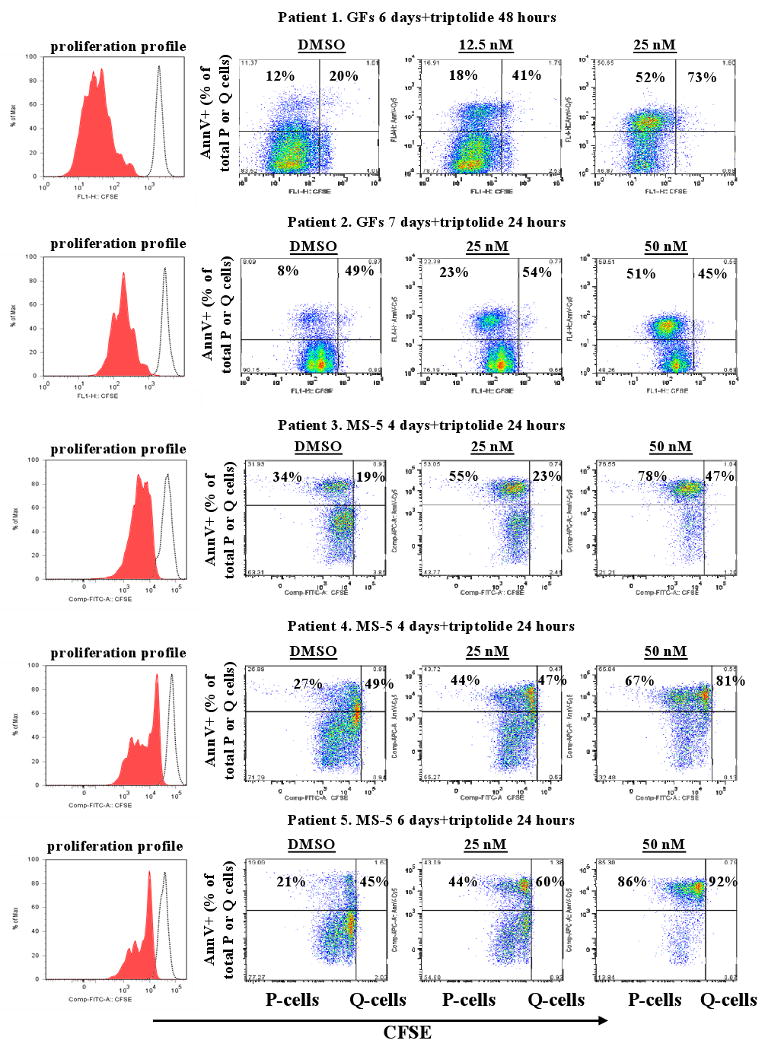
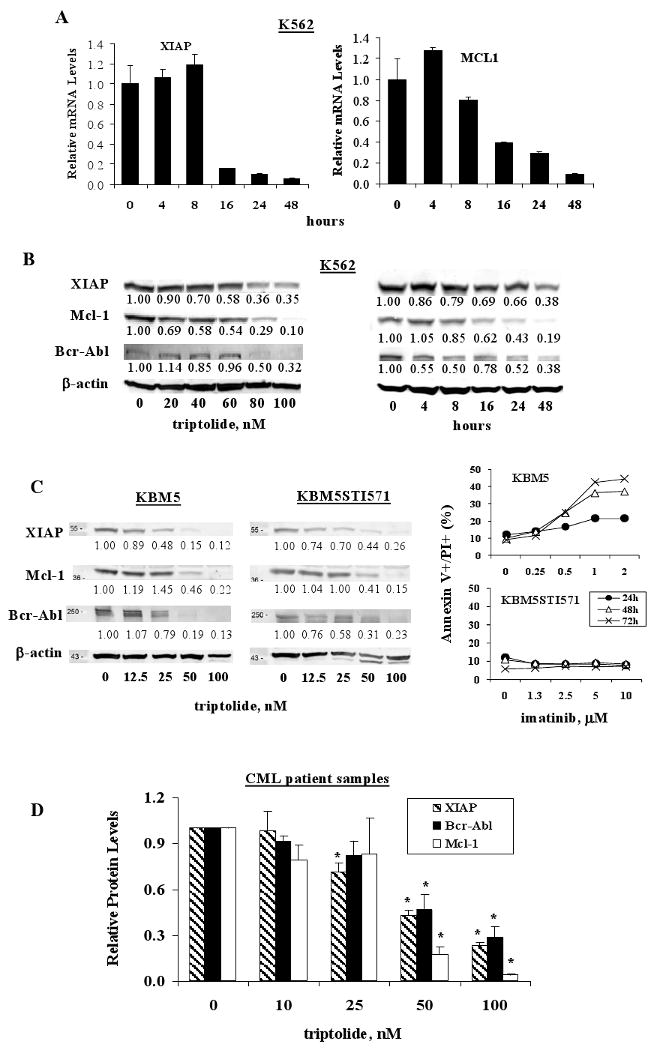
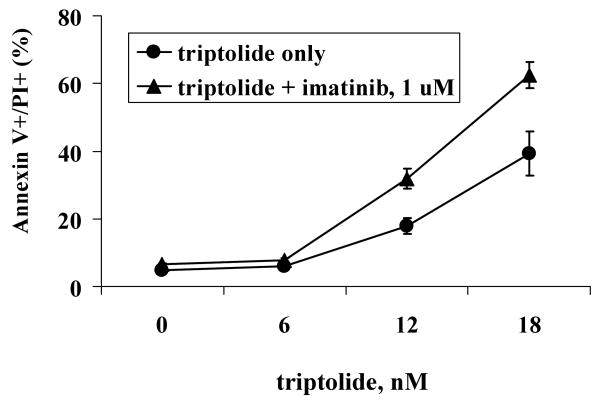
The advent of Bcr-Abl tyrosine kinase inhibitors (TKI) has revolutionized the treatment of chronic myelogenous leukemia (CML). However, resistance evolves due to BCR-ABL mutations and other mechanisms. Furthermore, patients with blast crisis CML are less responsive and quiescent CML stem cells are insensitive to these inhibitors. We found that triptolide, a diterpenoid, at nanomolar concentrations, promoted equally significant death of KBM5 cells, a cell line derived from a Bcr-Abl-bearing blast crisis CML patient and KBM5STI571 cells, an imatinib-resistant KBM5 subline bearing the T315I mutation. Similarly, Ba/F3 cells harboring mutated BCR-ABL were as sensitive as Ba/F3Bcr-Abl(p210wt) cells to triptolide. Importantly, triptolide induced apoptosis in primary samples from blast crisis CML patients, who showed resistance to Bcr-Abl TKIs in vivo, with less toxicity to normal cells. Triptolide decreased X-linked inhibitor of apoptosis protein, Mcl-1, and Bcr-Abl protein levels in K562, KBM5, and KBM5STI571 cells and in cells from blast crisis CML patients. It sensitized KBM5, but not KBM5STI571, cells to imatinib. More importantly, triptolide also induced death of quiescent CD34(+) CML progenitor cells, a major problem in the therapy of CML with TKIs. Collectively, these results suggest that triptolide potently induces blast crisis CML cell death independent of the cellular responses to Bcr-Abl TKIs, suggesting that triptolide could eradicate residual quiescent CML progenitor cells in TKI-treated patients and benefit TKI-resistant blast crisis CML patients.
Bcr-Abl 酪氨酸激酶抑制剂 (TKI) 的出现彻底改变了慢性髓细胞白血病 (CML) 的治疗方法。然而,由于 BCR-ABL 突变和其他机制,耐药性会不断发展。此外,患有急变期 CML 的患者反应较差,而这些抑制剂对静止的 CML 干细胞则不敏感。我们发现,雷公藤内酯,一种二萜,在纳摩尔浓度下,同样能显著促进 KBM5 细胞的死亡,KBM5 细胞系源自一个患有 Bcr-Abl 阳性急变期 CML 的患者,而 KBM5STI571 细胞是一种携带 T315I 突变的对伊马替尼耐药的 KBM5 亚系。同样,携带突变 BCR-ABL 的 Ba/F3 细胞对雷公藤内酯的敏感性与 Ba/F3Bcr-Abl(p210wt) 细胞相当。重要的是,雷公藤内酯能诱导对体内 Bcr-Abl TKI 耐药的急变期 CML 患者的原代样本发生细胞凋亡,而对正常细胞的毒性较低。雷公藤内酯能降低 K562、KBM5 和 KBM5STI571 细胞以及急变期 CML 患者的细胞中的 X 连锁凋亡抑制蛋白、Mcl-1 和 Bcr-Abl 蛋白水平。它能使 KBM5,但不能使 KBM5STI571 细胞对伊马替尼敏感。更重要的是,雷公藤内酯还能诱导静止的 CD34(+) CML 祖细胞死亡,这是 TKI 治疗 CML 的一个主要问题。总之,这些结果表明,雷公藤内酯能强力诱导急变期 CML 细胞死亡,而与细胞对 Bcr-Abl TKI 的反应无关,这表明雷公藤内酯可能能清除 TKI 治疗患者中静止的 CML 祖细胞的残留,使对 TKI 耐药的急变期 CML 患者受益。