University of California San Diego, La Jolla, CA 92093-0679, USA.
AIDS. 2009 Oct 23;23(16):2151-8. doi: 10.1097/QAD.0b013e3283313ca9.
To develop less costly methods to virologically monitor patients receiving antiretroviral therapy, we evaluated methods that use pooled blood samples and quantitative information available from viral load assays to monitor a cohort of patients on first-line antiretroviral therapy for virologic failure.
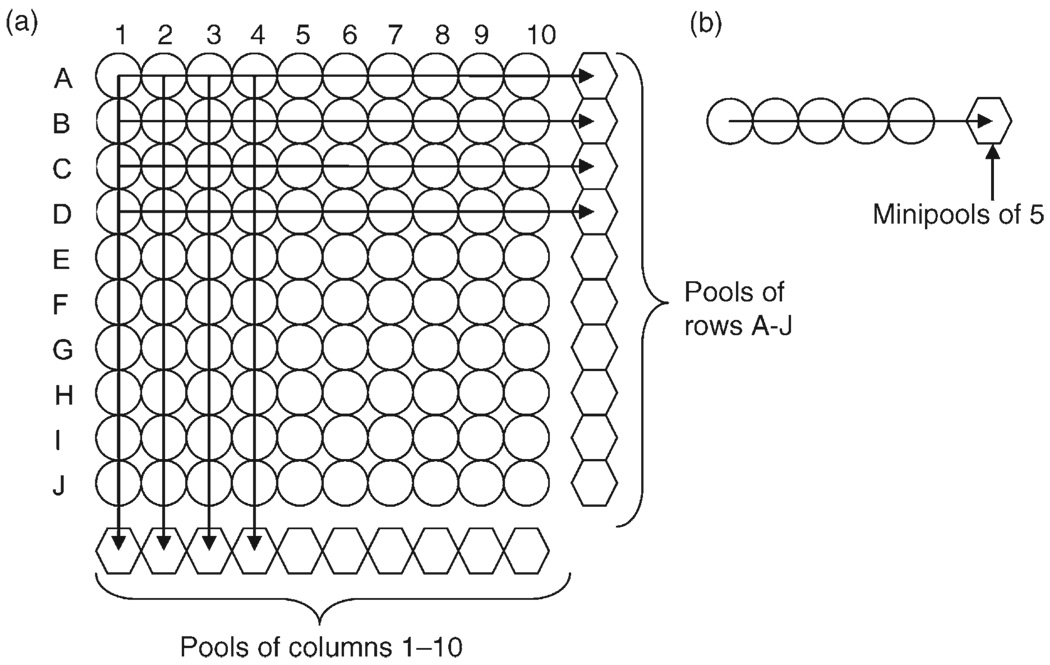
We evaluated 150 blood samples collected after 6 months of therapy from participants enrolled in a San Diego primary infection program between January 1998 and January 2007. Samples were screened for virologic failure with individual viral load testing, 10 x 10 matrix pools and minipools of five samples. For the pooled platforms (matrix and minipools), we used a search and retest algorithm based on the quantitative viral load data to resolve samples that remained ambiguous for virologic failure. Viral load thresholds were more than 500 and more than 1500 copies/ml for the matrix and more than 250 and more than 500 copies/ml for the minipool. Efficiency, accuracy and result turnaround times were evaluated.
Twenty-three percent of cohort samples were detectable at more than 50 HIV RNA copies/ml. At an algorithm threshold of more than 500 HIV RNA copies/ml, both minipool and matrix methods used less than half the number of viral load assays to screen the cohort, compared with testing samples individually. Both pooling platforms had negative predictive values of 100% for viral loads of more than 500 HIV RNA copies/ml and at least 94% for viral loads of more than 250 HIV RNA copies/ml.
In this cohort, both pooling methods improved the efficiency of virologic monitoring over individual testing with a minimal decrease in accuracy. These methods may allow for the induction and sustainability of the virologic monitoring of patients receiving antiretroviral therapy in resource-limited settings.
为了开发成本更低的方法来对接受抗逆转录病毒治疗的患者进行病毒学监测,我们评估了使用汇集的血液样本和病毒载量检测提供的定量信息来监测接受一线抗逆转录病毒治疗的患者队列中病毒学失败的方法。
我们评估了 1998 年 1 月至 2007 年 1 月期间参加圣地亚哥初次感染项目的参与者在治疗 6 个月后采集的 150 份血液样本。使用个体病毒载量检测、10 x 10 基质池和五个样本的迷你池对样本进行病毒学失败筛查。对于汇集平台(基质和迷你池),我们使用基于定量病毒载量数据的搜索和重新测试算法来解决病毒学失败结果仍不确定的样本。病毒载量阈值对于基质大于 500 和大于 1500 拷贝/ml,对于迷你池大于 250 和大于 500 拷贝/ml。我们评估了效率、准确性和结果周转时间。
队列样本中有 23%的样本可检测到超过 50 HIV RNA 拷贝/ml。在算法阈值大于 500 HIV RNA 拷贝/ml 时,与单独检测样本相比,迷你池和基质方法用于筛查队列的病毒载量检测数量均不到一半。两种汇集平台对病毒载量大于 500 HIV RNA 拷贝/ml 的阴性预测值均为 100%,对病毒载量大于 250 HIV RNA 拷贝/ml 的阴性预测值至少为 94%。
在本队列中,与单独检测相比,这两种汇集方法均提高了病毒学监测的效率,而准确性略有下降。这些方法可能允许在资源有限的环境中对接受抗逆转录病毒治疗的患者进行病毒学监测的启动和持续进行。