Chau Janita P C, Thompson David R, Twinn Sheila, Chang Anne M, Woo Jean
Nethersole School of Nursing, Chinese University of Hong Kong, Hong Kong.
BMC Neurol. 2009 Sep 7;9:49. doi: 10.1186/1471-2377-9-49.
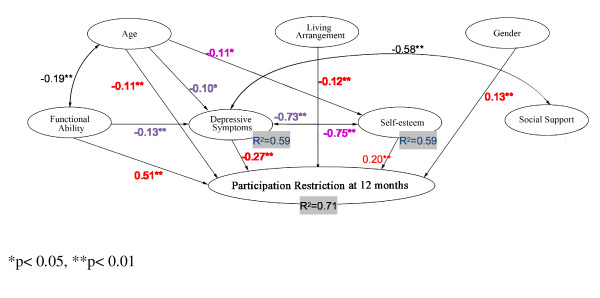
Apart from promoting physical recovery and assisting in activities of daily living, a major challenge in stroke rehabilitation is to minimize psychosocial morbidity and to promote the reintegration of stroke survivors into their family and community. The identification of key factors influencing long-term outcome are essential in developing more effective rehabilitation measures for reducing stroke-related morbidity. The aim of this study was to test a theoretical model of predictors of participation restriction which included the direct and indirect effects between psychosocial outcomes, physical outcome, and socio-demographic variables at 12 months after stroke.
Data were collected from 188 stroke survivors at 12 months following their discharge from one of the two rehabilitation hospitals in Hong Kong. The settings included patients' homes and residential care facilities. Path analysis was used to test a hypothesized model of participation restriction at 12 months.
The path coefficients show functional ability having the largest direct effect on participation restriction (beta = 0.51). The results also show that more depressive symptoms (beta = -0.27), low state self-esteem (beta = 0.20), female gender (beta = 0.13), older age (beta = -0.11) and living in a residential care facility (beta = -0.12) have a direct effect on participation restriction. The explanatory variables accounted for 71% of the variance in explaining participation restriction at 12 months.
Identification of stroke survivors at risk of high levels of participation restriction, depressive symptoms and low self-esteem will assist health professionals to devise appropriate rehabilitation interventions that target improving both physical and psychosocial functioning.
除了促进身体恢复和协助日常生活活动外,中风康复的一个主要挑战是尽量减少心理社会疾病,并促进中风幸存者重新融入家庭和社区。确定影响长期结果的关键因素对于制定更有效的康复措施以降低中风相关疾病至关重要。本研究的目的是检验一个参与限制预测因素的理论模型,该模型包括中风后12个月时心理社会结果、身体结果和社会人口统计学变量之间的直接和间接影响。
从香港两家康复医院之一出院12个月后的188名中风幸存者中收集数据。地点包括患者家中和住宿护理机构。路径分析用于检验12个月时参与限制的假设模型。
路径系数显示功能能力对参与限制的直接影响最大(β = 0.51)。结果还表明,更多的抑郁症状(β = -0.27)、低状态自尊(β = 0.20)、女性(β = 0.13)、年龄较大(β = -0.11)和住在住宿护理机构(β = -0.12)对参与限制有直接影响。解释变量在解释12个月时的参与限制方差中占71%。
识别有高水平参与限制、抑郁症状和低自尊风险的中风幸存者将有助于卫生专业人员设计适当的康复干预措施,以改善身体和心理社会功能。