Ndirangu James, Bärnighausen Till, Tanser Frank, Tint Khin, Newell Marie-Louise
Africa Centre for Health and Population Studies, University of KwaZulu Natal, South Africa.
Trop Med Int Health. 2009 Nov;14(11):1383-93. doi: 10.1111/j.1365-3156.2009.02382.x. Epub 2009 Sep 7.
To analyse coverage of childhood vaccinations in a rural South African population and investigate whether maternal HIV status is associated with children's vaccination status.
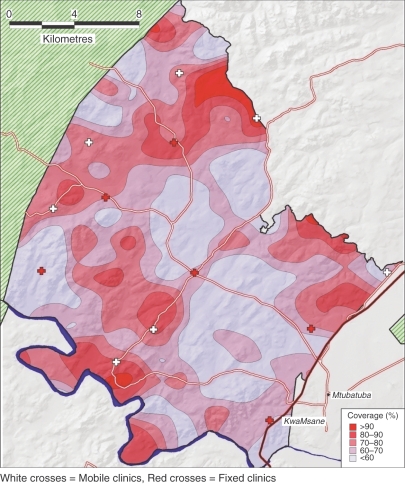
2 431 children with complete information, 12-23 months of age at some point during the period January 2005 through December 2006 and resident in the Africa Centre Demographic Surveillance Area at the time of their birth were investigated. We examined the relationship between maternal HIV status and child vaccination status for five vaccinations [Bacillus Calmette-Guérin (BCG), diphtheria-tetanus-pertussis (DTP3), poliomyelitis (polio3), hepatitis B (HepB3), and measles] in multiple logistic regressions, controlling for household wealth, maternal age, maternal education and distances to roads, fixed and mobile clinics.
Coverage of the five vaccinations ranged from 89.3% (95% CI 81.7-93.9) for BCG to 77.3% (67.1-83.6) for measles. Multivariably, maternal HIV-positive status was significantly associated with lower adjusted odds ratios (AOR) of child vaccination for all vaccines [(AOR) 0.60-0.74, all P < or = 0.036] except measles (0.75, P = 0.073), distance to mobile clinic was negatively associated with vaccination status (all P < or = 0.029), household wealth was positively (all P < or = 0.013) and distance to nearest road negatively (all P < or = 0.004) associated with vaccination status.
Positive maternal HIV status independently reduces children's probability to receive child vaccinations, which likely contributes to the morbidity and mortality differential between children of HIV-positive and HIV-negative mothers. As a means of increasing vaccination coverage, policy makers should consider increasing the number of mobile clinics in this and similar communities in rural Africa.
分析南非农村人口中儿童疫苗接种的覆盖率,并调查母亲的艾滋病毒感染状况是否与儿童的疫苗接种状况相关。
对2431名儿童进行了调查,这些儿童在2005年1月至2006年12月期间的某个时间点年龄在12至23个月之间,并且在出生时居住在非洲人口监测中心地区。我们在多因素logistic回归中研究了母亲的艾滋病毒感染状况与五种疫苗接种[卡介苗(BCG)、白喉-破伤风-百日咳(DTP3)、脊髓灰质炎(polio3)、乙型肝炎(HepB3)和麻疹]的儿童疫苗接种状况之间的关系,同时控制家庭财富、母亲年龄、母亲教育程度以及到公路、固定诊所和流动诊所的距离。
五种疫苗的接种覆盖率从卡介苗的89.3%(95%CI 81.7 - 93.9)到麻疹的77.3%(67.1 - 83.6)不等。在多因素分析中,除麻疹外(调整优势比[AOR]为0.75,P = 0.073),母亲艾滋病毒阳性状态与所有疫苗接种的调整后较低优势比(AOR)显著相关[(AOR) 0.60 - 0.74,所有P≤0.036],到流动诊所的距离与疫苗接种状况呈负相关(所有P≤0.029),家庭财富与疫苗接种状况呈正相关(所有P≤0.013),到最近公路的距离与疫苗接种状况呈负相关(所有P≤0.004)。
母亲艾滋病毒阳性状态独立降低了儿童接受疫苗接种的概率,这可能导致艾滋病毒阳性和艾滋病毒阴性母亲的子女在发病率和死亡率上存在差异。作为提高疫苗接种覆盖率的一种手段,政策制定者应考虑增加非洲农村地区此类及类似社区的流动诊所数量。