Département des Sciences Biologiques, Université du Québec à Montréal, Montréal, QC, Canada.
Immunology. 2009 Sep;128(1 Suppl):e181-92. doi: 10.1111/j.1365-2567.2008.02946.x. Epub 2009 Aug 4.
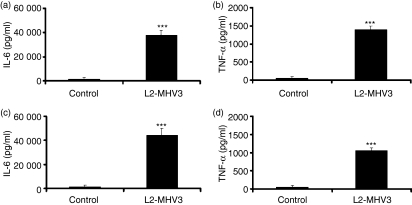
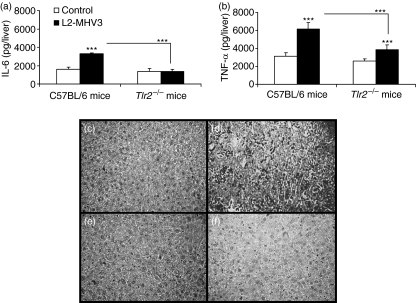
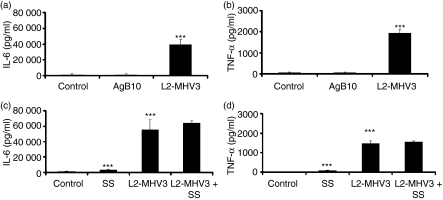
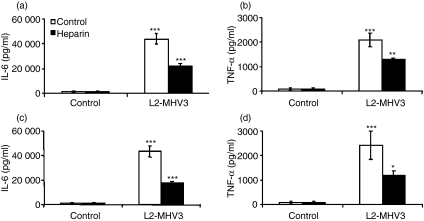
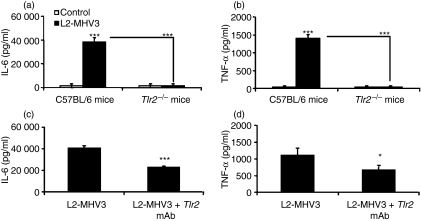
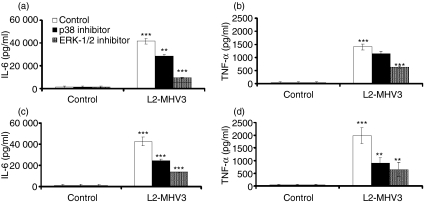
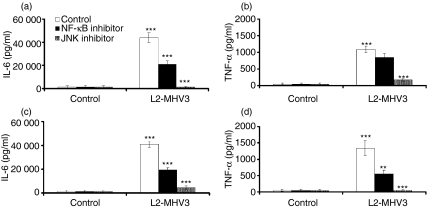
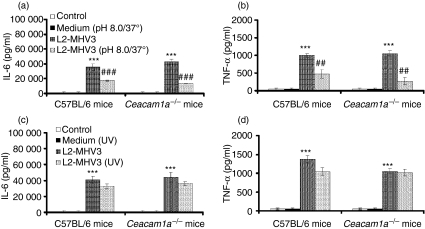
A rapid antiviral immune response may be related to viral interaction with the host cell leading to activation of macrophages via pattern recognition receptors (PPRs) or specific viral receptors. Carcinoembryonic cell adhesion antigen 1a (CEACAM1a) is the specific receptor for the mouse hepatitis virus (MHV), a coronavirus known to induce acute viral hepatitis in mice. The objective of this study was to understand the mechanisms responsible for the secretion of high-pathogenic MHV3-induced inflammatory cytokines. We report that the induction of the pro-inflammatory cytokines interleukin (IL)-6 and tumour necrosis factor (TNF)-alpha in peritoneal macrophages does not depend on CEACAM1a, as demonstrated in cells isolated from Ceacam1a(-/-) mice. The induction of IL-6 and TNF-alpha production was related rather to the fixation of the spike (S) protein of MHV3 on Toll-like receptor 2 (TLR2) in regions enriched in heparan sulphate and did not rely on viral replication, as demonstrated with denatured S protein and UV-inactivated virus. High levels of IL-6 and TNF-alpha were produced in livers from infected C57BL/6 mice but not in livers from Tlr2(-/-) mice. The histopathological observations were correlated with the levels of those inflammatory cytokines. Depending on mouse strain, the viral fixation to heparan sulfate/TLR2 stimulated differently the p38 mitogen-activated protein kinase (MAPK) and nuclear factor (NF)-kappaB in the induction of IL-6 and TNF-alpha. These results suggest that TLR2 and heparan sulphate receptors can act as new viral PPRs involved in inflammatory responses.
抗病毒的快速免疫反应可能与病毒与宿主细胞的相互作用有关,这种相互作用会通过模式识别受体(PPR)或特定的病毒受体激活巨噬细胞。癌胚细胞黏附分子 1a(CEACAM1a)是小鼠肝炎病毒(MHV)的特异性受体,该病毒是一种已知会导致小鼠急性病毒性肝炎的冠状病毒。本研究的目的是了解导致高致病性 MHV3 诱导的炎症细胞因子分泌的机制。我们报告称,在从小鼠中分离的细胞中,促炎性细胞因子白细胞介素(IL)-6 和肿瘤坏死因子(TNF)-α的诱导并不依赖于 CEACAM1a,这表明 CEACAM1a 不是引起高致病性 MHV3 诱导的炎症细胞因子分泌的原因。IL-6 和 TNF-α的产生诱导与 MHV3 的刺突(S)蛋白固定在富含硫酸乙酰肝素的 Toll 样受体 2(TLR2)上有关,并且不依赖于病毒复制,这可以通过变性的 S 蛋白和紫外线灭活的病毒来证明。在感染 C57BL/6 小鼠的肝脏中产生了高水平的 IL-6 和 TNF-α,但在 Tlr2(-/-)小鼠的肝脏中则没有。这些组织病理学观察结果与这些炎症细胞因子的水平相关。根据小鼠品系的不同,病毒与硫酸乙酰肝素/TLR2 的固定以不同的方式刺激 p38 丝裂原活化蛋白激酶(MAPK)和核因子(NF)-kappaB,从而诱导 IL-6 和 TNF-α的产生。这些结果表明 TLR2 和硫酸乙酰肝素受体可以作为参与炎症反应的新的病毒 PPR。