Guo W, Dong Zhiming, Guo Y, Kuang G, Yang Z, Chen Z
Department of Laboratory of Pathology, Hebei Cancer Institute, The Fourth Hospital of Hebei Medical University, Shijiazhuang, Hebei, China.
Eur J Med Res. 2009 Sep 28;14(10):453-8. doi: 10.1186/2047-783x-14-10-453.
Abnormal hypermethylation of CpG islands associated with tumor suppressor genes can lead to transcriptional silencing in neoplasia. The aim of this study was to investigate the promoter methylation and expression of E-cadherin gene in gastric cardiac adenocarcinoma (GCA).
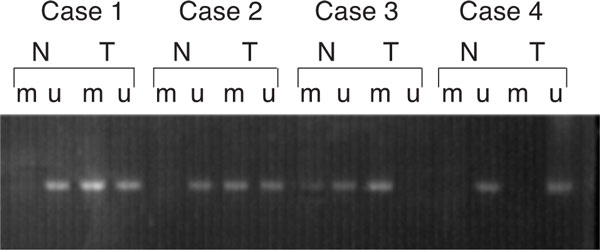
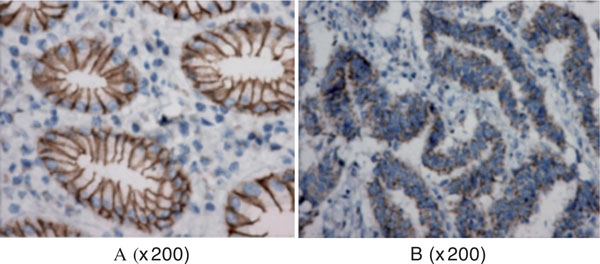
A nested MSP approach, immunohistochemistry method and RT-PCR were used respectively to examine the methylation status of the 5' CpG island of E-cadherin, its protein expression and mRNA expression in tumors and corresponding normal tissues.
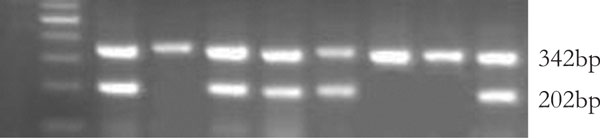
E-cadherin was methylated in 63 of 92 (68.5%) tumor specimens, which was significantly higher than that in corresponding normal tissues (P<0.001). Methylation frequencies of stage III and IV tumor tissues was significantly higher than that in stage I and II tumor tissues (P = 0.01). Methylation status of poor differentiation group was significantly higher than moderate and poor-moderate differentiation groups (P<0.01). By immunostaining 51 of 92 tumor tissues demonstrated heterogeneous, positive immunostaining of tumor tissues (44.6%), significantly different from matched normal tissues (P<0.001). Positive immunostaining of stage III and IV tumor tissues was significantly lower than stage I and II tumor tissues (P<0.01). Poor differentiation group was also significantly lower than moderate and poor-moderate differentiation groups (P<0.05). 80 percent of tumor tissues with E-cadherin gene methylated showed inactivated mRNA expression.
High methylation status of the 5' CpG island of E-cadherin gene may be one of the mechanisms in the development of gastric cardiac adenocarcinoma.
与肿瘤抑制基因相关的CpG岛异常高甲基化可导致肿瘤形成过程中的转录沉默。本研究旨在探讨贲门胃腺癌(GCA)中E-钙黏蛋白基因的启动子甲基化及表达情况。
分别采用巢式甲基化特异性PCR(MSP)法、免疫组织化学法和逆转录-聚合酶链反应(RT-PCR)检测肿瘤组织及相应正常组织中E-钙黏蛋白5'CpG岛的甲基化状态、蛋白表达及mRNA表达。
92例肿瘤标本中有63例(68.5%)E-钙黏蛋白发生甲基化,显著高于相应正常组织(P<0.001)。Ⅲ期和Ⅳ期肿瘤组织的甲基化频率显著高于Ⅰ期和Ⅱ期肿瘤组织(P = 0.01)。低分化组的甲基化状态显著高于中分化组和中低分化组(P<0.01)。通过免疫染色,92例肿瘤组织中有51例(44.6%)呈现异质性阳性免疫染色,与配对的正常组织有显著差异(P<0.001)。Ⅲ期和Ⅳ期肿瘤组织的阳性免疫染色显著低于Ⅰ期和Ⅱ期肿瘤组织(P<0.01)。低分化组也显著低于中分化组和中低分化组(P<0.05)。E-钙黏蛋白基因甲基化的肿瘤组织中有80%显示mRNA表达失活。
E-钙黏蛋白基因5'CpG岛的高甲基化状态可能是贲门胃腺癌发生发展的机制之一。