Cook Peter R, Marenduzzo Davide
Sir William Dunn School of Pathology, University of Oxford, Oxford OX1 3RE, England, UK.
J Cell Biol. 2009 Sep 21;186(6):825-34. doi: 10.1083/jcb.200903083. Epub 2009 Sep 14.
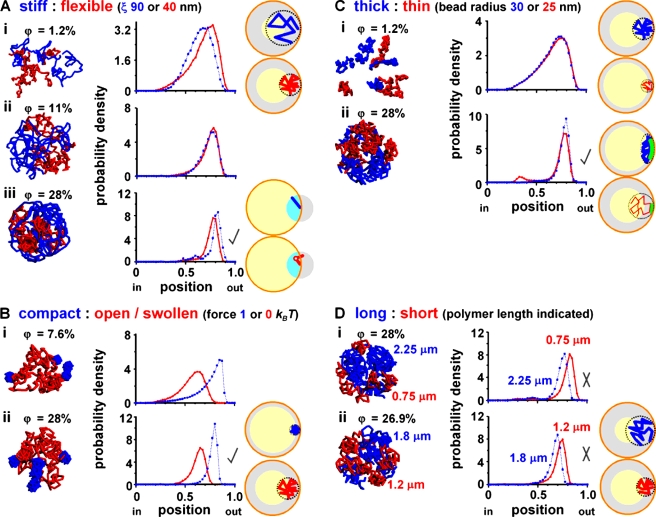
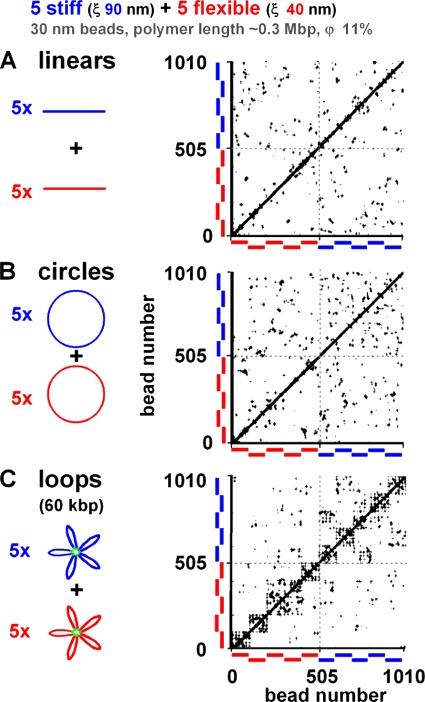
Chromosomes are not distributed randomly in nuclei. Appropriate positioning can activate (or repress) genes by bringing them closer to active (or inactive) compartments like euchromatin (or heterochromatin), and this is usually assumed to be driven by specific local forces (e.g., involving H bonds between nucleosomes or between nucleosomes and the lamina). Using Monte Carlo simulations, we demonstrate that nonspecific (entropic) forces acting alone are sufficient to position and shape self-avoiding polymers within a confining sphere in the ways seen in nuclei. We suggest that they can drive long flexible polymers (representing gene-rich chromosomes) to the interior, compact/thick ones (and heterochromatin) to the periphery, looped (but not linear) ones into appropriately shaped (ellipsoidal) territories, and polymers with large terminal beads (representing centromeric heterochromatin) into peripheral chromocenters. Flexible polymers tend to intermingle less than others, which is in accord with observations that gene-dense (and so flexible) chromosomes make poor translocation partners. Thus, entropic forces probably participate in the self-organization of chromosomes within nuclei.
染色体在细胞核内并非随机分布。通过使基因更靠近常染色质(或异染色质)等活性(或非活性)区域,合适的定位能够激活(或抑制)基因,通常认为这是由特定的局部作用力驱动的(例如,涉及核小体之间或核小体与核纤层之间的氢键)。我们通过蒙特卡罗模拟证明,单独作用的非特异性(熵)力足以使自回避聚合物在限制球体内以细胞核中观察到的方式进行定位和塑形。我们认为,它们能够将长柔性聚合物(代表富含基因的染色体)驱动至内部,将致密/厚实的聚合物(以及异染色质)驱动至外周,将环状(而非线性)聚合物驱动至形状合适的(椭圆形)区域,并将带有大末端珠子的聚合物(代表着丝粒异染色质)驱动至外周染色中心。柔性聚合物相互混合的倾向比其他聚合物小,这与基因密集(因此具有柔性)的染色体作为易位伙伴较差的观察结果一致。因此,熵力可能参与了细胞核内染色体的自组织过程。