University Hospital Sainte Marguerite, Marseille, France.
Diabetes Care. 2009 Dec;32(12):2245-50. doi: 10.2337/dc09-0750. Epub 2009 Sep 18.
To compare the improvements in glycemic control associated with transitioning to insulin pump therapy in patients using continuous glucose monitoring versus standard blood glucose self-monitoring.
The RealTrend study was a 6-month, randomized, parallel-group, two-arm, open-label study of 132 adults and children with uncontrolled type 1 diabetes (A1C >or=8%) being treated with multiple daily injections. One group was fitted with the Medtronic MiniMed Paradigm REAL-Time system (PRT group), an insulin pump with integrated continuous subcutaneous glucose monitoring (CGM) capability, with instructions to wear CGM sensors at least 70% of the time. Conventional insulin pump therapy was initiated in the other group (continuous subcutaneous insulin infusion [CSII] group). Outcome measures included A1C and glycemic variability.
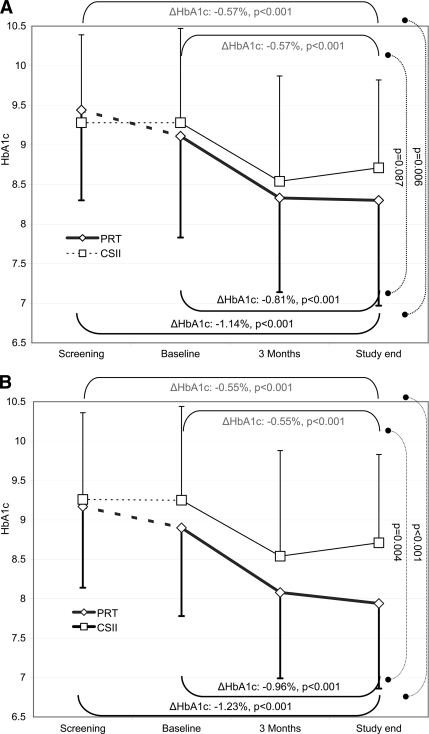
A total of 115 patients completed the study. Between baseline and trial end, A1C improved significantly in both groups (PRT group -0.81 +/- 1.09%, P < 0.001; CSII group -0.57 +/- 0.94%, P < 0.001), with no significant difference between groups. When the 91 patients who were fully protocol-compliant (including CGM sensor wear >or=70% of the time) were considered, A1C improvement was significantly greater in the PRT group (P = 0.004) (PRT group -0.96 +/- 0.93%, P < 0.001; CSII group -0.55 +/- 0.93%, P < 0.001). Hyperglycemia parameters decreased in line with improvements in A1C with no impact on hypoglycemia.
CGM-enabled insulin pump therapy improves glycemia more than conventional pump therapy during the first 6 months of pump use in patients who wear CGM sensors at least 70% of the time.
比较使用连续血糖监测与常规血糖自我监测的患者在转为胰岛素泵治疗后血糖控制改善情况。
RealTrend 研究是一项为期 6 个月、随机、平行组、两臂、开放性标签研究,共纳入 132 例血糖控制不佳(A1C>8%)的 1 型糖尿病成人和儿童患者,他们正在接受多次每日胰岛素注射治疗。一组患者佩戴美敦力 MiniMed Paradigm REAL-Time 系统(PRT 组),这是一种具有集成连续皮下葡萄糖监测(CGM)功能的胰岛素泵,并要求至少 70%的时间佩戴 CGM 传感器。另一组患者(连续皮下胰岛素输注 [CSII] 组)则开始常规胰岛素泵治疗。主要终点为 A1C 和血糖变异性。
共有 115 例患者完成了研究。与基线相比,两组患者的 A1C 在试验结束时均显著改善(PRT 组 -0.81±1.09%,P<0.001;CSII 组 -0.57±0.94%,P<0.001),两组之间无显著差异。当考虑 91 例完全遵守方案(包括至少 70%的时间佩戴 CGM 传感器)的患者时,PRT 组的 A1C 改善更显著(P=0.004)(PRT 组 -0.96±0.93%,P<0.001;CSII 组 -0.55±0.93%,P<0.001)。高血糖参数的降低与 A1C 的改善一致,对低血糖无影响。
在使用胰岛素泵治疗的前 6 个月内,对于至少 70%的时间佩戴 CGM 传感器的患者,CGM 启用的胰岛素泵治疗比常规泵治疗更能改善血糖。