Roepke Torsten K, King Elizabeth C, Reyna-Neyra Andrea, Paroder Monika, Purtell Kerry, Koba Wade, Fine Eugene, Lerner Daniel J, Carrasco Nancy, Abbott Geoffrey W
Greenberg Division of Cardiology, Department of Medicine and Department of Pharmacology, Weill Medical College of Cornell University, New York, New York, USA.
Nat Med. 2009 Oct;15(10):1186-94. doi: 10.1038/nm.2029. Epub 2009 Sep 20.
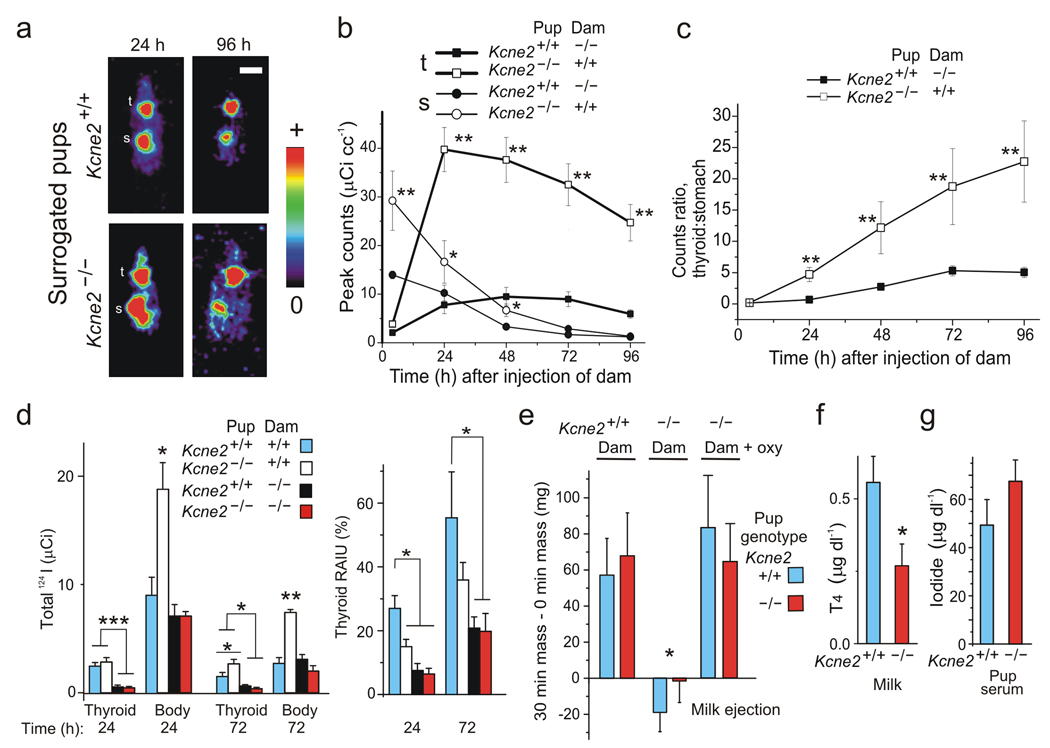
Thyroid dysfunction is a global health concern, causing defects including neurodevelopmental disorders, dwarfism and cardiac arrhythmia. Here, we show that the potassium channel subunits KCNQ1 and KCNE2 form a thyroid-stimulating hormone-stimulated, constitutively active, thyrocyte K+ channel required for normal thyroid hormone biosynthesis. Targeted disruption of Kcne2 in mice impaired thyroid iodide accumulation up to eightfold, impaired maternal milk ejection, halved milk tetraiodothyronine (T4) content and halved litter size. Kcne2-deficient mice had hypothyroidism, dwarfism, alopecia, goiter and cardiac abnormalities including hypertrophy, fibrosis, and reduced fractional shortening. The alopecia, dwarfism and cardiac abnormalities were alleviated by triiodothyronine (T3) and T4 administration to pups, by supplementing dams with T(4) before and after they gave birth or by feeding the pups exclusively from Kcne2+/+ dams; conversely, these symptoms were elicited in Kcne2+/+ pups by feeding exclusively from Kcne2-/- dams. These data provide a new potential therapeutic target for thyroid disorders and raise the possibility of an endocrine component to previously identified KCNE2- and KCNQ1-linked human cardiac arrhythmias.
甲状腺功能障碍是一个全球性的健康问题,会导致包括神经发育障碍、侏儒症和心律失常等缺陷。在此,我们表明钾通道亚基KCNQ1和KCNE2形成了一种受促甲状腺激素刺激的、组成型激活的甲状腺细胞钾通道,该通道是正常甲状腺激素生物合成所必需的。在小鼠中靶向破坏Kcne2会使甲状腺碘积累受损高达八倍,损害母体乳汁排出,使乳汁中甲状腺素(T4)含量减半,并使窝产仔数减半。Kcne2基因缺失的小鼠患有甲状腺功能减退、侏儒症、脱发、甲状腺肿大以及心脏异常,包括心肌肥厚、纤维化和射血分数降低。通过给幼崽注射三碘甲状腺原氨酸(T3)和T4、在母鼠分娩前后补充T4或仅用Kcne2+/+母鼠喂养幼崽,可缓解脱发、侏儒症和心脏异常;相反,仅用Kcne2-/-母鼠喂养Kcne2+/+幼崽会引发这些症状。这些数据为甲状腺疾病提供了一个新的潜在治疗靶点,并增加了内分泌因素与先前确定的与KCNE2和KCNQ1相关的人类心律失常有关的可能性。