Pang Wanyong, Earley Bernadette, Sweeney Torres, Gath Vivian, Crowe Mark A
Teagasc, Animal Bioscience Research Centre, Dunsany, Co, Meath, Ireland.
BMC Vet Res. 2009 Sep 23;5:36. doi: 10.1186/1746-6148-5-36.
Castration of male cattle has been shown to elicit inflammatory reactions and acute inflammation is initiated and sustained by the participation of cytokines.
Sixty continental x beef bulls (Mean age 12 +/- (s.e.) 0.2 months; Mean weight 341 +/- (s.e.) 3.0 kg) were blocked by weight and randomly assigned to one of three treatments (n = 20 animals per treatment): 1) untreated control (Con); 2) banding castration at 0 min (Band); 3) Burdizzo castration at 0 min (Burd). Samples of the testis, epididymis and scrotal skin were collected surgically from 5 animals from each group at 12 h, 24 h, 7 d, and 14 d post-treatment, and analysed using real-time PCR. A repeated measurement analysis (Proc GLM) was performed using SAS. If there was no treatment and time interaction, main effects of treatment by time were tested by ANOVA.
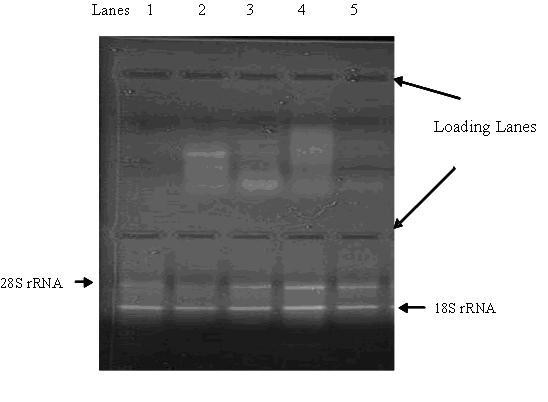
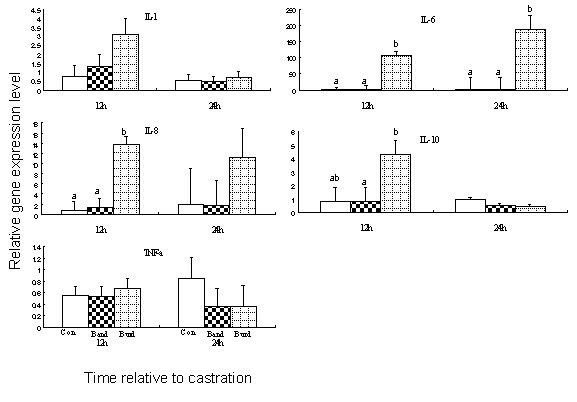
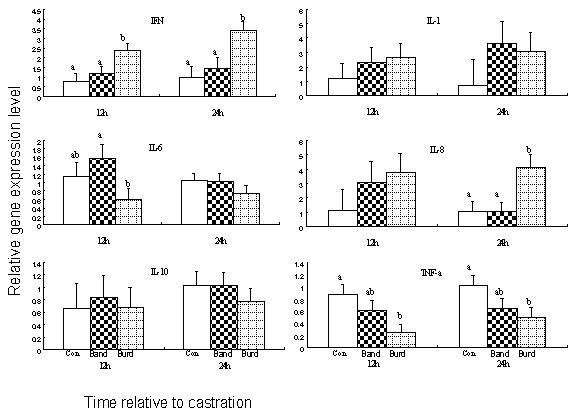
Electrophoresis data showed that by 7 d post-castration RNA isolated from all the testicle samples of the Burd castrated animals, the epididymis and middle scrotum samples from Band castrates were degraded. Transitory effects were observed in the gene expression of IFN-gamma, IL-6, IL-8 and TNF-alpha at 12 h and 24 h post treatment. Burd castrates had greater (P < 0.05) testicular IFN-gamma mRNA levels compared with Band and Con animals, but lower (P < 0.05) testicular TNF-alpha mRNA levels compared with Con animals. Band castrates had greater (P < 0.05) testicular IL-6 mRNA levels than Burd castrates at 12 h post-castration. Burd castrates had greater (P < 0.05) testicular IL-8 mRNA levels than Band and Con animals at 24 h post-castration. In the epididymis, Burd castrates had greater (P < 0.05) IL-6 mRNA (both at 12 h and 24 h post treatment) and IL-8 mRNA (12 h post treatment) levels compared with Band and Con animals; Burd castrates had greater (P = 0.049) IL-10 mRNA levels than Band castrates at 12 h post-castration.
Banding castration caused more inflammatory associated gene expression changes to the epididymis and scrotum than burdizzo. Burdizzo caused more severe acute inflammatory responses, in terms of pro-inflammatory cytokine gene expression, in the testis and epididymis than banding.
已表明阉割公牛会引发炎症反应,并且急性炎症是由细胞因子的参与启动并维持的。
60头欧洲大陆品种与肉牛的杂交公牛(平均年龄12±(标准误)0.2个月;平均体重341±(标准误)3.0千克)按体重进行分组,然后随机分配到三种处理方式之一(每种处理方式n = 20头动物):1)未处理的对照组(Con);2)在0分钟进行结扎去势(Band);3)在0分钟进行布尔迪佐去势(Burd)。在处理后12小时、24小时、7天和14天,从每组的5头动物身上手术采集睾丸、附睾和阴囊皮肤样本,并使用实时PCR进行分析。使用SAS进行重复测量分析(Proc GLM)。如果不存在处理与时间的交互作用,则通过方差分析检验处理与时间的主效应。
电泳数据显示,在去势后7天,从布尔迪佐去势动物的所有睾丸样本、结扎去势动物的附睾和阴囊中部样本中分离出的RNA已降解。在处理后12小时和24小时,观察到IFN-γ、IL-6、IL-8和TNF-α基因表达的短暂效应。与Band和Con动物相比,布尔迪佐去势动物的睾丸IFN-γ mRNA水平更高(P < 0.05),但与Con动物相比,睾丸TNF-α mRNA水平更低(P < 0.05)。在去势后12小时,结扎去势动物的睾丸IL-6 mRNA水平比布尔迪佐去势动物更高(P < 0.05)。在去势后24小时,布尔迪佐去势动物的睾丸IL-8 mRNA水平比Band和Con动物更高(P < 0.05)。在附睾中,与Band和Con动物相比,布尔迪佐去势动物在处理后12小时和24小时的IL-6 mRNA水平(两者)以及处理后12小时的IL-8 mRNA水平更高(P < 0.05);在去势后12小时,布尔迪佐去势动物的IL-10 mRNA水平比结扎去势动物更高(P = 0.049)。
与布尔迪佐去势相比,结扎去势导致附睾和阴囊中更多与炎症相关的基因表达变化。就促炎细胞因子基因表达而言,布尔迪佐去势在睾丸和附睾中引起的急性炎症反应比结扎去势更严重。