Cai You-Qing, Chen Shao-Rui, Han Hee-Dong, Sood Anil K, Lopez-Berestein Gabriel, Pan Hui-Lin
Department of Anesthesiology and Perioperative Medicine, The University of Texas M. D. Anderson Cancer Center, Houston, TX 77030, USA.
J Neurochem. 2009 Nov;111(4):1000-10. doi: 10.1111/j.1471-4159.2009.06396.x. Epub 2009 Sep 23.
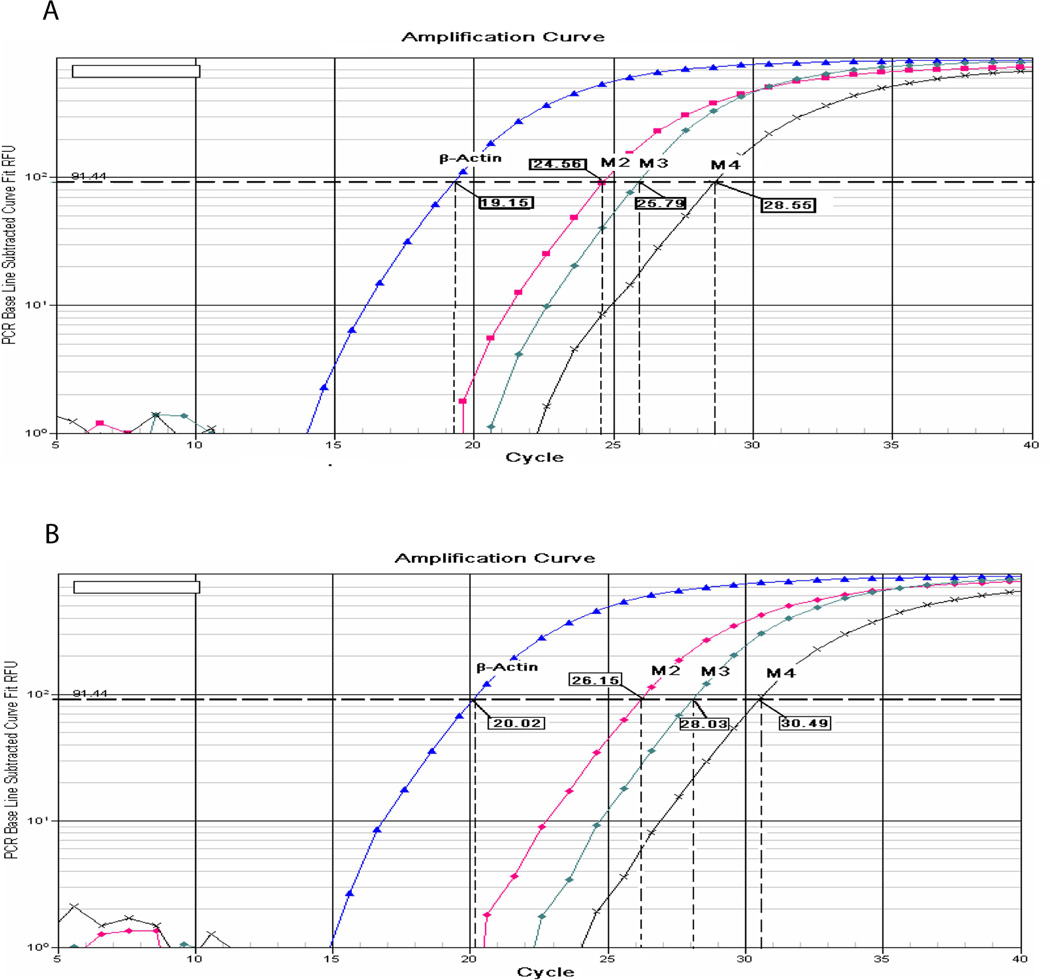
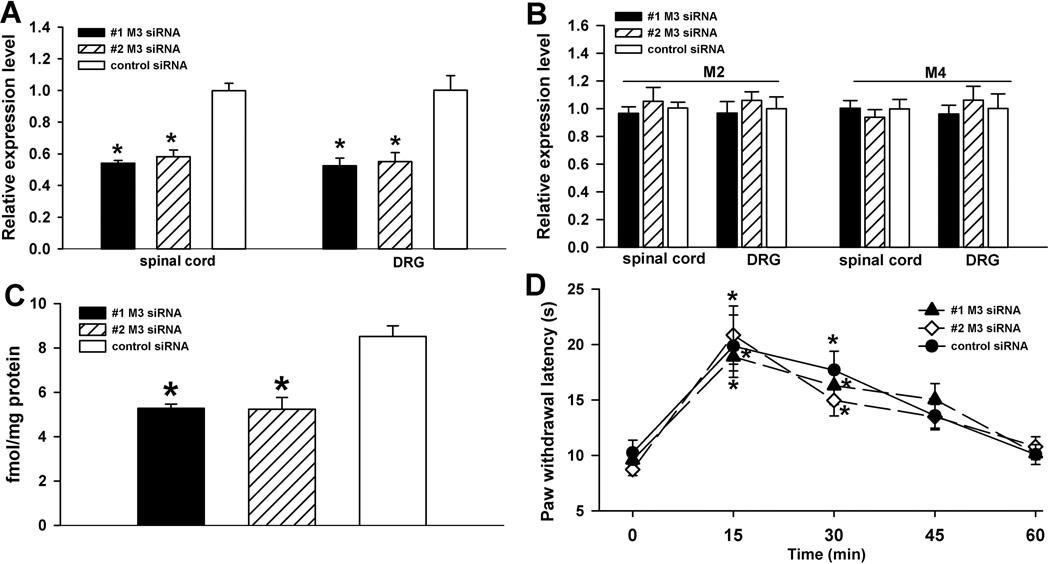
Muscarinic acetylcholine receptors (mAChRs) are involved in the control of nociception in the spinal cord. The M(2), M(3), and M(4) mAChR subtypes are present in the spinal dorsal horn. However, the role of the individual subtypes in the anti-nociceptive effect produced by mAChR agonists is uncertain. Here, we determined the contribution of M(2), M(3), and M(4) subtypes to spinal muscarinic analgesia by using small-interference RNA (siRNA) targeting specific mAChR subtypes in rats. The neuronal uptake and distribution of a chitosan-siRNA conjugated fluorescent dye in the spinal cord and dorsal root ganglion were confirmed after intrathecal injection. The control and gene-specific siRNA-chitosan complexes were injected intrathecally for three consecutive days. Quantitative reverse-transcription polymerase chain reaction analysis showed that treatment with siRNA targeting M(2), M(3), or M(4) subtype produced a large reduction in the corresponding mRNA levels in the dorsal root ganglion and dorsal spinal cord. Also, the protein levels of the mAChR subtypes in the spinal cord were significantly down-regulated by siRNA treatment, as determined by the immunoprecipitation and receptor-binding assay. Treatment with the M(2)-siRNA caused a large reduction in the inhibitory effect of muscarine on the nociceptive withdrawal threshold. Furthermore, M(4) knockdown at the spinal level significantly reduced the anti-nociceptive effect of muscarine. However, the anti-nociceptive effect of muscarine was not significantly changed by the M(3)-specific siRNA. Our study suggests that chitosan nanoparticles can be used for efficient delivery of siRNA into the neuronal tissues in vivo. Our findings also provide important functional evidence that M(2) and M(4), but not M(3), contribute to nociceptive regulation by mAChRs at the spinal level.
毒蕈碱型乙酰胆碱受体(mAChRs)参与脊髓痛觉的调控。M(2)、M(3)和M(4) mAChR亚型存在于脊髓背角。然而,各亚型在mAChR激动剂产生的抗痛觉作用中的作用尚不确定。在此,我们通过使用靶向大鼠特定mAChR亚型的小干扰RNA(siRNA),确定了M(2)、M(3)和M(4)亚型对脊髓毒蕈碱镇痛的贡献。鞘内注射后,证实了壳聚糖-siRNA偶联荧光染料在脊髓和背根神经节中的神经元摄取和分布。将对照和基因特异性siRNA-壳聚糖复合物连续三天鞘内注射。定量逆转录聚合酶链反应分析表明,用靶向M(2)、M(3)或M(4)亚型的siRNA处理可使背根神经节和脊髓背角中相应的mRNA水平大幅降低。此外,通过免疫沉淀和受体结合试验确定,siRNA处理可使脊髓中mAChR亚型的蛋白水平显著下调。用M(2)-siRNA处理可使毒蕈碱对伤害性退缩阈值的抑制作用大幅降低。此外,脊髓水平的M(4)基因敲低显著降低了毒蕈碱的抗痛觉作用。然而,M(3)特异性siRNA并未显著改变毒蕈碱的抗痛觉作用。我们的研究表明,壳聚糖纳米颗粒可用于在体内将siRNA有效递送至神经元组织。我们的研究结果还提供了重要的功能证据,表明在脊髓水平,M(2)和M(4)而非M(3)参与了mAChRs对痛觉的调节。