Enteric Virus Unit, Virus Reference Department, Centre for Infections, Health Protection Agency, London, UK.
Virol J. 2009 Sep 25;6:150. doi: 10.1186/1743-422X-6-150.
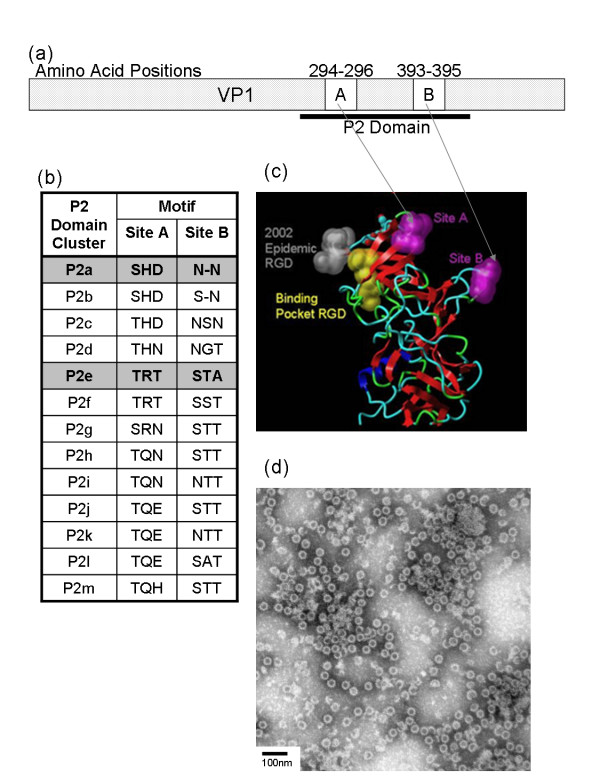
The human noroviruses are a highly diverse group of viruses with a single-stranded RNA genome encoding a single major structural protein (VP1), which has a hypervariable domain (P2 domain) as the most exposed part of the virion. The noroviruses are classified on the basis of nucleotide sequence diversity in the VP1-encoding ORF2 gene, which divides the majority of human noroviruses into two genogroups (GI and GII). GII-4 noroviruses are the major aetiological agent of outbreaks of gastroenteritis around the world. During a winter season the diversity among the GII-4 noroviruses has been shown to fluctuate, driving the appearance of new virus variants in the population. We have previously shown that sequence data and in silico modelling experiments suggest there are two surface-exposed sites (site A and site B) in the hypervariable P2 domain. We predict these sites may form a functional variant-specific epitope that evolves under selective pressure from the host immune response and gives rise to antibody escape mutants.
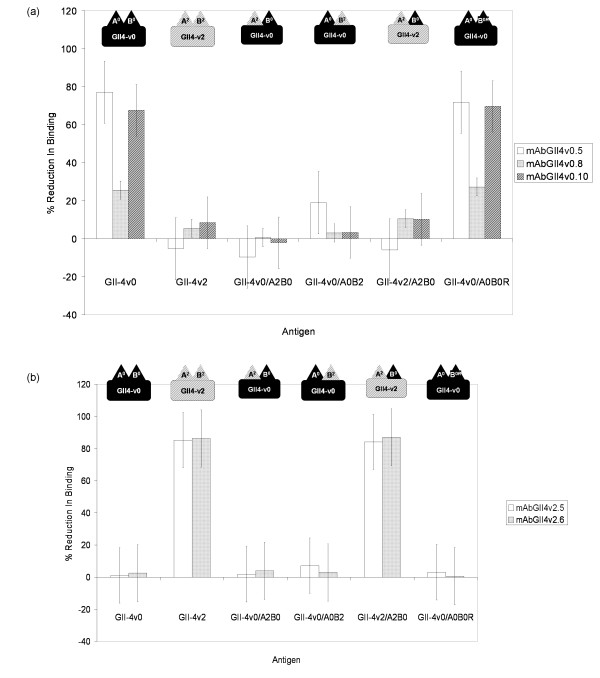
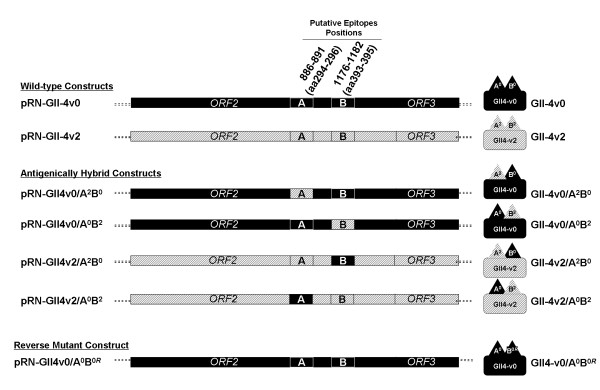
In this paper, we describe the construction of recombinant baculoviruses to express VLPs representing one pre-epidemic and one epidemic variant of GII-4 noroviruses, and the production of monoclonal antibodies against them. We use these novel reagents to provide evidence that site A and site B form a conformational, variant-specific, surface-exposed site on the GII-4 norovirus capsid that is involved in antibody binding.
As predicted by our earlier study, significant amino acid changes at site A and site B give rise to GII-4 norovirus epidemic variants that are antibody escape mutants.
人类诺如病毒是一组具有单链 RNA 基因组的高度多样化病毒,该基因组编码单一主要结构蛋白(VP1),其具有超变区(P2 区),作为病毒粒子最暴露的部分。诺如病毒是基于 VP1 编码 ORF2 基因中的核苷酸序列多样性进行分类的,该基因将大多数人类诺如病毒分为两个基因组(GI 和 GII)。GII-4 诺如病毒是导致全世界肠胃炎暴发的主要病原体。在冬季,GII-4 诺如病毒的多样性已被证明会波动,从而导致新的病毒变异株在人群中出现。我们之前已经表明,序列数据和计算机模拟实验表明,在超变 P2 区中有两个表面暴露的位点(位点 A 和位点 B)。我们预测这些位点可能形成一个功能上可变的特异性表位,该表位在宿主免疫反应的选择压力下进化,并产生抗体逃逸突变体。
在本文中,我们描述了构建表达 GII-4 诺如病毒一个流行前变体和一个流行变体的重组杆状病毒的过程,并产生了针对它们的单克隆抗体。我们使用这些新的试剂来提供证据表明,位点 A 和位点 B 形成了 GII-4 诺如病毒衣壳上的一个构象、变体特异性、表面暴露的位点,该位点参与抗体结合。
正如我们早期研究预测的那样,位点 A 和位点 B 的显著氨基酸变化导致 GII-4 诺如病毒流行变体成为抗体逃逸突变体。