Abera A B, Sales K J, Catalano R D, Katz A A, Jabbour H N
MRC Human Reproductive Sciences Unit, The Queen's Medical Research Institute, 47 Little France Crescent, Edinburgh EH16 4TJ, UK.
Cell Signal. 2010 Jan;22(1):71-9. doi: 10.1016/j.cellsig.2009.09.012. Epub 2009 Sep 25.
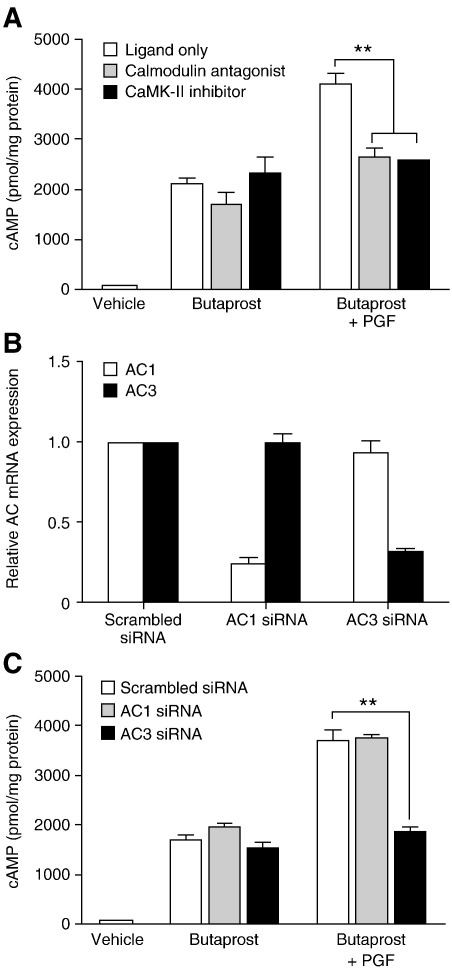
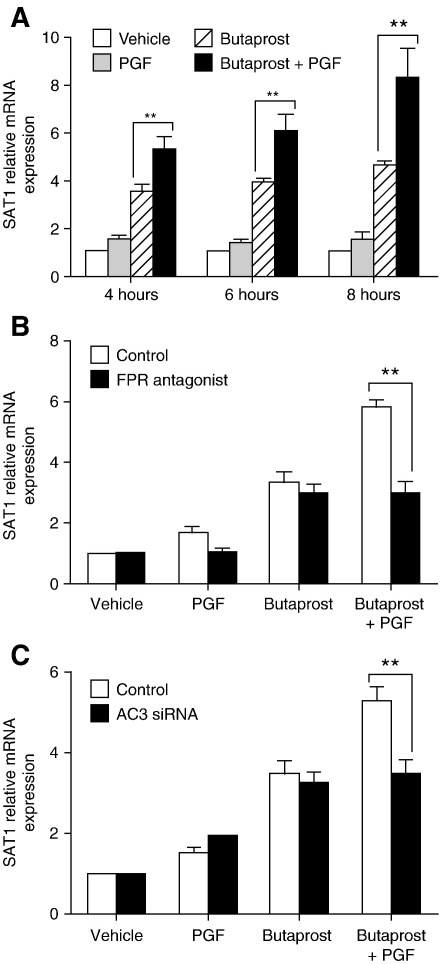
Prostaglandins exert their effects on target cells by coupling to specific G protein-coupled receptors (GPCRs) that are often co-expressed in the same cells and use alternate and in some cases opposing intracellular signaling pathways. This study investigated the cross-talk that influences intracellular signaling and gene expression profiling in response to co-activation of the EP2 and FP prostanoid receptors in Ishikawa cells stably expressing both receptors (FPEP2 cells). In this study we show that in FPEP2 cells, PGF alone does not alter adenosine 3',5'-cyclic monophosphate (cAMP) production, but in combination with Butaprost enhances EP2 receptor mediated cAMP release compared to treatment with Butaprost alone. PGF-mediated potentiation of cAMP release was abolished by antagonism of the FP receptor, inhibition of phospholipase C (PLC) and inositol phosphate receptor (IP3R) whereas inhibition of protein kinase C (PKC) had no effect. Moreover, inhibition of calcium effectors using calmodulin antagonist (W7) or Ca(2+)/calmodulin-dependent kinase II (CaMK-II) inhibitor (KN-93) abolished PGF potentiation of Butaprost-mediated cAMP release. Using siRNA molecules targeted against the adenylyl cyclase 3 (AC3) isoform, we show that AC3 is responsible for the cross-talk between the FP and EP2 receptors. Using gene array studies we have identified a candidate gene, Spermidine/N1-acetyltransferase (SAT1), which is regulated by this cAMP mediated cross-talk. In conclusion, this study demonstrates that co-activation of the FP and EP2 receptors results in enhanced release of cAMP via FP receptor-G alpha(q)-Ca(2+)-calmodulin pathway by activating calcium sensitive AC3 isoform.
前列腺素通过与特定的G蛋白偶联受体(GPCRs)结合来对靶细胞发挥作用,这些受体通常在同一细胞中共表达,并使用交替的,在某些情况下是相反的细胞内信号通路。本研究调查了在稳定表达两种受体的石川细胞(FPEP2细胞)中,EP2和FP前列腺素受体共激活时影响细胞内信号传导和基因表达谱的相互作用。在本研究中,我们表明在FPEP2细胞中,单独的PGF不会改变3',5'-环磷酸腺苷(cAMP)的产生,但与布他前列素联合使用时,与单独用布他前列素处理相比,可增强EP2受体介导的cAMP释放。通过阻断FP受体、抑制磷脂酶C(PLC)和肌醇磷酸受体(IP3R),可消除PGF介导的cAMP释放增强作用,而抑制蛋白激酶C(PKC)则没有效果。此外,使用钙调蛋白拮抗剂(W7)或钙/钙调蛋白依赖性激酶II(CaMK-II)抑制剂(KN-93)抑制钙效应器,可消除PGF对布他前列素介导的cAMP释放的增强作用。使用针对腺苷酸环化酶3(AC3)同工型的小干扰RNA(siRNA)分子,我们表明AC3负责FP和EP2受体之间的相互作用。通过基因阵列研究,我们鉴定出一个候选基因,即亚精胺/N1-乙酰转移酶(SAT1),它受这种cAMP介导的相互作用调控。总之,本研究表明,FP和EP2受体的共激活通过激活钙敏感的AC3同工型,经由FP受体-Gα(q)-Ca(2+)-钙调蛋白途径导致cAMP释放增强。