Behavioral Genetics Laboratory, McLean Hospital, and Department of Psychiatry, Harvard Medical School, Belmont, Massachusetts 02478, USA.
Biol Psychiatry. 2010 Jan 1;67(1):85-7. doi: 10.1016/j.biopsych.2009.08.015.
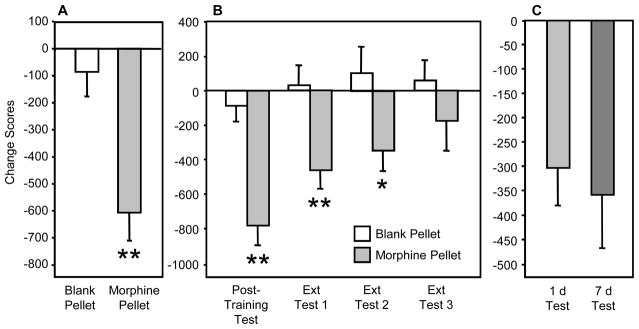
Cues paired with drug administration trigger relapse to drug seeking by inducing conditioned drug craving and withdrawal. Because drug cues hinder abstinence in addicts, therapies that reduce responsiveness to drug cues might facilitate rehabilitation. Extinction is a means of reducing conditioned responses and involves exposure to the conditioned stimulus in the absence of the unconditioned stimulus with which it was paired previously. We examined conditioned withdrawal extinction using naloxone-induced conditioned place aversion (CPA) in morphine-dependent rats.
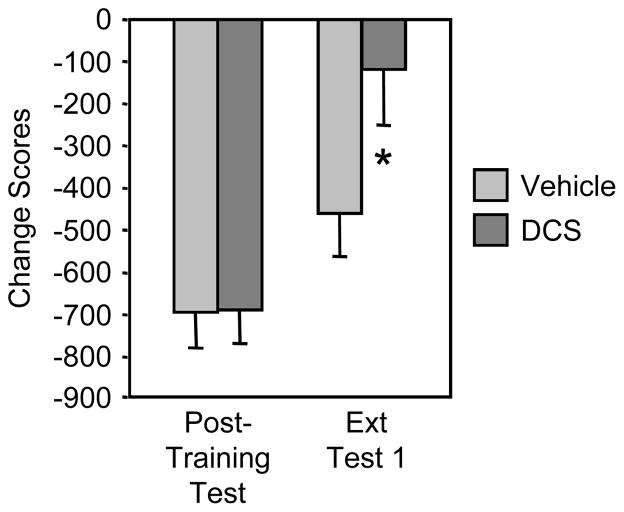
Morphine-dependent rats were trained to associate an environment with naloxone-precipitated withdrawal. Subsequently, they received extinction training in which they were confined in the previously naloxone-paired environment in the absence of acute withdrawal. In some rats, the N-methyl-D-aspartate (NMDA) receptor partial agonist D-cycloserine (DCS) was administered before extinction training.
Morphine withdrawal-induced CPA persists in the absence of extinction training. Administration of DCS before extinction training facilitates extinction.
D-cycloserine facilitates extinction of morphine withdrawal-associated place aversion. This effect is qualitatively similar to the effect of DCS on extinction of conditioned fear, raising the possibility of common neural mechanisms. This work extends our understanding of drug cue responsivity and provides a rationale for the development of extinction-based treatments for addiction.
与药物给药相关联的线索通过诱导条件性药物渴望和戒断来引发药物觅药的复发。由于药物线索会阻碍成瘾者的戒除,因此减少对药物线索的反应能力的治疗方法可能有助于康复。消退是减少条件反应的一种手段,涉及在没有先前与之配对的非条件刺激的情况下暴露于条件刺激。我们使用纳洛酮诱导的吗啡依赖大鼠条件性位置厌恶(CPA)来检查条件性戒断消退。
吗啡依赖大鼠被训练将环境与纳洛酮诱发的戒断相关联。随后,他们接受了消退训练,在没有急性戒断的情况下将他们限制在以前与纳洛酮配对的环境中。在一些大鼠中,在消退训练之前给予 N-甲基-D-天冬氨酸(NMDA)受体部分激动剂 D-环丝氨酸(DCS)。
吗啡戒断引起的 CPA 在没有消退训练的情况下仍然存在。在消退训练之前给予 DCS 可促进消退。
D-环丝氨酸促进吗啡戒断相关位置厌恶的消退。这种效应与 DCS 对条件性恐惧消退的效应相似,这增加了共同神经机制的可能性。这项工作扩展了我们对药物线索反应性的理解,并为基于消退的成瘾治疗的发展提供了依据。