The Wallace H. Coulter Department of Biomedical Engineering, Georgia Institute of Technology, Atlanta, GA 30332, USA.
Nucleic Acids Res. 2009 Dec;37(22):e145. doi: 10.1093/nar/gkp758.
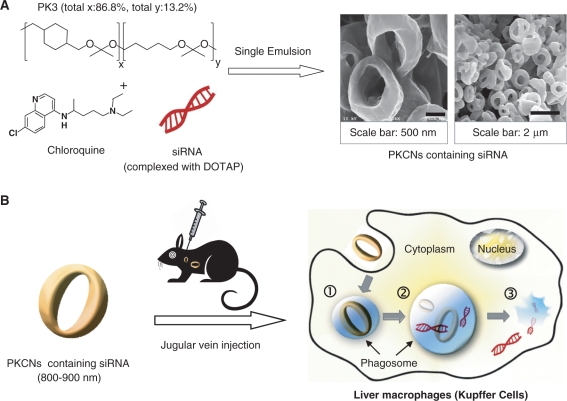
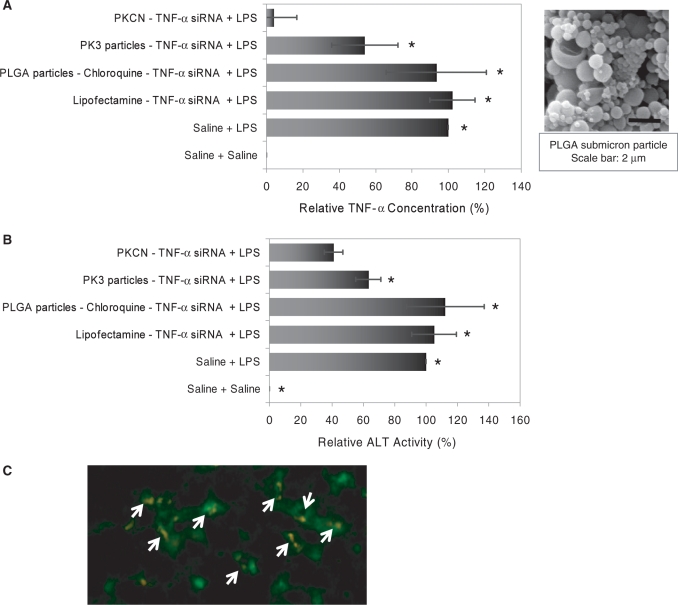
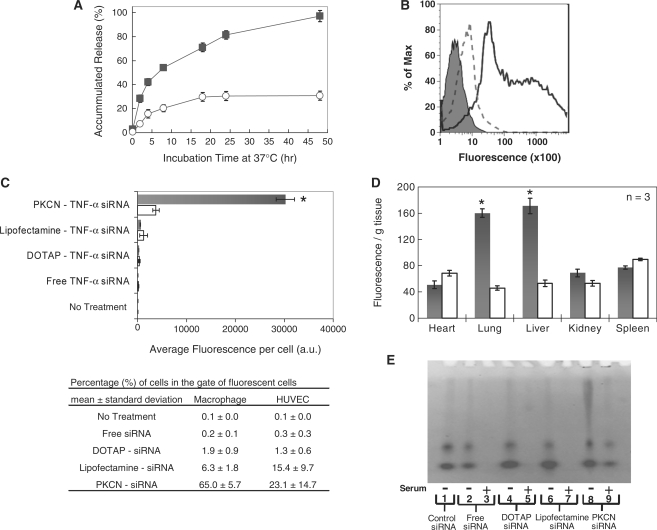
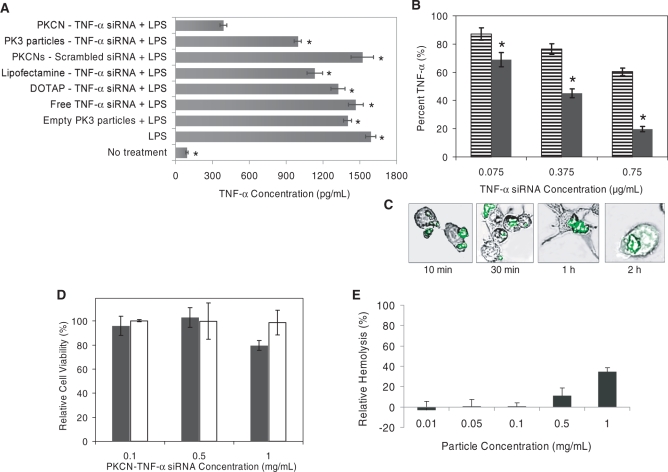
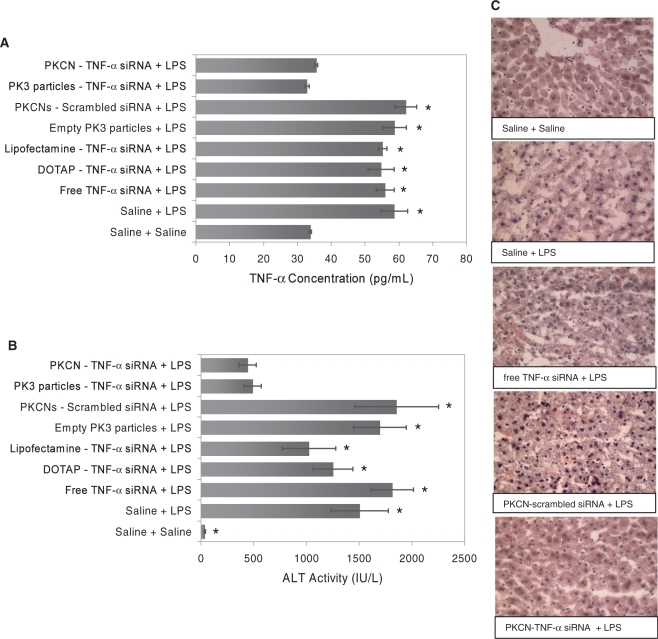
Therapeutics based on small interfering RNA (siRNA) have a great clinical potential; however, delivery problems have limited their clinical efficacy, and new siRNA delivery vehicles are greatly needed. In this report, we demonstrate that submicron particles (800-900 nm) composed of the polyketal PK3 and chloroquine, termed as the PKCNs, can deliver tumor necrosis factor-alpha (TNF-alpha) siRNA in vivo to Kupffer cells efficiently and inhibit gene expression in the liver at concentrations as low as 3.5 microg/kg. The high delivery efficiency of the PKCNs arises from the unique properties of PK3, which can protect siRNA from serum nucleases, stimulate cell uptake and trigger a colloid osmotic disruption of the phagosome and release encapsulated siRNA into the cell cytoplasm. We anticipate numerous applications of the PKCNs for siRNA delivery to macrophages, given their high delivery efficiency, and the central role of macrophages in causing diseases such as hepatitis, liver cirrhosis and chronic renal disease.
基于小干扰 RNA(siRNA)的治疗方法具有巨大的临床潜力;然而,递药问题限制了它们的临床疗效,因此非常需要新的 siRNA 递药载体。在本报告中,我们证明了由聚酮 PK3 和氯喹组成的亚微米颗粒(800-900nm),称为 PKCNs,可以有效地将肿瘤坏死因子-α(TNF-α)siRNA 递送至体内枯否细胞,并以低至 3.5μg/kg 的浓度抑制肝脏中的基因表达。PKCNs 的高效递药效率源于 PK3 的独特性质,它可以保护 siRNA 免受血清核酸酶的影响,刺激细胞摄取,并引发吞噬体的胶体渗透压破坏,将包裹的 siRNA 释放到细胞质中。鉴于 PKCNs 对巨噬细胞的高效递药效率,以及巨噬细胞在引起肝炎、肝硬化和慢性肾病等疾病中的核心作用,我们预计 PKCNs 将有许多用于 siRNA 递送至巨噬细胞的应用。