Department of Physiology and Biophysics, Aarhus University, Denmark.
J Gen Physiol. 2009 Oct;134(4):309-22. doi: 10.1085/jgp.200910290.
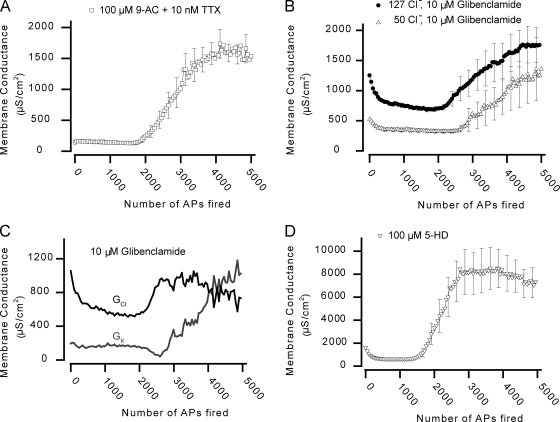
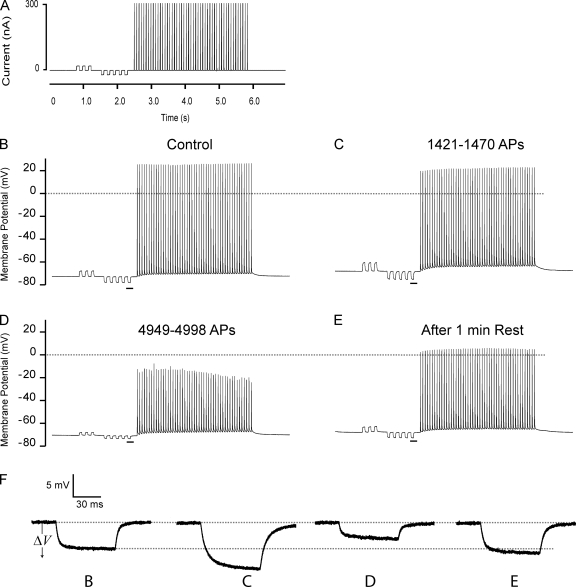
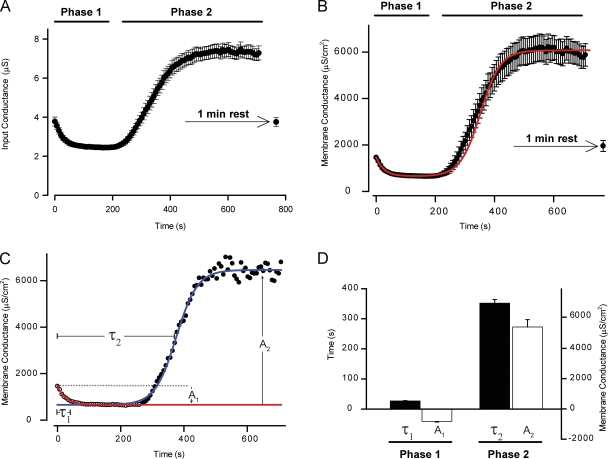
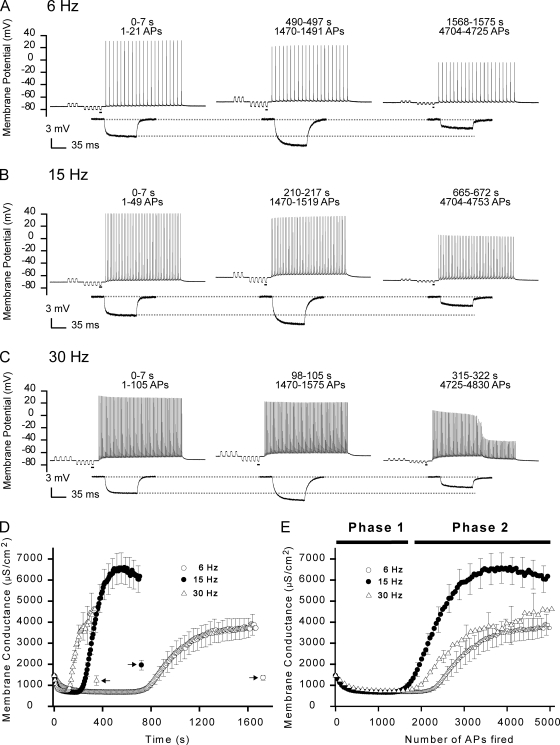
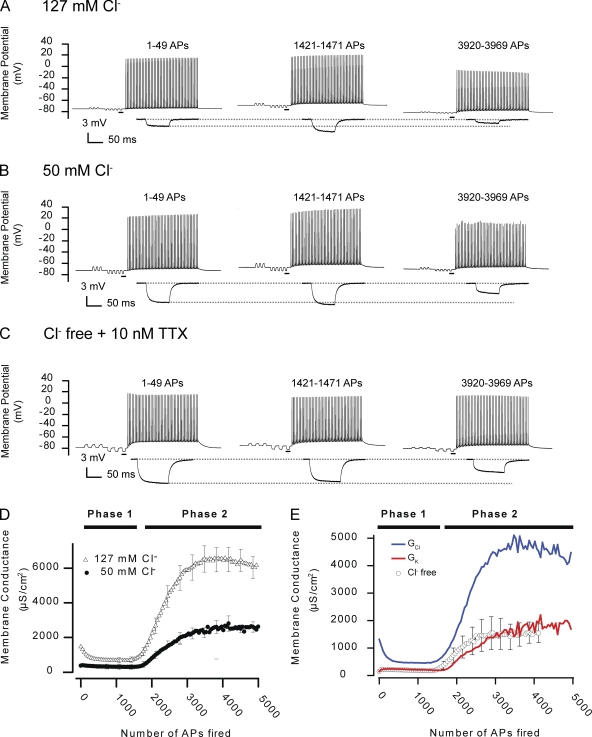
Action potential (AP) excitation requires a transient dominance of depolarizing membrane currents over the repolarizing membrane currents that stabilize the resting membrane potential. Such stabilizing currents, in turn, depend on passive membrane conductance (G(m)), which in skeletal muscle fibers covers membrane conductances for K(+) (G(K)) and Cl(-) (G(Cl)). Myotonic disorders and studies with metabolically poisoned muscle have revealed capacities of G(K) and G(Cl) to inversely interfere with muscle excitability. However, whether regulation of G(K) and G(Cl) occur in AP-firing muscle under normal physiological conditions is unknown. This study establishes a technique that allows the determination of G(Cl) and G(K) with a temporal resolution of seconds in AP-firing muscle fibers. With this approach, we have identified and quantified a biphasic regulation of G(m) in active fast-twitch extensor digitorum longus fibers of the rat. Thus, at the onset of AP firing, a reduction in G(Cl) of approximately 70% caused G(m) to decline by approximately 55% in a manner that is well described by a single exponential function characterized by a time constant of approximately 200 APs (phase 1). When stimulation was continued beyond approximately 1,800 APs, synchronized elevations in G(K) ( approximately 14-fold) and G(Cl) ( approximately 3-fold) caused G(m) to rise sigmoidally to approximately 400% of its level before AP firing (phase 2). Phase 2 was often associated with a failure to excite APs. When AP firing was ceased during phase 2, G(m) recovered to its level before AP firing in approximately 1 min. Experiments with glibenclamide (K(ATP) channel inhibitor) and 9-anthracene carboxylic acid (ClC-1 Cl(-) channel inhibitor) revealed that the decreased G(m) during phase 1 reflected ClC-1 channel inhibition, whereas the massively elevated G(m) during phase 2 reflected synchronized openings of ClC-1 and K(ATP) channels. In conclusion, G(Cl) and G(K) are acutely regulated in AP-firing fast-twitch muscle fibers. Such regulation may contribute to the physiological control of excitability in active muscle.
动作电位 (AP) 兴奋需要去极化膜电流在稳定静息膜电位的复极化膜电流中短暂占主导地位。这种稳定电流反过来又依赖于被动膜电导 (G(m)),它覆盖了骨骼肌纤维中 K(+) (G(K)) 和 Cl(-) (G(Cl)) 的膜电导。肌强直性营养不良和代谢中毒肌肉的研究揭示了 G(K) 和 G(Cl) 的能力可以反向干扰肌肉兴奋性。然而,在正常生理条件下,AP 发射肌肉中是否存在 G(K) 和 G(Cl) 的调节尚不清楚。本研究建立了一种技术,允许以秒为时间分辨率在发射 AP 的肌肉纤维中确定 G(Cl) 和 G(K)。通过这种方法,我们已经确定并量化了大鼠快速抽搐伸趾长肌纤维中 G(m) 的双相调节。因此,在 AP 发射开始时,G(Cl) 的减少约 70%导致 G(m) 以单指数函数的方式下降约 55%,该函数的时间常数约为 200 个 AP(第 1 相)。当刺激持续超过约 1800 个 AP 时,G(K) (约 14 倍) 和 G(Cl) (约 3 倍) 的同步升高导致 G(m) 呈 sigmoid 样升高至 AP 发射前水平的约 400%(第 2 相)。第 2 相通常与无法激发 AP 有关。当在第 2 相中停止 AP 发射时,G(m) 在大约 1 分钟内恢复到 AP 发射前的水平。用格列本脲(K(ATP) 通道抑制剂)和 9-蒽羧酸(ClC-1 Cl(-) 通道抑制剂)进行的实验表明,第 1 相期间 G(m) 的减少反映了 ClC-1 通道的抑制,而第 2 相期间大量升高的 G(m) 反映了 ClC-1 和 K(ATP) 通道的同步开放。总之,AP 发射的快肌纤维中 G(Cl) 和 G(K) 被急性调节。这种调节可能有助于主动肌肉兴奋性的生理控制。