Ghulam Muhammad A K M, Candolfi Marianela, King Gwendalyn D, Yagiz Kader, Foulad David, Mineharu Yohei, Kroeger Kurt M, Treuer Katherine A, Nichols W Stephen, Sanderson Nicholas S, Yang Jieping, Khayznikov Maksim, Van Rooijen Nico, Lowenstein Pedro R, Castro Maria G
Gene Therapeutics Research Institute, Cedars-Sinai Medical Center, David Geffen School of Medicine, University of California at Los Angeles, Los Angeles, California 90048, USA.
Clin Cancer Res. 2009 Oct 1;15(19):6113-27. doi: 10.1158/1078-0432.CCR-09-1087. Epub 2009 Sep 29.
Glioblastoma multiforme is a deadly primary brain cancer. Because the tumor kills due to recurrences, we tested the hypothesis that a new treatment would lead to immunological memory in a rat model of recurrent glioblastoma multiforme.
We developed a combined treatment using an adenovirus (Ad) expressing fms-like tyrosine kinase-3 ligand (Flt3L), which induces the infiltration of immune cells into the tumor microenvironment, and an Ad expressing herpes simplex virus-1-thymidine kinase (TK), which kills proliferating tumor cells in the presence of ganciclovir.
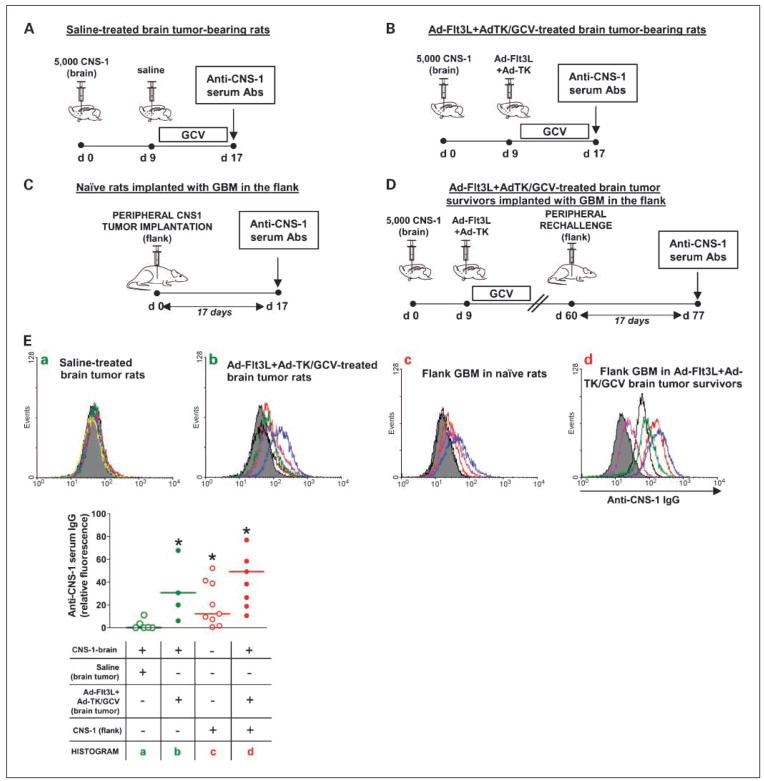
This treatment induced immunological memory that led to rejection of a second glioblastoma multiforme implanted in the contralateral hemisphere and of an extracranial glioblastoma multiforme implanted intradermally. Rechallenged long-term survivors exhibited anti-glioblastoma multiforme-specific T cells and displayed specific delayed-type hypersensitivity. Using depleting antibodies, we showed that rejection of the second tumor was dependent on CD8(+) T cells. Circulating anti-glioma antibodies were observed when glioblastoma multiforme cells were implanted intradermally in naïve rats or in long-term survivors. However, rats bearing intracranial glioblastoma multiforme only exhibited circulating antitumoral antibodies upon treatment with Ad-Flt3L + Ad-TK. This combined treatment induced tumor regression and release of the chromatin-binding protein high mobility group box 1 in two further intracranial glioblastoma multiforme models, that is, Fisher rats bearing intracranial 9L and F98 glioblastoma multiforme cells.
Treatment with Ad-Flt3L + Ad-TK triggered systemic anti-glioblastoma multiforme cellular and humoral immune responses, and anti-glioblastoma multiforme immunological memory. Release of the chromatin-binding protein high mobility group box 1 could be used as a noninvasive biomarker of therapeutic efficacy for glioblastoma multiforme. The robust treatment efficacy lends further support to its implementation in a phase I clinical trial.
多形性胶质母细胞瘤是一种致命的原发性脑癌。由于肿瘤因复发而致死,我们在复发性多形性胶质母细胞瘤大鼠模型中检验了一种新治疗方法会引发免疫记忆的假说。
我们研发了一种联合治疗方法,使用一种表达类fms酪氨酸激酶-3配体(Flt3L)的腺病毒(Ad),其可诱导免疫细胞浸润至肿瘤微环境,以及一种表达单纯疱疹病毒-1-胸苷激酶(TK)的Ad,其在更昔洛韦存在的情况下可杀死增殖的肿瘤细胞。
这种治疗诱导了免疫记忆,导致对植入对侧半球的第二个多形性胶质母细胞瘤以及皮内植入的颅外多形性胶质母细胞瘤产生排斥。再次受到攻击的长期存活者表现出抗多形性胶质母细胞瘤特异性T细胞,并表现出特异性迟发型超敏反应。使用耗竭性抗体,我们表明第二个肿瘤的排斥依赖于CD8(+) T细胞。当将多形性胶质母细胞瘤细胞皮内植入未接触过该肿瘤的大鼠或长期存活者体内时,可观察到循环抗胶质瘤抗体。然而,患有颅内多形性胶质母细胞瘤的大鼠仅在接受Ad-Flt3L + Ad-TK治疗后才表现出循环抗肿瘤抗体。这种联合治疗在另外两个颅内多形性胶质母细胞瘤模型中诱导了肿瘤消退以及染色质结合蛋白高迁移率族蛋白B1的释放,这两个模型即携带颅内9L和F98多形性胶质母细胞瘤细胞的Fisher大鼠。
Ad-Flt3L + Ad-TK治疗引发了全身性抗多形性胶质母细胞瘤细胞和体液免疫反应以及抗多形性胶质母细胞瘤免疫记忆。染色质结合蛋白高迁移率族蛋白B1的释放可作为多形性胶质母细胞瘤治疗效果的一种非侵入性生物标志物。强大的治疗效果为其在I期临床试验中的实施提供了进一步支持。