Harris Richard E, Sundgren Pia C, Craig A D, Kirshenbaum Eric, Sen Ananda, Napadow Vitaly, Clauw Daniel J
University of Michigan, Chronic Pain and Fatigue Research Center, Ann Arbor, MI 48106, USA.
Arthritis Rheum. 2009 Oct;60(10):3146-52. doi: 10.1002/art.24849.
Central pain augmentation resulting from enhanced excitatory and/or decreased inhibitory neurotransmission is a proposed mechanism underlying the pathophysiology of functional pain syndromes such as fibromyalgia (FM). Multiple functional magnetic resonance imaging studies implicate the insula as a region of heightened neuronal activity in this condition. Since glutamate (Glu) is a major cortical excitatory neurotransmitter that functions in pain neurotransmission, we undertook this study to test our hypothesis that increased levels of insular Glu would be present in FM patients and that the concentration of this molecule would be correlated with pain report.
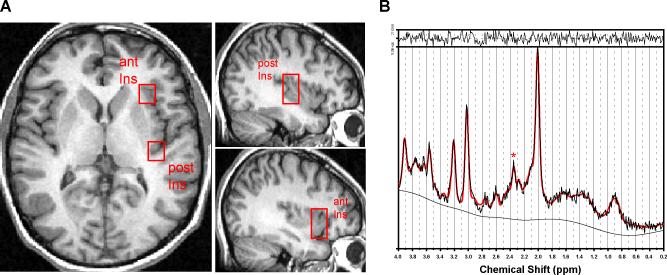
Nineteen FM patients and 14 age- and sex-matched pain-free controls underwent pressure pain testing and a proton magnetic resonance spectroscopy session in which the right anterior insula and right posterior insula were examined at rest.
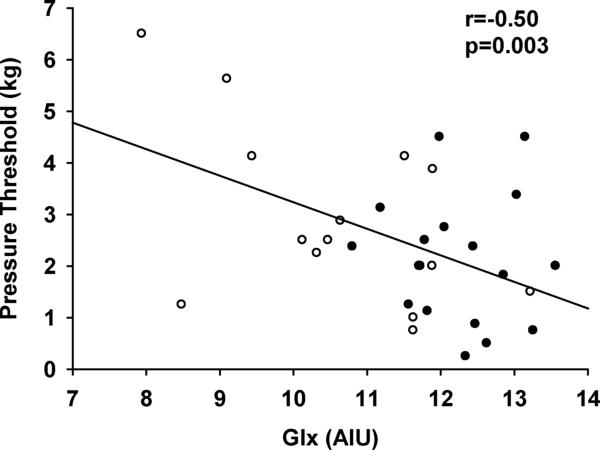
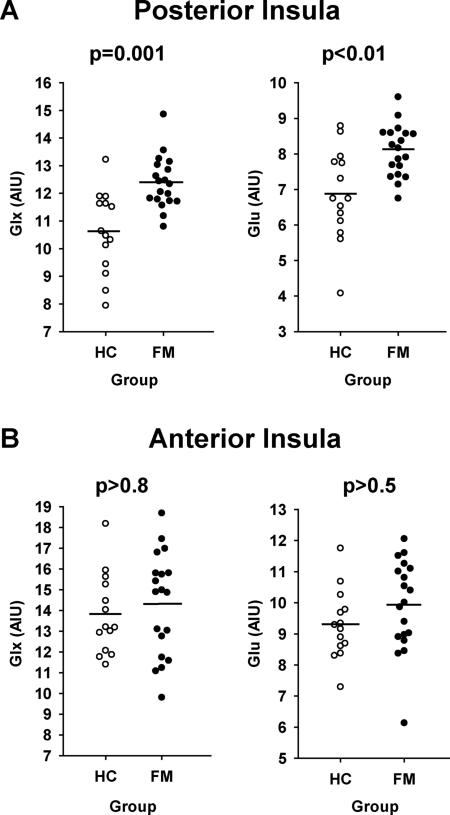
Compared with healthy controls, FM patients had significantly higher levels of Glu (mean +/- SD 8.09 +/- 0.72 arbitrary institutional units versus 6.86 +/- 1.29 arbitrary institutional units; P = 0.009) and combined glutamine and Glu (i.e., Glx) (mean +/- SD 12.38 +/- 0.94 arbitrary institutional units versus 10.59 +/- 1.48 arbitrary institutional units; P = 0.001) within the right posterior insula. No significant differences between groups were detected in any of the other major metabolites within this region (P > 0.05 for all comparisons), and no group differences were detected for any metabolite within the right anterior insula (P > 0.11 for all comparisons). Within the right posterior insula, higher levels of Glu and Glx were associated with lower pressure pain thresholds across both groups for medium pain (for Glu, r = -0.43, P = 0.012; for Glx, r = -0.50, P = 0.003).
Enhanced glutamatergic neurotransmission resulting from higher concentrations of Glu within the posterior insula may play a role in the pathophysiology of FM and other central pain augmentation syndromes.
兴奋性增强和/或抑制性神经传递减弱所导致的中枢性疼痛增强是诸如纤维肌痛(FM)等功能性疼痛综合征病理生理学的一种潜在机制。多项功能磁共振成像研究表明,脑岛是在这种情况下神经元活动增强的一个区域。由于谷氨酸(Glu)是在疼痛神经传递中起作用的一种主要皮质兴奋性神经递质,我们开展了本研究以检验我们的假设,即FM患者脑岛内Glu水平会升高,且该分子的浓度会与疼痛报告相关。
19名FM患者以及14名年龄和性别匹配的无疼痛对照者接受了压力疼痛测试和一次质子磁共振波谱检查,在静息状态下对右侧前脑岛和右侧后脑岛进行检查。
与健康对照者相比,FM患者右侧后脑岛内的Glu水平显著更高(平均±标准差为8.09±0.72任意单位,而对照组为6.86±1.29任意单位;P = 0.009),谷氨酰胺和Glu的总和(即Glx)水平也显著更高(平均±标准差为12.38±0.94任意单位,而对照组为10.59±1.48任意单位;P = 0.001)。该区域内其他任何主要代谢物在两组之间均未检测到显著差异(所有比较的P>0.05),右侧前脑岛内的任何代谢物在两组之间也未检测到差异(所有比较的P>0.11)。在右侧后脑岛内,两组中较高水平的Glu和Glx均与中度疼痛时较低的压力疼痛阈值相关(对于Glu,r = -0.43,P = 0.012;对于Glx,r = -0.50,P = 0.003)。
后脑岛内较高浓度的Glu所导致的谷氨酸能神经传递增强可能在FM及其他中枢性疼痛增强综合征的病理生理学中起作用。