Istituto di Chimica Biomolecolare, Consiglio Nazionale delle Ricerche, Sassari, Italy.
BMC Cancer. 2009 Oct 3;9:352. doi: 10.1186/1471-2407-9-352.
Several genetic alterations have been demonstrated to contribute to the development and progression of melanoma. In this study, we further investigated the impact of key-regulator genes in susceptibility and pathogenesis of such a disease.
A large series (N = 846) of sporadic and familial cases originating from South Italy was screened for germline mutations in p16(CDKN2A), BRCA2, and MC1R genes by DHPLC analysis and automated DNA sequencing. Paired primary melanomas and lymph node metastases from same patients (N = 35) as well as melanoma cell lines (N = 18) were analyzed for somatic mutations in NRAS, BRAF, and p16(CDKN2A) genes.
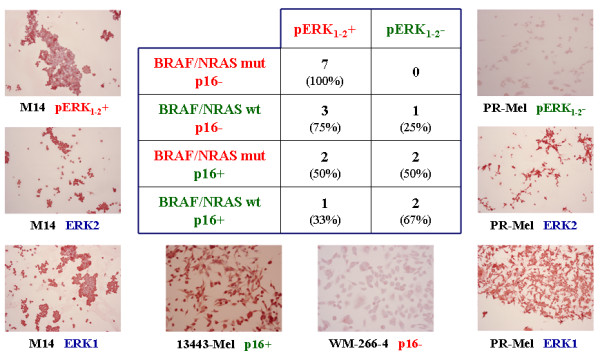
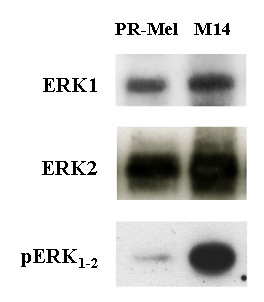
For melanoma susceptibility, investigations at germline level indicated that p16(CDKN2A) was exclusively mutated in 16/545 (2.9%) non-Sardinian patients, whereas BRCA2 germline mutations were observed in 4/91 (4.4%) patients from North Sardinia only. Two MC1R germline variants, Arg151Cys and Asp294His, were significantly associated with melanoma in Sardinia. Regarding genetic events involved in melanoma pathogenesis at somatic level, mutually-exclusive mutations of NRAS and BRAF genes were observed at quite same rate (about two thirds) in cultured and in vivo melanomas (either primary or metastatic lesions). Conversely, p16(CDKN2A) gene alterations were observed at increased rates moving from primary to metastatic melanomas and melanoma cell lines. Activation of the ERK gene product was demonstrated to be consistently induced by a combination of molecular alterations (NRAS/BRAF mutations and p16(CDKN2A) silencing).
Our findings further clarified that: a) mutation prevalence in melanoma susceptibility genes may vary within each specific geographical area; b) multiple molecular events are accumulating during melanomagenesis.
多项遗传改变已被证实有助于黑色素瘤的发展和进展。 在这项研究中,我们进一步研究了关键调节基因在这种疾病的易感性和发病机制中的作用。
对来自意大利南部的一个大型散发性和家族性病例系列(N=846)进行了 p16(CDKN2A)、BRCA2 和 MC1R 基因的种系突变筛查,采用 DHPLC 分析和自动 DNA 测序。 对来自同一患者的配对原发性黑色素瘤和淋巴结转移(N=35)以及黑色素瘤细胞系(N=18)进行了 NRAS、BRAF 和 p16(CDKN2A)基因的体细胞突变分析。
对于黑色素瘤易感性,种系水平的研究表明,p16(CDKN2A)仅在 16/545(2.9%)非撒丁岛患者中发生突变,而仅在来自撒丁岛北部的 4/91(4.4%)患者中发现 BRCA2 种系突变。 两个 MC1R 种系变体 Arg151Cys 和 Asp294His 在撒丁岛与黑色素瘤显著相关。 关于体细胞水平上黑色素瘤发病机制中涉及的遗传事件,NRAS 和 BRAF 基因的互斥突变在培养和体内黑色素瘤(原发性或转移性病变)中发生率相当(约三分之二)。 相反,p16(CDKN2A)基因的改变在从原发性转移到转移性黑色素瘤和黑色素瘤细胞系时发生率增加。 证明 ERK 基因产物的激活是由分子改变(NRAS/BRAF 突变和 p16(CDKN2A)沉默)的组合一致诱导的。
我们的研究结果进一步阐明:a)黑色素瘤易感基因中的突变发生率可能因每个特定地理区域而异;b)在黑色素瘤发生过程中会累积多种分子事件。