Nüesch Reto, Gayet-Ageron Angèle, Chetchotisakd Ploenchan, Prasithsirikul Wisit, Kiertiburanakul Sasisopin, Munsakul Warangkana, Raksakulkarn Phitsanu, Tansuphasawasdikul Somboon, Chautrakarn Sineenart, Ruxrungtham Kiat, Hirschel Bernard, Anaworanich Jintanat
HIV-NAT, The Thai Red Cross AIDS Research Center, Bangkok, Thailand.
Open AIDS J. 2009 Sep 15;3:38-45. doi: 10.2174/1874613600903010038.
Investigation on anxiety, stress, depression, and quality of life (QoL) within STACCATO, a randomised trial of two treatment strategies: CD4 guided scheduled treatment interruption (STI) compared to continuous treatment (CT).
Thai patients with HIV-infection enrolled in the STACCATO trial.
Anxiety, depression assessed by the questionnaires Hospital Anxiety and Depression Scale (HADS) and DASS, stress assessed by the Depression Anxiety Stress Scale (DASS), and QoL evaluated by the HIV Medical Outcome Study (MOS-HIV) questionnaires. Answers to questionnaires were evaluated at 4 time-points: baseline, 24 weeks, 48 weeks and at the end of STACCATO.
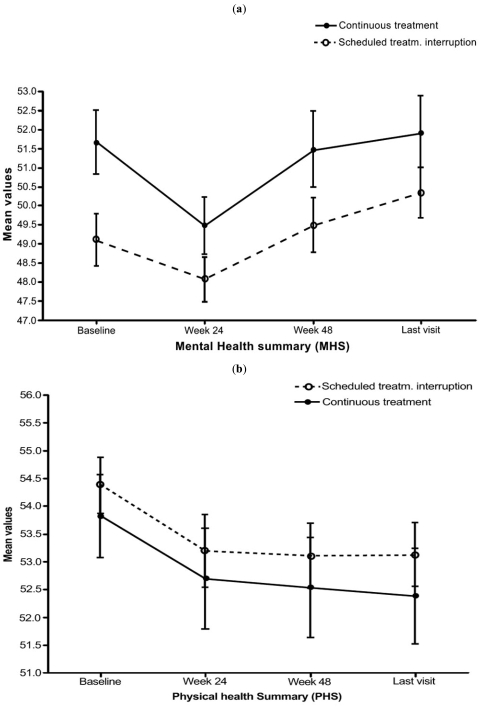
A total of 251 patients answered the HADS/DASS and 241 answered the MOS-HIV of the 379 Thai patients enrolled into STACCATO (66.2 and 63.6% respectively). At baseline 16.3% and 7.2% of patients reported anxiety and depression using HADS scale. Using the DASS scale, 35.1% reported mild to moderate and 9.6% reported severe anxiety; 8.8% reported mild to moderate and 2.0% reported severe depression; 42.6% reported mild to moderate and 4.8% reported severe stress. We showed a significant improvement of the MHS across time (p=0.001), but no difference between arms (p=0.17). The summarized physical health status score (PHS) did not change during the trial (p=0.15) nor between arm (p=0.45). There was no change of MHS or PHS in the STI arm, taking into account the number of STI cycle (p=0.30 and 0.57) but MHS significant increased across time-points (p=0.007).
Antiretroviral therapy improved mental health and QOL, irrespective of the treatment strategy.
在STACCATO研究中调查焦虑、压力、抑郁和生活质量(QoL),该研究是一项关于两种治疗策略的随机试验:与持续治疗(CT)相比,CD4引导的定期治疗中断(STI)。
纳入STACCATO试验的泰国HIV感染患者。
采用医院焦虑抑郁量表(HADS)和抑郁焦虑压力量表(DASS)问卷评估焦虑和抑郁,采用抑郁焦虑压力量表(DASS)评估压力,采用HIV医学结果研究(MOS-HIV)问卷评估生活质量。在4个时间点评估问卷答案:基线、24周、48周和STACCATO研究结束时。
在纳入STACCATO研究的379名泰国患者中,共有251名患者回答了HADS/DASS问卷,241名患者回答了MOS-HIV问卷(分别为66.2%和63.6%)。在基线时,使用HADS量表,16.3%和7.2%的患者报告有焦虑和抑郁。使用DASS量表,35.1%报告有轻度至中度焦虑,9.6%报告有重度焦虑;8.8%报告有轻度至中度抑郁,2.0%报告有重度抑郁;42.6%报告有轻度至中度压力,4.8%报告有重度压力。我们发现随时间推移心理健康得分(MHS)有显著改善(p=0.001),但两组之间无差异(p=0.17)。在试验期间,总结的身体健康状况评分(PHS)没有变化(p=0.15),两组之间也没有差异(p=0.45)。考虑到STI周期数,STI组的MHS和PHS没有变化(p=0.30和0.57),但MHS随时间点显著增加(p=0.007)。
无论治疗策略如何,抗逆转录病毒疗法均可改善心理健康和生活质量。