Department of Orthopaedics, University of North Carolina, Chapel Hill, NC 27599-7055, USA.
J Bone Miner Res. 2010 Mar;25(3):520-6. doi: 10.1359/jbmr.091007.
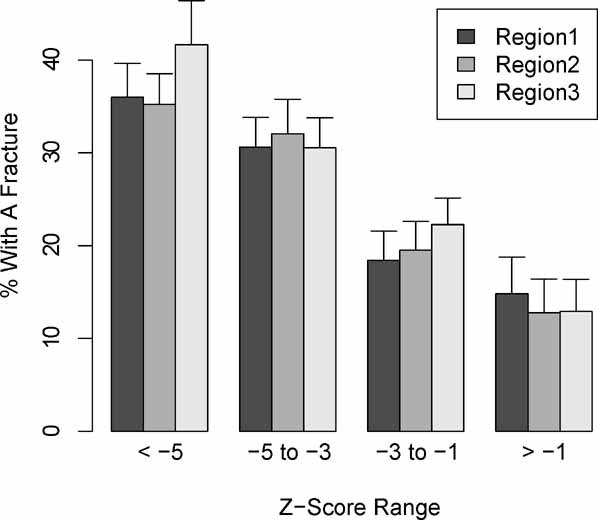
Children with limited or no ability to ambulate frequently sustain fragility fractures. Joint contractures, scoliosis, hip dysplasia, and metallic implants often prevent reliable measures of bone mineral density (BMD) in the proximal femur and lumbar spine, where BMD is commonly measured. Further, the relevance of lumbar spine BMD to fracture risk in this population is questionable. In an effort to obtain bone density measures that are both technically feasible and clinically relevant, a technique was developed involving dual-energy X-ray absorptiometry (DXA) measures of the distal femur projected in the lateral plane. The purpose of this study is to test the hypothesis that these new measures of BMD correlate with fractures in children with limited or no ability to ambulate. The relationship between distal femur BMD Z-scores and fracture history was assessed in a cross-sectional study of 619 children aged 6 to 18 years with muscular dystrophy or moderate to severe cerebral palsy compiled from eight centers. There was a strong correlation between fracture history and BMD Z-scores in the distal femur; 35% to 42% of those with BMD Z-scores less than -5 had fractured compared with 13% to 15% of those with BMD Z-scores greater than -1. Risk ratios were 1.06 to 1.15 (95% confidence interval 1.04-1.22), meaning a 6% to 15% increased risk of fracture with each 1.0 decrease in BMD Z-score. In clinical practice, DXA measure of BMD in the distal femur is the technique of choice for the assessment of children with impaired mobility.
行动能力有限或无法行动的儿童经常发生脆性骨折。关节挛缩、脊柱侧凸、髋关节发育不良和金属植入物通常会妨碍对股骨近端和腰椎进行可靠的骨密度 (BMD) 测量,而 BMD 通常就是在这些部位进行测量的。此外,对于该人群,腰椎 BMD 与骨折风险的相关性也值得怀疑。为了获得既具有技术可行性又具有临床相关性的骨密度测量值,开发了一种涉及双能 X 射线吸收法 (DXA) 测量侧位投影的股骨远端的技术。本研究的目的是检验以下假设,即这些新的 BMD 测量值与行动能力有限或无法行动的儿童的骨折有关。在对来自八个中心的 619 名年龄在 6 至 18 岁、患有肌肉萎缩症或中度至重度脑瘫的儿童进行的横断面研究中,评估了股骨远端 BMD Z 评分与骨折史之间的关系。骨折史与股骨远端 BMD Z 评分之间存在很强的相关性;与 BMD Z 评分大于-1 的儿童相比,BMD Z 评分小于-5 的儿童中有 35%至 42%发生了骨折,而 BMD Z 评分大于-1 的儿童中有 13%至 15%发生了骨折。风险比为 1.06 至 1.15(95%置信区间为 1.04-1.22),这意味着 BMD Z 评分每降低 1.0,骨折风险就会增加 6%至 15%。在临床实践中,DXA 测量股骨远端的 BMD 是评估行动能力受损儿童的首选技术。