Dawes Emma J, Churcher Thomas S, Zhuang Shijie, Sinden Robert E, Basáñez María-Gloria
Department of Infectious Disease Epidemiology, Faculty of Medicine, Imperial College London, London, UK.
Malar J. 2009 Oct 12;8:228. doi: 10.1186/1475-2875-8-228.
Daily mortality is an important determinant of a vector's ability to transmit pathogens. Original simplifying assumptions in malaria transmission models presume vector mortality is independent of age, infection status and parasite load. Previous studies illustrate conflicting evidence as to the importance of Plasmodium-induced vector mortality, but very few studies to date have considered the effect of infection density on mosquito survival.
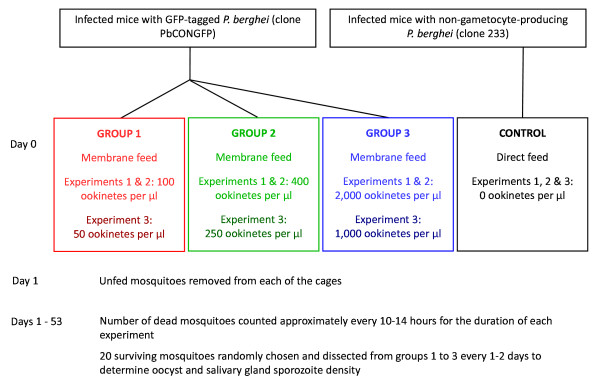
A series of three experiments were conducted, each consisting of four cages of 400-1,000 Anopheles stephensi mosquitoes fed on blood infected with different Plasmodium berghei ookinete densities per microlitre of blood. Twice daily the numbers of dead mosquitoes in each group were recorded, and on alternate days a sample of live mosquitoes from each group were dissected to determine parasite density in both midgut and salivary glands.
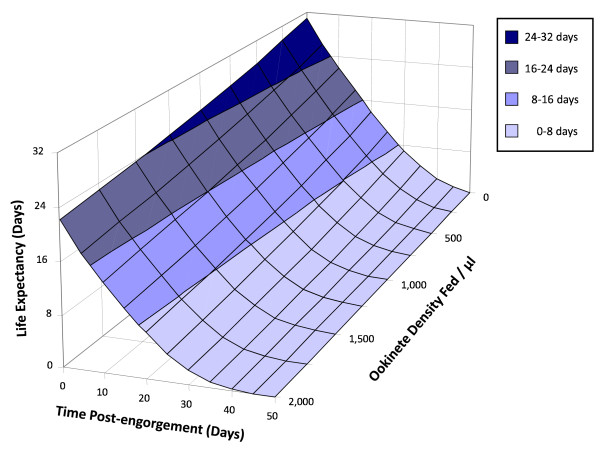
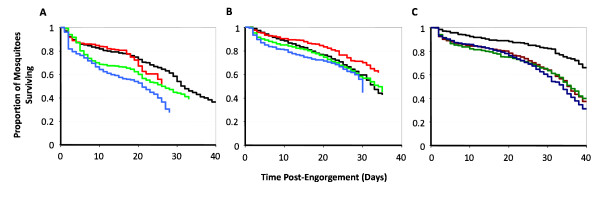
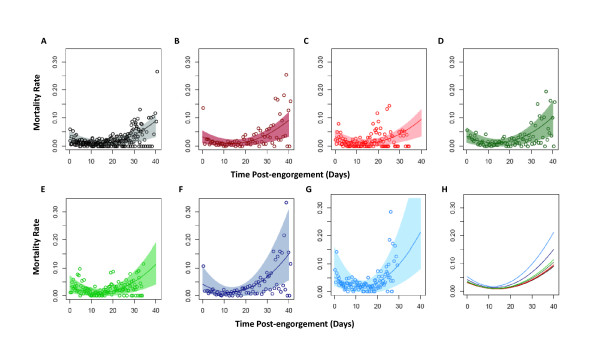
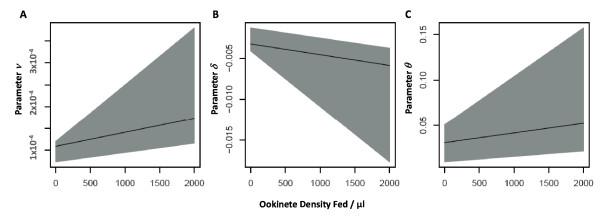
Survival analyses indicate that mosquito mortality is both age- and infection intensity-dependent. Mosquitoes experienced an initially high, partly feeding-associated, mortality rate, which declined to a minimum before increasing with mosquito age and parasite intake. As a result, the life expectancy of a mosquito is shown to be dependent on both insect age and the density of Plasmodium infection.
These results contribute to understanding in greater detail the processes that influence sporogony in the mosquito, indicate the impact that parasite density could have on malaria transmission dynamics, and have implications for the design, development, and evaluation of transmission-blocking strategies.
每日死亡率是病媒传播病原体能力的一个重要决定因素。疟疾传播模型最初的简化假设认为病媒死亡率与年龄、感染状态和寄生虫负荷无关。先前的研究对于疟原虫诱导的病媒死亡率的重要性给出了相互矛盾的证据,但迄今为止很少有研究考虑感染密度对蚊子存活的影响。
进行了一系列三个实验,每个实验由四个笼子组成,每个笼子里有400 - 1000只斯氏按蚊,用每微升血液中感染不同伯氏疟原虫动合子密度的血液喂养。每天记录每组中死亡蚊子的数量两次,并且每隔一天解剖每组中的一部分活蚊子样本,以确定中肠和唾液腺中的寄生虫密度。
生存分析表明蚊子死亡率既与年龄有关,也与感染强度有关。蚊子最初经历了较高的、部分与取食相关的死亡率,该死亡率在随着蚊子年龄和寄生虫摄入量增加之前降至最低。因此,显示出蚊子的预期寿命取决于昆虫年龄和疟原虫感染密度。
这些结果有助于更详细地理解影响蚊子孢子生殖的过程,表明寄生虫密度可能对疟疾传播动态产生的影响,并且对传播阻断策略的设计、开发和评估具有启示意义。