Department of Disease and Stress Biology, John Innes Centre, Norwich, United Kingdom.
PLoS One. 2009 Oct 15;4(10):e7463. doi: 10.1371/journal.pone.0007463.
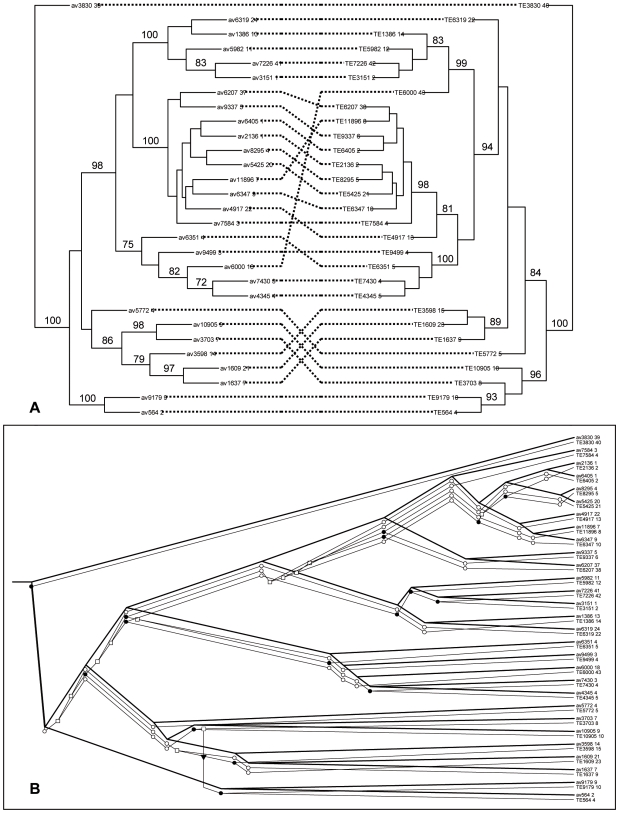
Parasites are able to evolve rapidly and overcome host defense mechanisms, but the molecular basis of this adaptation is poorly understood. Powdery mildew fungi (Erysiphales, Ascomycota) are obligate biotrophic parasites infecting nearly 10,000 plant genera. They obtain their nutrients from host plants through specialized feeding structures known as haustoria. We previously identified the AVR(k1) powdery mildew-specific gene family encoding effectors that contribute to the successful establishment of haustoria. Here, we report the extensive proliferation of the AVR(k1) gene family throughout the genome of B. graminis, with sequences diverging in formae speciales adapted to infect different hosts. Also, importantly, we have discovered that the effectors have coevolved with a particular family of LINE-1 retrotransposons, named TE1a. The coevolution of these two entities indicates a mutual benefit to the association, which could ultimately contribute to parasite adaptation and success. We propose that the association would benefit 1) the powdery mildew fungus, by providing a mechanism for amplifying and diversifying effectors and 2) the associated retrotransposons, by providing a basis for their maintenance through selection in the fungal genome.
寄生虫能够迅速进化并克服宿主防御机制,但这种适应的分子基础还了解甚少。白粉菌(Erysiphales,子囊菌门)是专性生物寄生菌,感染了近 10000 种植物属。它们通过专门的取食结构(称为吸器)从宿主植物中获取营养。我们之前已经鉴定了 AVR(k1)白粉菌特异性基因家族,该基因家族编码有助于成功建立吸器的效应子。在这里,我们报告了 AVR(k1)基因家族在禾柄锈菌基因组中的广泛增殖,其序列在适应不同宿主的专化型中发生了分歧。同样重要的是,我们发现效应子与一类名为 TE1a 的 LINE-1 反转录转座子共同进化。这两个实体的共同进化表明它们之间存在互利关系,这可能最终有助于寄生虫的适应和成功。我们提出,这种关联将使白粉菌受益,1)提供了一种扩大和多样化效应子的机制,2)为相关的反转录转座子提供了一个基础,通过在真菌基因组中的选择来维持它们。