Perroud Nader, Uher Rudolf, Marusic Andrej, Rietschel Marcella, Mors Ole, Henigsberg Neven, Hauser Joanna, Maier Wolfgang, Souery Daniel, Placentino Anna, Szczepankiewicz Aleksandra, Jorgensen Lisbeth, Strohmaier Jana, Zobel Astrid, Giovannini Caterina, Elkin Amanda, Gunasinghe Cerisse, Gray Joanna, Campbell Desmond, Gupta Bhanu, Farmer Anne E, McGuffin Peter, Aitchison Katherine J
MRC SGDP Centre, Institute of Psychiatry at King's College London, UK.
BMC Med. 2009 Oct 15;7:60. doi: 10.1186/1741-7015-7-60.
Suicidal thoughts and behaviours during antidepressant treatment, especially during the first weeks of treatment, have prompted warnings by regulatory bodies. The aim of the present study is to investigate the course and predictors of emergence and worsening of suicidal ideation during tricyclic antidepressant and serotonin reuptake inhibitor treatment.
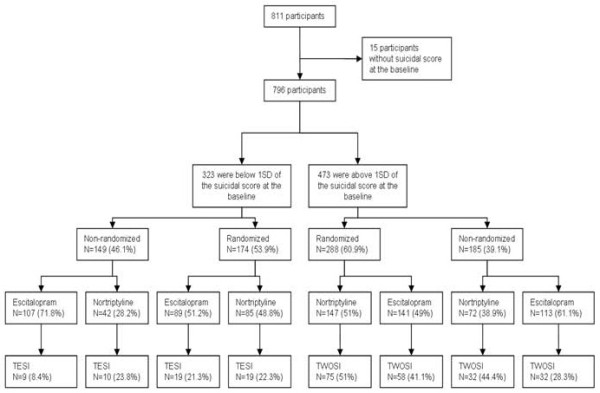
In a multicentre part-randomised open-label study, 811 adult patients with moderate to severe unipolar depression were allocated to flexible dosage of escitalopram or nortriptyline for 12 weeks. The suicidality items of three standard measures were integrated in a suicidal ideation score. Increases in this score were classified as treatment emergent suicidal ideation (TESI) or treatment worsening suicidal ideation (TWOSI) according to the absence or presence of suicidal ideation at baseline.
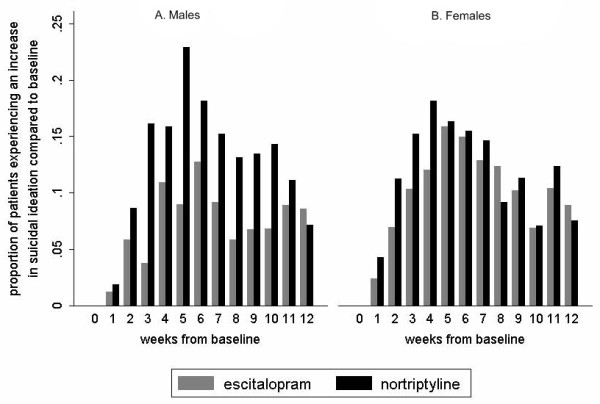
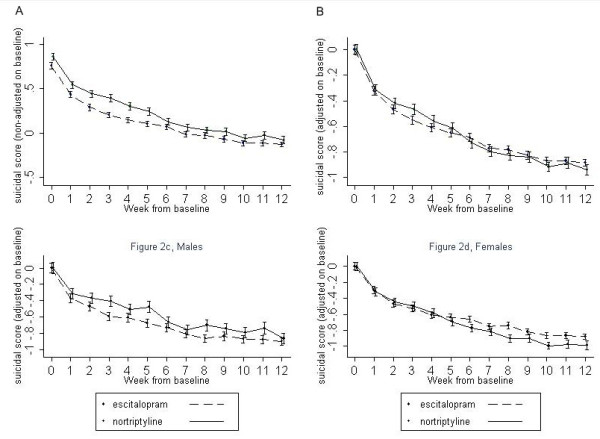
Suicidal ideation decreased during antidepressant treatment. Rates of TESI and TWOSI peaked in the fifth week. Severity of depression predicted TESI and TWOSI. In men, nortriptyline was associated with a 9.8-fold and 2.4-fold increase in TESI and TWOSI compared to escitalopram, respectively. Retirement and history of suicide attempts predicted TWOSI.
Increases in suicidal ideation were associated with depression severity and decreased during antidepressant treatment. In men, treatment with escitalopram is associated with lower risk of suicidal ideation compared to nortriptyline. Clinicians should remain alert to suicidal ideation beyond the initial weeks of antidepressant treatment.
EudraCT (No.2004-001723-38) and ISRCTN (No. 03693000).
抗抑郁治疗期间,尤其是治疗的最初几周出现的自杀念头和行为,已促使监管机构发出警告。本研究的目的是调查三环类抗抑郁药和5-羟色胺再摄取抑制剂治疗期间自杀意念出现及恶化的过程和预测因素。
在一项多中心部分随机开放标签研究中,811例中重度单相抑郁症成年患者被分配接受艾司西酞普兰或去甲替林灵活剂量治疗12周。将三项标准测评中的自杀相关条目整合为自杀意念评分。根据基线时是否存在自杀意念,该评分的增加被分类为治疗中出现的自杀意念(TESI)或治疗中恶化的自杀意念(TWOSI)。
抗抑郁治疗期间自杀意念减少。TESI和TWOSI发生率在第5周达到峰值。抑郁严重程度可预测TESI和TWOSI。在男性中,与艾司西酞普兰相比,去甲替林使TESI和TWOSI分别增加9.8倍和2.4倍。退休和自杀未遂史可预测TWOSI。
自杀意念增加与抑郁严重程度相关,且在抗抑郁治疗期间减少。在男性中,与去甲替林相比,使用艾司西酞普兰治疗自杀意念风险较低。临床医生在抗抑郁治疗最初几周之后仍应警惕自杀意念。
欧洲临床试验数据库(编号:2004-001723-38)和国际标准随机对照试验编号(编号:03693000)。