Institute of Pharmacology and Toxicology, Tzu Chi University, Hualien, Taiwan.
J Biomed Sci. 2009 Oct 16;16(1):94. doi: 10.1186/1423-0127-16-94.
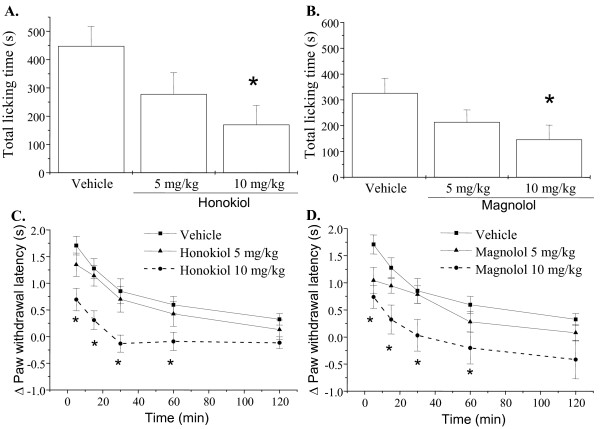
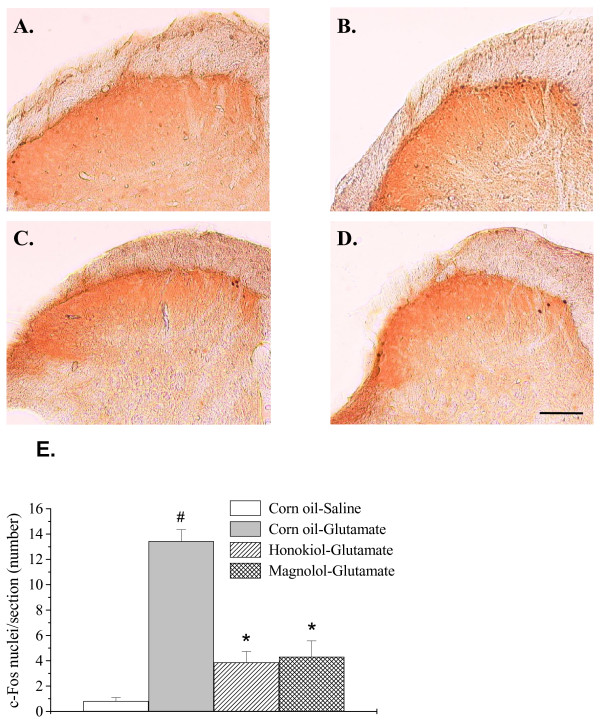
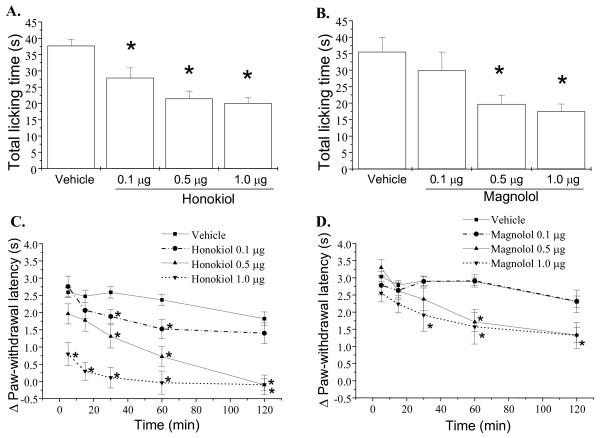
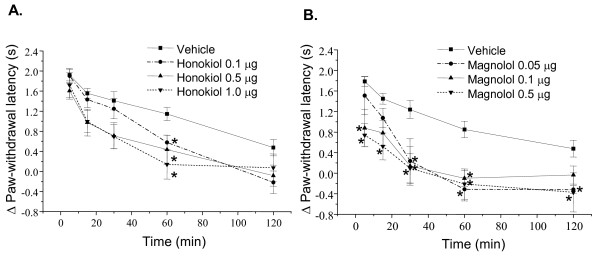
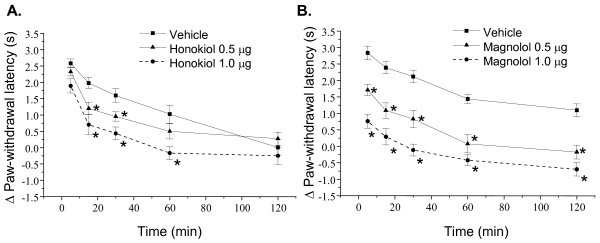
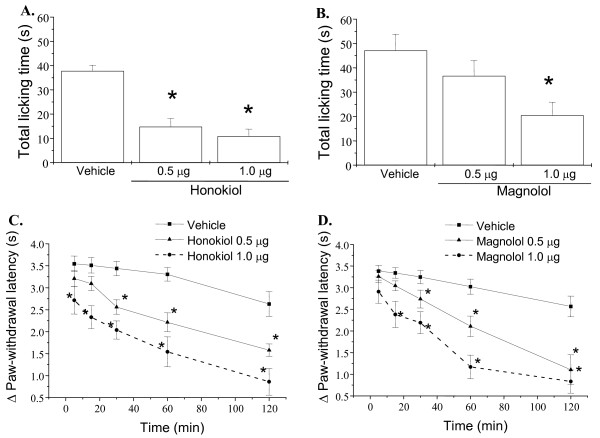
The antinociceptive effects of honokiol and magnolol, two major bioactive constituents of the bark of Magnolia officinalis, were investigated on animal paw licking responses and thermal hyperalgesia induced by glutamate receptor agonists including glutamate, N-methyl-D-aspartate (NMDA), and metabotropic glutamate 5 receptor (mGluR5) activator (RS)-2-chloro-5-hydroxyphenylglycine (CHPG), as well as inflammatory mediators such as substance P and prostaglandin E2 (PGE2) in mice. The actions of honokiol and magnolol on glutamate-induced c-Fos expression in the spinal cord dorsal horn were also examined. Our data showed that honokiol and magnolol blocked glutamate-, substance P- and PGE2-induced inflammatory pain with similar potency and efficacy. Consistently, honokiol and magnolol significantly decreased glutamate-induced c-Fos protein expression in superficial (I-II) laminae of the L4-L5 lumbar dorsal horn. However, honokiol was more selective than magnolol for inhibition of NMDA-induced licking behavioral and thermal hyperalgesia. In contrast, magnolol was more potent to block CHPG-mediated thermal hyperalgesia. These results demonstrate that honokiol and magnolol effectively decreased the inflammatory pain. Furthermore, their different potency on inhibition of nociception provoked by NMDA receptor and mGluR5 activation should be considered.
厚朴酚和厚朴酚是厚朴树皮中的两种主要生物活性成分,本研究旨在探讨其对谷氨酸受体激动剂(包括谷氨酸、N-甲基-D-天冬氨酸(NMDA)和代谢型谷氨酸受体 5 激动剂(RS)-2-氯-5-羟基苯甘氨酸(CHPG))以及炎症介质(如 P 物质和前列腺素 E2(PGE2))诱导的动物爪舔反应和热痛觉过敏的镇痛作用。此外,还观察了 honokiol 和 magnolol 对谷氨酸诱导的脊髓背角 c-Fos 表达的作用。结果表明,厚朴酚和厚朴酚对谷氨酸、P 物质和 PGE2 诱导的炎症性疼痛具有相似的强度和效果。一致地,厚朴酚和厚朴酚显著降低了浅层(I-II)脊髓背角中谷氨酸诱导的 c-Fos 蛋白表达。然而,与 magnolol 相比,honokiol 对 NMDA 诱导的舔行为和热痛觉过敏的抑制作用更具选择性。相反,magnolol 对 CHPG 介导的热痛觉过敏的抑制作用更强。这些结果表明,厚朴酚和厚朴酚能有效减轻炎症性疼痛。此外,它们对 NMDA 受体和 mGluR5 激活引起的痛觉过敏的抑制作用的不同强度应该被考虑。