Department of Neurology, University of New Mexico Health Sciences Center, Albuquerque, New Mexico 87131-0001, USA.
Neurosurgery. 2009 Oct;65(4):702-8. doi: 10.1227/01.NEU.0000351768.11363.48.
Traumatic brain injury (TBI) causes an increase in matrix metalloproteinases (MMPs), which are associated with neuroinflammation, blood-brain barrier disruption, hemorrhage, and cell death. We hypothesized that patients with TBI have an increase in MMPs in ventricular cerebrospinal fluid (CSF) and plasma.
Patients with TBI and a ventricular catheter were entered into the study. Samples of CSF and plasma were collected at the time of catheter placement and at 24 and 72 hours after admission. Seven TBI patients were entered into the study, with 6 having complete data for analysis. Only patients who had a known time of insult that fell within a 6-hour window from initial insult to ventriculostomy were accepted into the study. Control CSF came from ventricular fluid in patients undergoing shunt placement for normal pressure hydrocephalus. Both MMP-2 and MMP-9 were measured with gelatin zymography and MMP-3 with Western immunoblot.
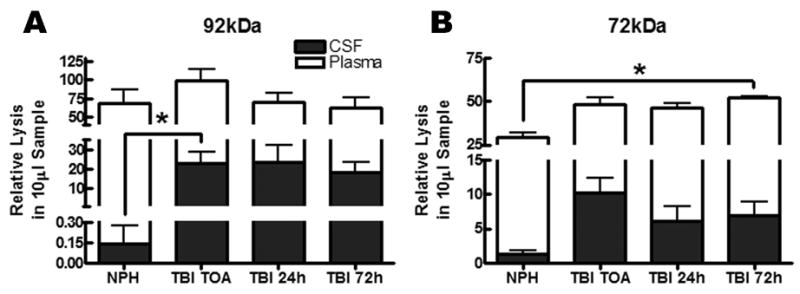
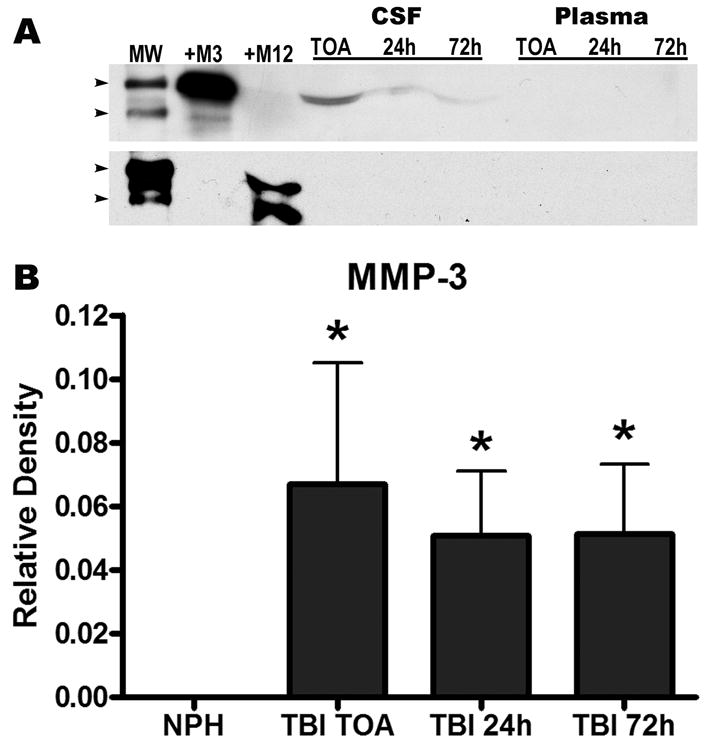
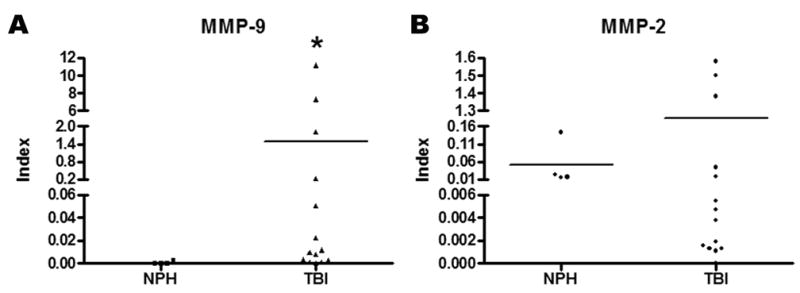
We found a significant elevation in the levels of the latent form of MMP-9 (92-kD) in the CSF obtained at the time of arrival (P < 0.05). Elevated levels of MMP-2 were detected in plasma at 72 hours, but not in the CSF. Using albumin from both CSF and blood, we calculated the MMP-9 index, which was significantly increased in the CSF, indicating endogenous MMP production. Western immunoblot showed elevated levels of MMP-3 in CSF at all times measured, whereas MMP-3 was not detected in the CSF of normal pressure hydrocephalus.
We show that MMPs are increased in the CSF of TBI patients. Although the number of patients was small, the results were robust and clearly demonstrated increases in MMP-3 and MMP-9 in ventricular CSF in TBI patients compared with controls. Although these preliminary results will need to be replicated, we propose that MMPs may be important in blood-brain barrier opening and hemorrhage secondary to brain injury in patients.
创伤性脑损伤 (TBI) 会导致基质金属蛋白酶 (MMPs) 增加,而 MMPs 与神经炎症、血脑屏障破坏、出血和细胞死亡有关。我们假设 TBI 患者的脑室脑脊液 (CSF) 和血浆中 MMPs 增加。
将 TBI 患者和脑室导管纳入研究。在导管放置时以及入院后 24 小时和 72 小时采集 CSF 和血浆样本。将 7 名 TBI 患者纳入研究,其中 6 名患者有完整的数据进行分析。仅接受已知损伤时间在从初始损伤到脑室造口术的 6 小时窗口内的患者进入研究。对照 CSF 来自因正常压力脑积水而行分流术的患者的脑室液。使用明胶酶谱法测量 MMP-2 和 MMP-9,使用 Western 免疫印迹法测量 MMP-3。
我们发现,在入院时获得的 CSF 中,MMP-9(92-kD)的潜伏形式水平显著升高(P<0.05)。在 72 小时时在血浆中检测到 MMP-2 水平升高,但在 CSF 中未检测到。使用 CSF 和血液中的白蛋白,我们计算了 MMP-9 指数,该指数在 CSF 中显著增加,表明内源性 MMP 产生。Western 免疫印迹法显示,在所有测量时间,CSF 中的 MMP-3 水平升高,而正常压力脑积水的 CSF 中未检测到 MMP-3。
我们表明,TBI 患者的 CSF 中 MMPs 增加。尽管患者数量较少,但结果是可靠的,并且清楚地表明与对照组相比,TBI 患者的脑室 CSF 中 MMP-3 和 MMP-9 增加。尽管这些初步结果需要复制,但我们提出 MMPs 可能在继发于脑损伤的血脑屏障开放和出血中很重要。