Bennardo Nicole, Gunn Amanda, Cheng Anita, Hasty Paul, Stark Jeremy M
Department of Cancer Biology, Division of Radiation Biology, Beckman Research Institute of the City of Hope, Duarte, California, USA.
PLoS Genet. 2009 Oct;5(10):e1000683. doi: 10.1371/journal.pgen.1000683. Epub 2009 Oct 16.
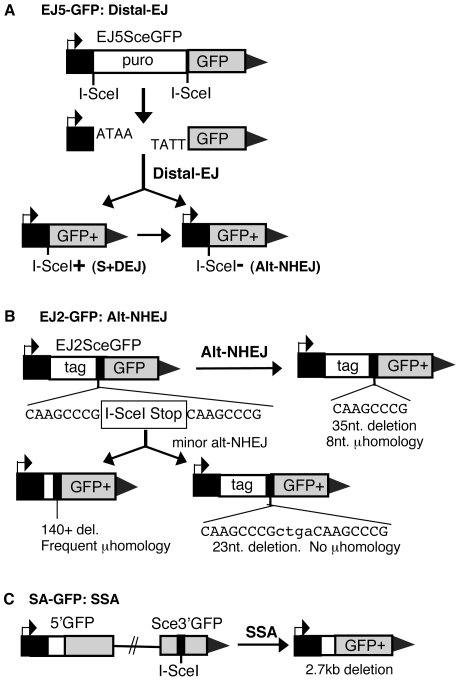
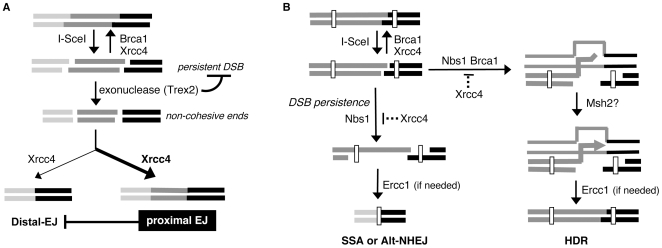
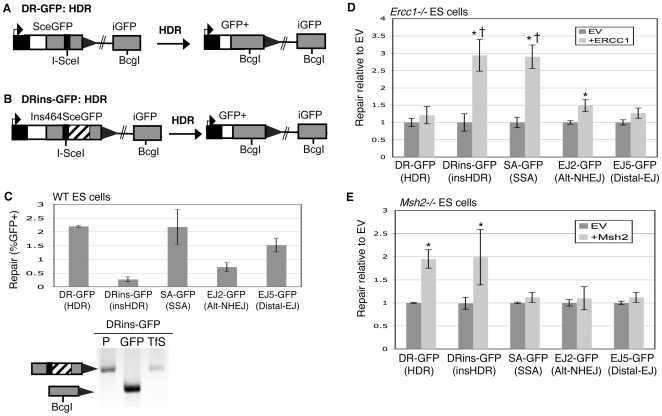
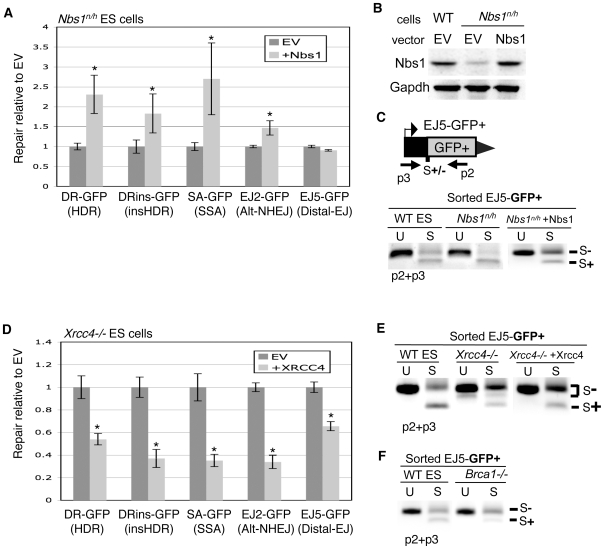
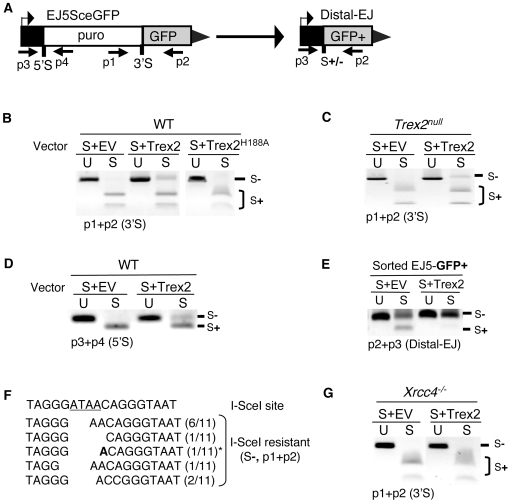
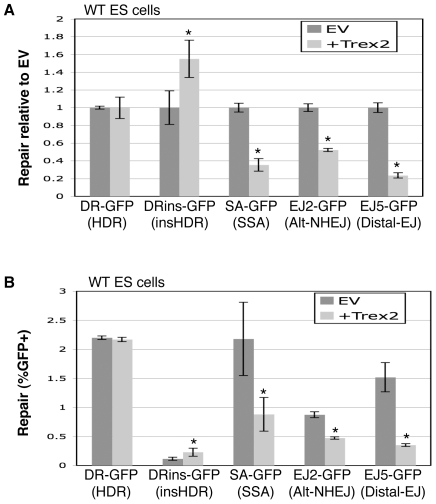
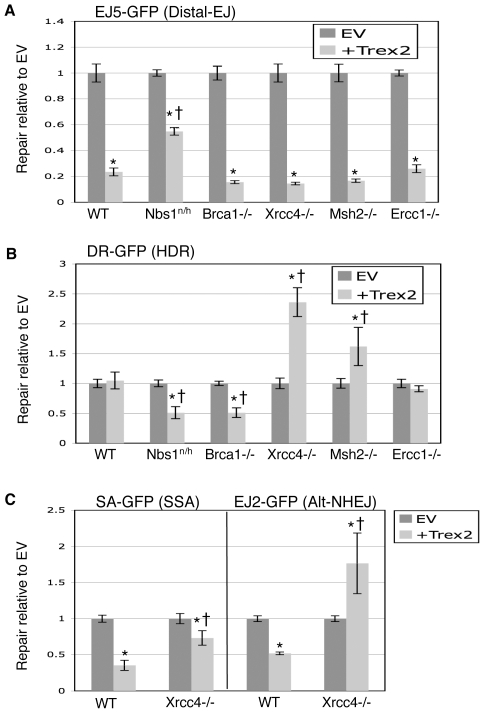
To characterize the repair pathways of chromosome double-strand breaks (DSBs), one approach involves monitoring the repair of site-specific DSBs generated by rare-cutting endonucleases, such as I-SceI. Using this method, we first describe the roles of Ercc1, Msh2, Nbs1, Xrcc4, and Brca1 in a set of distinct repair events. Subsequently, we considered that the outcome of such assays could be influenced by the persistent nature of I-SceI-induced DSBs, in that end-joining (EJ) products that restore the I-SceI site are prone to repeated cutting. To address this aspect of repair, we modified I-SceI-induced DSBs by co-expressing I-SceI with a non-processive 3' exonuclease, Trex2, which we predicted would cause partial degradation of I-SceI 3' overhangs. We find that Trex2 expression facilitates the formation of I-SceI-resistant EJ products, which reduces the potential for repeated cutting by I-SceI and, hence, limits the persistence of I-SceI-induced DSBs. Using this approach, we find that Trex2 expression causes a significant reduction in the frequency of repair pathways that result in substantial deletion mutations: EJ between distal ends of two tandem DSBs, single-strand annealing, and alternative-NHEJ. In contrast, Trex2 expression does not inhibit homology-directed repair. These results indicate that limiting the persistence of a DSB causes a reduction in the frequency of repair pathways that lead to significant genetic loss. Furthermore, we find that individual genetic factors play distinct roles during repair of non-cohesive DSB ends that are generated via co-expression of I-SceI with Trex2.
为了表征染色体双链断裂(DSB)的修复途径,一种方法是监测由稀有切割内切核酸酶(如I-SceI)产生的位点特异性DSB的修复情况。使用这种方法,我们首先描述了Ercc1、Msh2、Nbs1、Xrcc4和Brca1在一系列不同修复事件中的作用。随后,我们认为此类检测的结果可能会受到I-SceI诱导的DSB的持续性影响,因为恢复I-SceI位点的末端连接(EJ)产物容易被重复切割。为了解决修复的这一方面问题,我们通过将I-SceI与一种非连续性3'核酸外切酶Trex2共表达来修饰I-SceI诱导的DSB,我们预测这会导致I-SceI 3'突出端的部分降解。我们发现Trex2的表达促进了I-SceI抗性EJ产物的形成,这降低了I-SceI重复切割的可能性,从而限制了I-SceI诱导的DSB的持续性。使用这种方法,我们发现Trex2的表达导致导致大量缺失突变的修复途径频率显著降低:两个串联DSB远端之间的EJ、单链退火和替代性非同源末端连接(alt-NHEJ)。相比之下,Trex2的表达并不抑制同源定向修复。这些结果表明,限制DSB的持续性会导致导致显著遗传损失的修复途径频率降低。此外,我们发现个体遗传因素在通过I-SceI与Trex2共表达产生的非粘性DSB末端的修复过程中发挥着不同的作用。