Loganantharaj Raja, Chung Jun
Bioinformatics Research Lab, University of Louisiana, Lafayette, LA 70504, USA.
J Biomed Biotechnol. 2009;2009:648987. doi: 10.1155/2009/648987. Epub 2009 Oct 12.
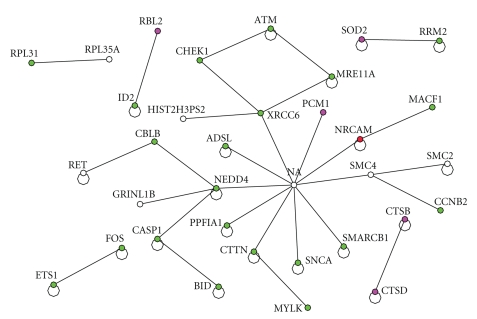
Microarray technology provides an opportunity to view transcriptions at genomic level under different conditions controlled by an experiment. From an array experiment using a human cancer cell line that is engineered to differ in expression of tumor antigen, integrin alpha6beta4, few hundreds of differentially expressed genes are selected and are clustered using one of several standard algorithms. The set of genes in a cluster is expected to have similar expression patterns and are most likely to be coregulated and thereby expected to have similar function. The highly expressed set of upregulated genes become candidates for further evaluation as potential biomarkers. Besides these benefits, microarray experiment by itself does not help us to understand or discover potential pathways or to identify important set of genes for potential drug targets. In this paper we discuss about integrating protein-to-protein interaction information, pathway information with array expression data set to identify a set of "important" genes, and potential signal transduction networks that help to target and reverse the oncogenic phenotype induced by tumor antigen such as integrin alpha6beta4. We will illustrate the proposed method with our recent microarray experiment conducted for identifying transcriptional targets of integrin alpha6beta4 for cancer progression.
微阵列技术提供了一个机会,可在实验控制的不同条件下,在基因组水平上观察转录情况。通过使用一种经过基因工程改造以使其肿瘤抗原整合素α6β4表达不同的人类癌细胞系进行的阵列实验,数百个差异表达基因被挑选出来,并使用几种标准算法之一进行聚类。一个聚类中的基因集预计具有相似的表达模式,很可能受到共同调控,因此预计具有相似的功能。上调基因中高表达的一组成为作为潜在生物标志物进行进一步评估的候选基因。除了这些好处之外,微阵列实验本身并不能帮助我们理解或发现潜在的途径,也无法识别潜在药物靶点的重要基因集。在本文中,我们讨论了如何将蛋白质 - 蛋白质相互作用信息、途径信息与阵列表达数据集整合起来,以识别一组“重要”基因以及潜在的信号转导网络,这些网络有助于靶向并逆转由肿瘤抗原如整合素α6β4诱导的致癌表型。我们将通过我们最近为识别整合素α6β4在癌症进展中的转录靶点而进行的微阵列实验来说明所提出的方法。