Kandul Nikolai P, Noor Mohamed A F
Biology Department, Duke University, PO Box 90338, FFSC 4244, Durham, NC 27708, USA.
BMC Genet. 2009 Oct 19;10:67. doi: 10.1186/1471-2156-10-67.
Alternative splicing (AS) of maturing mRNA can generate structurally and functionally distinct transcripts from the same gene. Recent bioinformatic analyses of available genome databases inferred a positive correlation between intron length and AS. To study the interplay between intron length and AS empirically and in more detail, we analyzed the diversity of alternatively spliced transcripts (ASTs) in the Drosophila RNA-binding Bruno-3 (Bru-3) gene. This gene was known to encode thirteen exons separated by introns of diverse sizes, ranging from 71 to 41,973 nucleotides in D. melanogaster. Although Bru-3's structure is expected to be conducive to AS, only two ASTs of this gene were previously described.
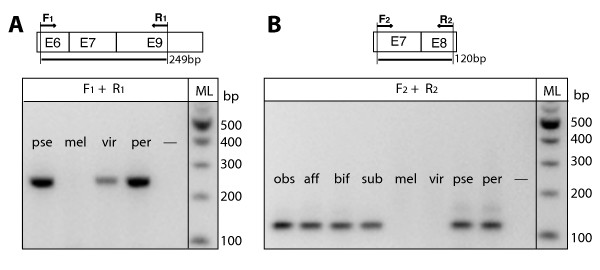
Cloning of RT-PCR products of the entire ORF from four species representing three diverged Drosophila lineages provided an evolutionary perspective, high sensitivity, and long-range contiguity of splice choices currently unattainable by high-throughput methods. Consequently, we identified three new exons, a new exon fragment and thirty-three previously unknown ASTs of Bru-3. All exon-skipping events in the gene were mapped to the exons surrounded by introns of at least 800 nucleotides, whereas exons split by introns of less than 250 nucleotides were always spliced contiguously in mRNA. Cases of exon loss and creation during Bru-3 evolution in Drosophila were also localized within large introns. Notably, we identified a true de novo exon gain: exon 8 was created along the lineage of the obscura group from intronic sequence between cryptic splice sites conserved among all Drosophila species surveyed. Exon 8 was included in mature mRNA by the species representing all the major branches of the obscura group. To our knowledge, the origin of exon 8 is the first documented case of exonization of intronic sequence outside vertebrates.
We found that large introns can promote AS via exon-skipping and exon turnover during evolution likely due to frequent errors in their removal from maturing mRNA. Large introns could be a reservoir of genetic diversity, because they have a greater number of mutable sites than short introns. Taken together, gene structure can constrain and/or promote gene evolution.
成熟mRNA的可变剪接(AS)能够从同一基因产生结构和功能不同的转录本。最近对现有基因组数据库的生物信息学分析推断内含子长度与可变剪接之间存在正相关。为了更详细地实证研究内含子长度与可变剪接之间的相互作用,我们分析了果蝇RNA结合蛋白Bruno-3(Bru-3)基因中可变剪接转录本(ASTs)的多样性。已知该基因编码13个外显子,被大小各异的内含子隔开,在黑腹果蝇中内含子长度从71到41,973个核苷酸不等。尽管Bru-3的结构预计有利于可变剪接,但此前仅描述了该基因的两种可变剪接转录本。
从代表三个不同果蝇谱系的四个物种中克隆整个开放阅读框(ORF)的RT-PCR产物,提供了一个进化视角、高灵敏度以及目前高通量方法无法实现的剪接选择的长距离连续性。因此,我们鉴定出了三个新外显子、一个新外显子片段以及Bru-3的33种先前未知的可变剪接转录本。该基因中的所有外显子跳跃事件都定位在被至少800个核苷酸的内含子包围的外显子上,而被小于250个核苷酸的内含子隔开的外显子在mRNA中总是连续剪接。果蝇Bru-3进化过程中外显子丢失和产生的情况也定位在大内含子内。值得注意的是,我们鉴定出了一个真正的从头外显子获得:外显子8是在暗果蝇组的谱系中从所有被调查果蝇物种中保守的隐蔽剪接位点之间的内含子序列产生的。代表暗果蝇组所有主要分支的物种将外显子8包含在成熟mRNA中。据我们所知,外显子8的起源是脊椎动物以外内含子序列外显子化的首个有记录的案例。
我们发现大内含子在进化过程中可能通过外显子跳跃和外显子更替促进可变剪接,这可能是由于它们从成熟mRNA中去除时频繁出现错误。大内含子可能是遗传多样性的一个储存库,因为它们比短内含子具有更多的可变位点。综上所述,基因结构可以限制和/或促进基因进化。