Happ B, Li J, Doerfler W
Institute of Genetics, University of Cologne, Germany.
J Virol. 1991 Jan;65(1):89-97. doi: 10.1128/JVI.65.1.89-97.1991.
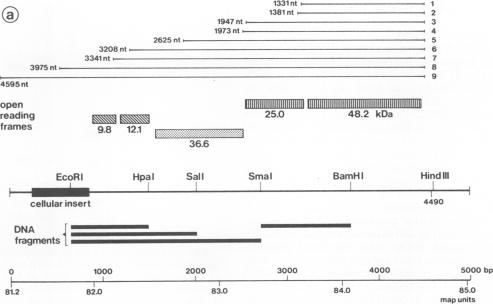
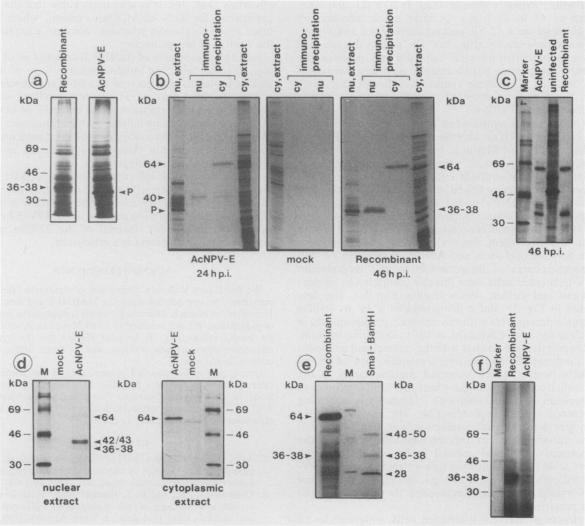
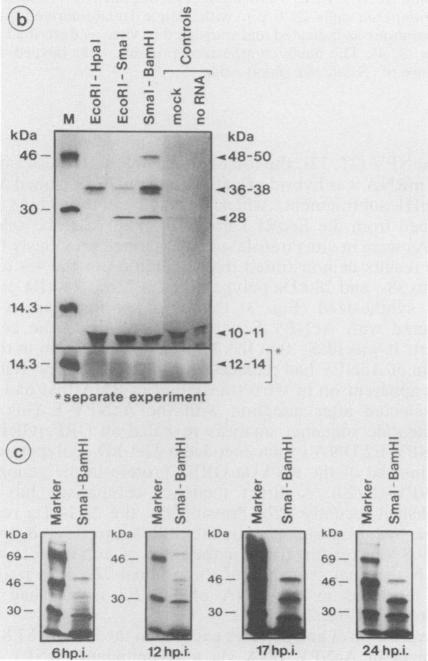
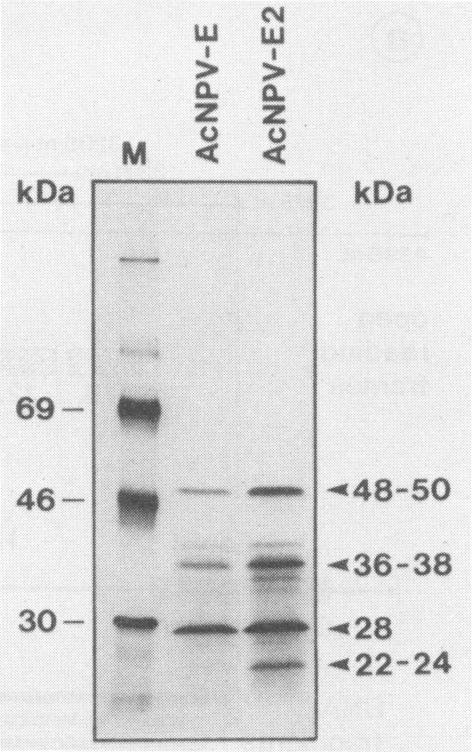
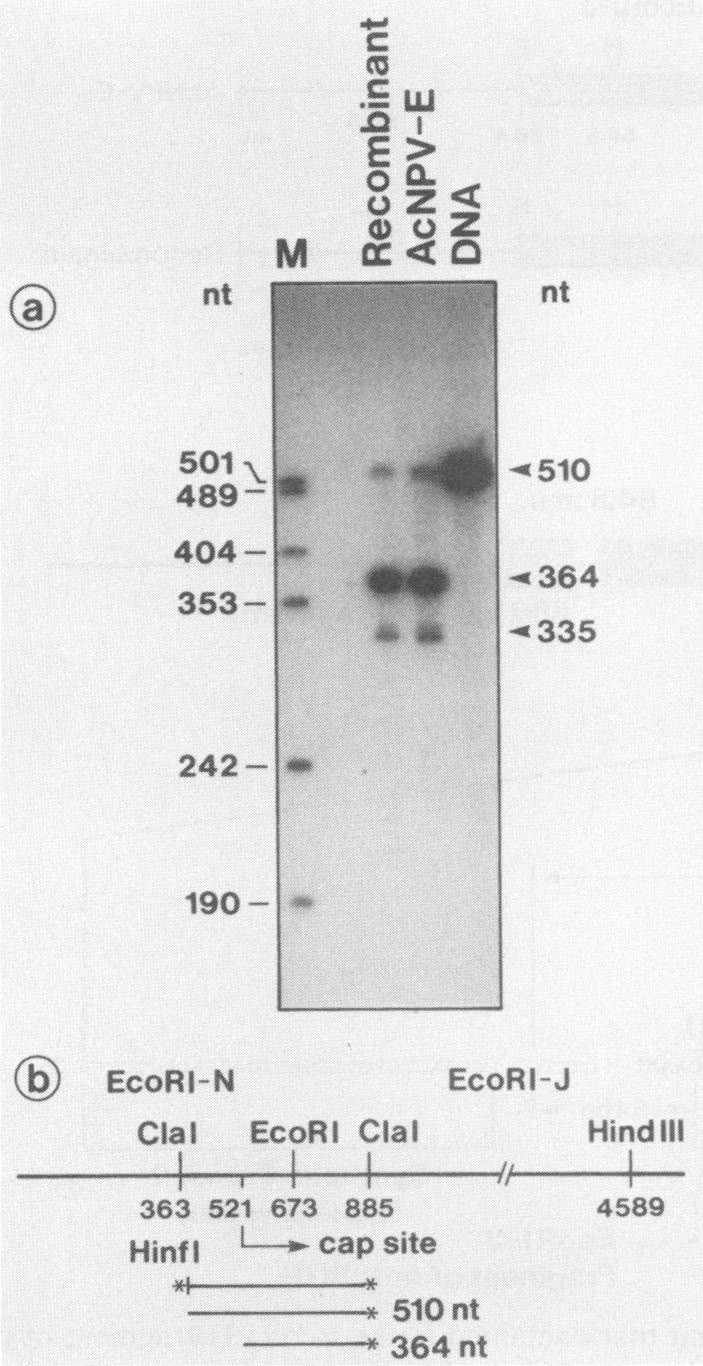
We have previously demonstrated that five open reading frames exist in the nucleotide sequence of the 81.2- to 85.0-map-unit (m.u.) segment of plaque isolate E of Autographa californica nuclear polyhedrosis virus (AcNPV) DNA. The corresponding polypeptides are 9.8, 12.1, 36.6, 25.0, and 48.2 kDa in size (C. Oellig, B. Happ, T. Müller, and W. Doerfler, J. Virol. 63:1494, 1989), and we have investigated whether these proteins can be translated in infected cells. On subfragments of this viral DNA segment, mRNAs were selected from AcNPV-infected Spodoptera frugiperda insect cells at different times postinfection (p.i.). The in vitro translation of these RNAs in a rabbit reticulocyte-derived cell-free translation system yielded polypeptides of approximately 10 to 11, 12 to 14, 28, 36 to 38, and 48 to 50-kDa which were commensurate in size with the theoretically expected values. mRNAs for the 28- and 48- to 50-kDa proteins were identified by their translation products at 6 h p.i., and mRNAs for the 10- to 11-, 12- to 14-, and 36- to 38-kDa proteins were identified by their translation products at 12 h p.i. We constructed an AcNPV recombinant which carried in its polyhedrin gene the 3.9-kbp EcoRI-HindIII (81.8 to 84.8 m.u.) subfragment of the EcoRI J segment. Nucleotide sequence determinations revealed that the intact polyhedrin promoter lay adjacent to the additional 81.8- to 84.8-m.u. fragment in this recombinant. In S. frugiperda cells, which were infected with the recombinant AcNPV, a protein of 36 to 38 kDa was detected at 44 h p.i. in larger amounts than after infection with the nonrecombinant virus. However, there was no evidence for larger amounts of RNA derived from the 81.8- to 84.8-m.u. fragment in recombinant-infected cells. Recombinant-infected cells lacked the polyhedrin polypeptide. The synthesis of the 36- to 38-kDa polypeptide in recombinant- or AcNPV-E-infected S. frugiperda cells could be demonstrated by immunoprecipitation experiments. Peculiarly, this polypeptide was present in the cytoplasm as a 64-kDa glycoprotein. These data corroborate the notion that at least some of the open reading frames encoded in the 81.2- to 85.0-m.u. segment of AcNPV can be expressed in S. frugiperda cells.
我们之前已经证明,苜蓿银纹夜蛾核型多角体病毒(AcNPV)DNA的噬菌斑分离株E的81.2至85.0图谱单位(m.u.)片段的核苷酸序列中存在五个开放阅读框。相应的多肽大小分别为9.8、12.1、36.6、25.0和48.2 kDa(C. Oellig、B. Happ、T. Müller和W. Doerfler,《病毒学杂志》63:1494,1989年),并且我们已经研究了这些蛋白质是否能在受感染细胞中翻译。在该病毒DNA片段的亚片段上,于感染后不同时间(p.i.)从AcNPV感染的草地贪夜蛾昆虫细胞中选择mRNA。这些RNA在兔网织红细胞来源的无细胞翻译系统中的体外翻译产生了大小约为10至11、12至14、28、36至38和48至50 kDa的多肽,其大小与理论预期值相符。28 kDa以及48至50 kDa蛋白质的mRNA通过其在感染后6小时的翻译产物得以鉴定,而10至11 kDa、12至14 kDa以及36至38 kDa蛋白质的mRNA则通过其在感染后12小时的翻译产物得以鉴定。我们构建了一种AcNPV重组体,其多角体蛋白基因中携带了EcoRI J片段的3.9 kbp EcoRI - HindIII(81.8至84.8 m.u.)亚片段。核苷酸序列测定表明,完整的多角体蛋白启动子位于该重组体中额外的81.8至84.8 m.u.片段附近。在感染了重组AcNPV的草地贪夜蛾细胞中,在感染后44小时检测到一种36至38 kDa的蛋白质,其含量比感染非重组病毒后更多。然而,没有证据表明重组感染细胞中存在源自81.8至84.8 m.u.片段的更多RNA。重组感染细胞缺乏多角体蛋白多肽。通过免疫沉淀实验可以证明在重组或AcNPV - E感染的草地贪夜蛾细胞中合成了36至38 kDa的多肽。特别的是,这种多肽在细胞质中以64 kDa糖蛋白的形式存在。这些数据证实了这样一种观点,即AcNPV的81.2至85.0 m.u.片段中编码的至少一些开放阅读框可以在草地贪夜蛾细胞中表达。