Lehrstuhl Verhaltensforschung, Universität Bielefeld, Postfach 100131, D-33501 Bielefeld, Germany.
FB Biowissenschaften, J. W. Goethe-Universität, Siesmayerstr. 70, D-60054 Frankfurt/Main, Germany.
Front Zool. 2009 Oct 23;6:25. doi: 10.1186/1742-9994-6-25.
Zebra finches can be trained to use the geomagnetic field as a directional cue for short distance orientation. The physical mechanisms underlying the primary processes of magnetoreception are, however, largely unknown. Two hypotheses of how birds perceive magnetic information are mainly discussed, one dealing with modulation of radical pair processes in retinal structures, the other assuming that iron deposits in the upper beak of the birds are involved. Oscillating magnetic fields in the MHz range disturb radical pair mechanisms but do not affect magnetic particles. Thus, application of such oscillating fields in behavioral experiments can be used as a diagnostic tool to decide between the two alternatives.
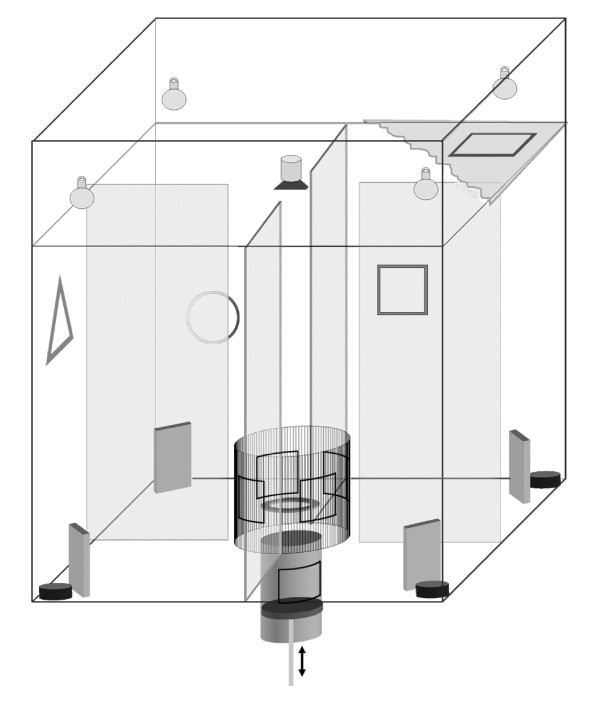
In a setup that eliminates all directional cues except the geomagnetic field zebra finches were trained to search for food in the magnetic north/south axis. The birds were then tested for orientation performance in two magnetic conditions. In condition 1 the horizontal component of the geomagnetic field was shifted by 90 degrees using a helmholtz coil. In condition 2 a high frequently oscillating field (1.156 MHz) was applied in addition to the shifted field. Another group of birds was trained to solve the orientation task, but with visual landmarks as directional cue. The birds were then tested for their orientation performance in the same magnetic conditions as applied for the first experiment.
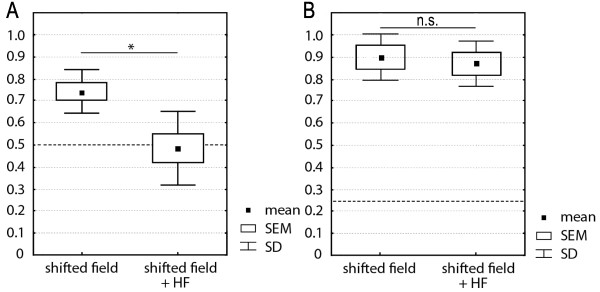
The zebra finches could be trained successfully to orient in the geomagnetic field for food search in the north/south axis. They were also well oriented in test condition 1, with the magnetic field shifted horizontally by 90 degrees. In contrast, when the oscillating field was added, the directional choices during food search were randomly distributed. Birds that were trained to visually guided orientation showed no difference of orientation performance in the two magnetic conditions.
The results indicate that zebra finches use a receptor that bases on radical pair processes for sensing the direction of the earth magnetic field in this short distance orientation behavior.
斑胸草雀可以被训练成使用地磁场作为短距离定向的方向线索。然而,磁受体的主要过程的物理机制在很大程度上仍是未知的。目前主要讨论了鸟类感知磁场信息的两种假说,一种涉及到视网膜结构中的自由基对过程的调制,另一种假设鸟类上喙中的铁沉积物参与其中。兆赫兹范围内的振荡磁场会干扰自由基对机制,但不会影响磁性粒子。因此,在行为实验中应用这种振荡场可以作为一种诊断工具,在两种选择之间做出决定。
在一个消除了除地磁场以外的所有方向线索的设置中,斑胸草雀被训练在磁北/磁南轴上寻找食物。然后,这些鸟类在两种磁场条件下接受定向性能测试。在条件 1 中,使用亥姆霍兹线圈将地磁场的水平分量偏移 90 度。在条件 2 中,除了偏移的磁场外,还施加高频振荡场(1.156 MHz)。另一组鸟类被训练解决定向任务,但使用视觉地标作为定向线索。然后,这些鸟类在与第一个实验相同的磁场条件下接受定向性能测试。
斑胸草雀可以成功地被训练在磁北/磁南轴上寻找食物的地磁场中进行定向。它们在磁场水平偏移 90 度的测试条件 1 中也表现出良好的定向。相比之下,当施加振荡场时,在食物搜索期间的定向选择是随机分布的。那些被训练进行视觉引导定向的鸟类在两种磁场条件下的定向性能没有差异。
结果表明,斑胸草雀在这种短距离定向行为中使用基于自由基对过程的受体来感知地磁场的方向。