Health Services Research Group, University of Newcastle, 3rd floor, David Maddison Building, Cnr King and Watt St, Newcastle, NSW, 2300, Australia.
BMC Health Serv Res. 2009 Oct 24;9:195. doi: 10.1186/1472-6963-9-195.
The use of accreditation and quality measurement and reporting to improve healthcare quality and patient safety has been widespread across many countries. A review of the literature reveals no association between the accreditation system and the quality measurement and reporting systems, even when hospital compliance with these systems is satisfactory. Improvement of health care outcomes needs to be based on an appreciation of the whole system that contributes to those outcomes. The research literature currently lacks an appropriate analysis and is fragmented among activities. This paper aims to propose an integrated research model of these two systems and to demonstrate the usefulness of the resulting model for strategic research planning.
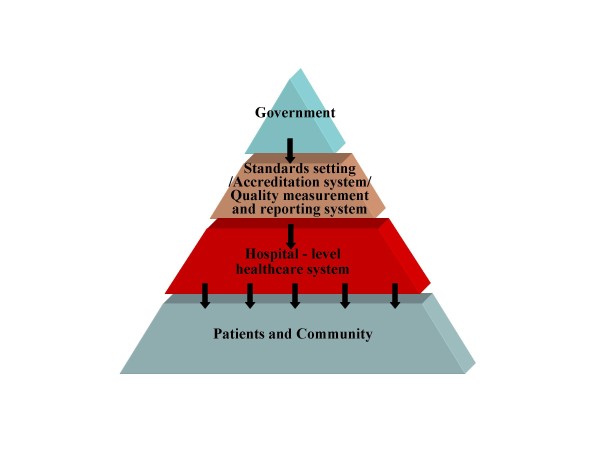
METHODS/DESIGN: To achieve these aims, a systematic integration of the healthcare accreditation and quality measurement/reporting systems is structured hierarchically. A holistic systems relationship model of the administration segment is developed to act as an investigation framework. A literature-based empirical study is used to validate the proposed relationships derived from the model. Australian experiences are used as evidence for the system effectiveness analysis and design base for an adaptive-control study proposal to show the usefulness of the system model for guiding strategic research.
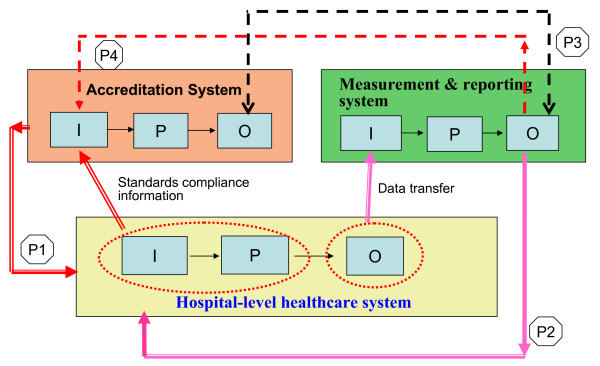
Three basic relationships were revealed and validated from the research literature. The systemic weaknesses of the accreditation system and quality measurement/reporting system from a system flow perspective were examined. The approach provides a system thinking structure to assist the design of quality improvement strategies. The proposed model discovers a fourth implicit relationship, a feedback between quality performance reporting components and choice of accreditation components that is likely to play an important role in health care outcomes. An example involving accreditation surveyors is developed that provides a systematic search for improving the impact of accreditation on quality of care and hence on the accreditation/performance correlation.
There is clear value in developing a theoretical systems approach to achieving quality in health care. The introduction of the systematic surveyor-based search for improvements creates an adaptive-control system to optimize health care quality. It is hoped that these outcomes will stimulate further research in the development of strategic planning using systems theoretic approach for the improvement of quality in health care.
在许多国家,广泛采用认证和质量衡量及报告制度来提高医疗质量和患者安全。文献综述显示,即使医院对这些系统的遵守情况令人满意,认证系统与质量衡量和报告系统之间也没有关联。要改善医疗保健结果,需要基于对促成这些结果的整个系统的理解。研究文献目前缺乏适当的分析,且分散在各种活动中。本文旨在提出这两个系统的综合研究模型,并展示该模型对战略研究规划的有用性。
方法/设计:为了实现这些目标,对医疗保健认证和质量衡量/报告系统进行了系统的层次结构整合。开发了一个整体系统关系模型来作为调查框架。使用基于文献的实证研究来验证源自模型的建议关系。利用澳大利亚的经验为系统有效性分析提供证据,并为自适应控制研究提案设计基础,以展示系统模型在指导战略研究方面的有用性。
从研究文献中揭示并验证了三个基本关系。从系统流程的角度检查了认证系统和质量衡量/报告系统的系统弱点。该方法提供了一种系统思维结构,以协助设计质量改进策略。所提出的模型发现了第四个隐含关系,即质量绩效报告组件与认证组件选择之间的反馈,这可能在医疗保健结果中发挥重要作用。开发了一个涉及认证审查员的示例,系统地寻找提高认证对护理质量的影响的方法,从而提高认证/绩效相关性。
开发一种理论系统方法来实现医疗保健质量显然具有价值。引入基于系统的审查员的系统搜索改进方法,创建了一个自适应控制系统,以优化医疗保健质量。希望这些结果将进一步激发使用系统理论方法进行战略规划的研究,以改善医疗保健质量。