Department of Genetic Medicine, Weill Cornell Medical College, New York, New York, USA.
BMC Genomics. 2009 Oct 24;10:493. doi: 10.1186/1471-2164-10-493.
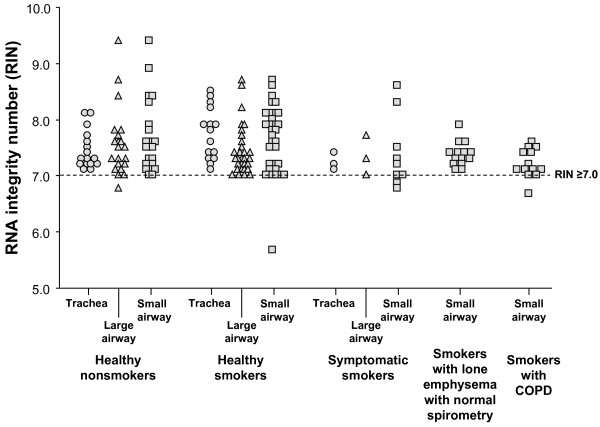
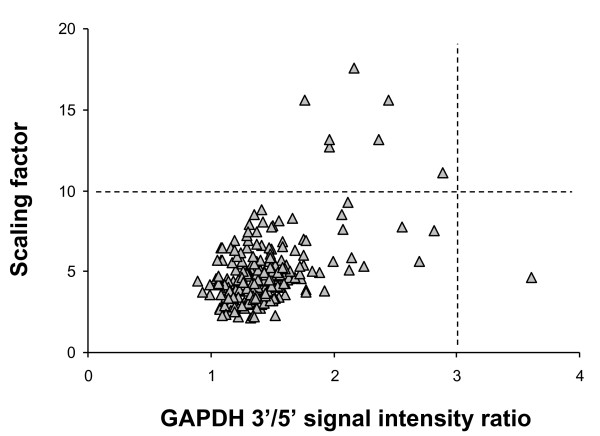
Microarray technology provides a powerful tool for defining gene expression profiles of airway epithelium that lend insight into the pathogenesis of human airway disorders. The focus of this study was to establish rigorous quality control parameters to ensure that microarray assessment of the airway epithelium is not confounded by experimental artifact. Samples (total n = 223) of trachea, large and small airway epithelium were collected by fiberoptic bronchoscopy of 144 individuals and hybridized to Affymetrix microarrays. The pre- and post-chip quality control (QC) criteria established, included: (1) RNA quality, assessed by RNA Integrity Number (RIN) > or = 7.0; (2) cRNA transcript integrity, assessed by signal intensity ratio of GAPDH 3' to 5' probe sets < or = 3.0; and (3) the multi-chip normalization scaling factor < or = 10.0.
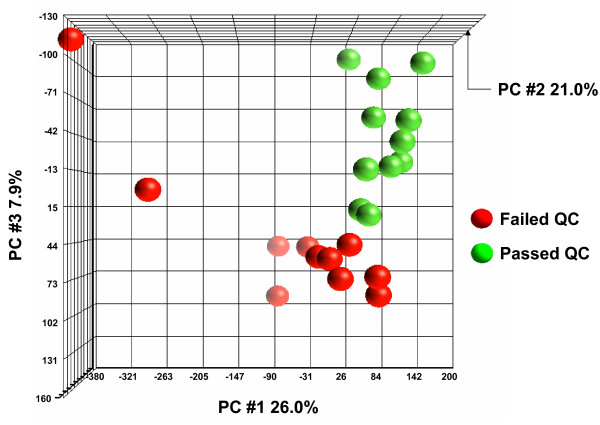
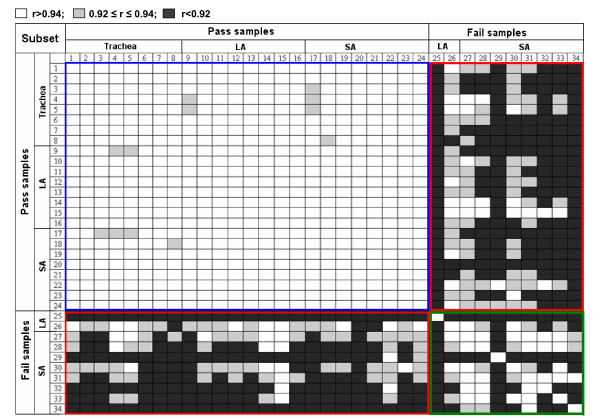
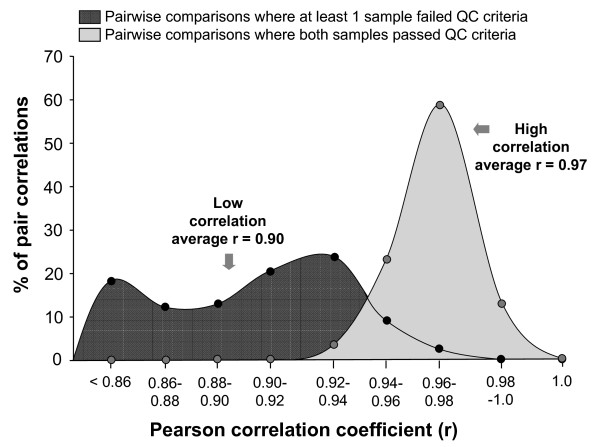
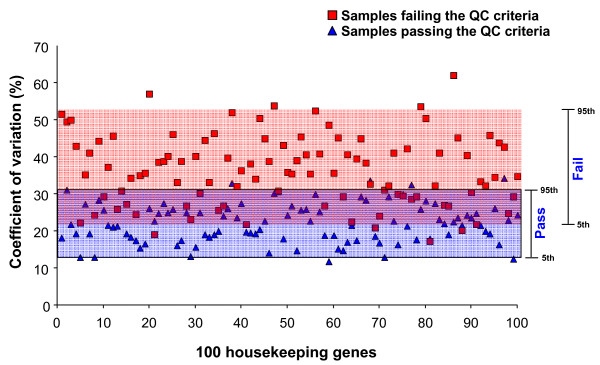
Of the 223 samples, all three criteria were assessed in 191; of these 184 (96.3%) passed all three criteria. For the remaining 32 samples, the RIN was not available, and only the other two criteria were used; of these 29 (90.6%) passed these two criteria. Correlation coefficients for pairwise comparisons of expression levels for 100 maintenance genes in which at least one array failed the QC criteria (average Pearson r = 0.90 +/- 0.04) were significantly lower (p < 0.0001) than correlation coefficients for pairwise comparisons between arrays that passed the QC criteria (average Pearson r = 0.97 +/- 0.01). Inter-array variability was significantly decreased (p < 0.0001) among samples passing the QC criteria compared with samples failing the QC criteria.
Based on the aberrant maintenance gene data generated from samples failing the established QC criteria, we propose that the QC criteria outlined in this study can accurately distinguish high quality from low quality data, and can be used to delete poor quality microarray samples before proceeding to higher-order biological analyses and interpretation.
微阵列技术为确定气道上皮细胞的基因表达谱提供了有力的工具,有助于深入了解人类气道疾病的发病机制。本研究的重点是建立严格的质量控制参数,以确保气道上皮细胞的微阵列评估不受实验伪影的影响。通过对 144 名个体的纤维支气管镜检查收集了 223 个气管、大、小气道上皮样本,并与 Affymetrix 微阵列杂交。确定了芯片前和芯片后质量控制(QC)标准,包括:(1)RNA 质量,通过 RNA 完整性数(RIN)评估> = 7.0;(2)cRNA 转录完整性,通过 GAPDH 3'到 5'探针集的信号强度比评估< = 3.0;(3)多芯片归一化缩放因子< = 10.0。
在 223 个样本中,有 191 个样本评估了这三个标准;其中 184 个(96.3%)通过了所有三个标准。对于其余 32 个样本,RIN 不可用,仅使用了其他两个标准;其中 29 个(90.6%)通过了这两个标准。在至少一个阵列未通过 QC 标准的 100 个维持基因的表达水平的成对比较中,相关系数(平均 Pearson r = 0.90 +/- 0.04)显著降低(p < 0.0001),而通过 QC 标准的阵列之间的相关系数(平均 Pearson r = 0.97 +/- 0.01)显著降低。与未通过 QC 标准的样本相比,通过 QC 标准的样本之间的阵列间变异性显著降低(p < 0.0001)。
基于从未通过建立的 QC 标准的样本中产生的异常维持基因数据,我们提出本研究中概述的 QC 标准可以准确地区分高质量数据和低质量数据,并可用于在进行更高阶的生物学分析和解释之前删除低质量的微阵列样本。