Institut universitaire de cardiologie et de pneumologie de Québec, Canada.
Respir Res. 2009 Oct 24;10(1):98. doi: 10.1186/1465-9921-10-98.
Genetic variants at the vitamin D receptor (VDR) locus are associated with asthma and atopy. We hypothesized that polymorphisms in other genes of the vitamin D pathway are associated with asthma or atopy.
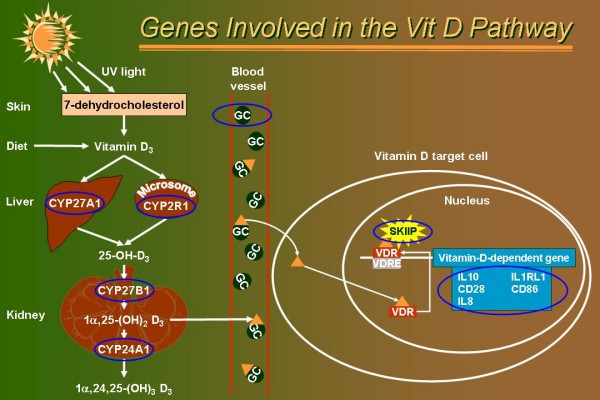
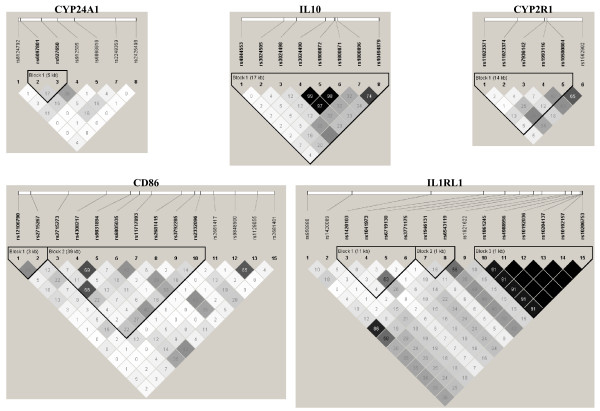
Eleven candidate genes were chosen for this study, five of which code for proteins in the vitamin D metabolism pathway (CYP27A1, CYP27B1, CYP2R1, CYP24A1, GC) and six that are known to be transcriptionally regulated by vitamin D (IL10, IL1RL1, CD28, CD86, IL8, SKIIP). For each gene, we selected a maximally informative set of common SNPs (tagSNPs) using the European-derived (CEU) HapMap dataset. A total of 87 SNPs were genotyped in a French-Canadian family sample ascertained through asthmatic probands (388 nuclear families, 1064 individuals) and evaluated using the Family Based Association Test (FBAT) program. We then sought to replicate the positive findings in four independent samples: two from Western Canada, one from Australia and one from the USA (CAMP).
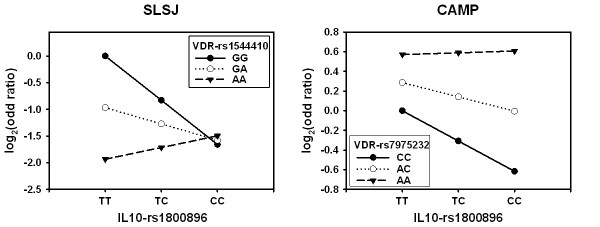
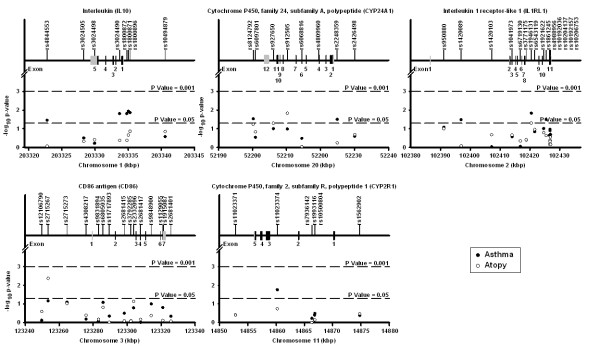
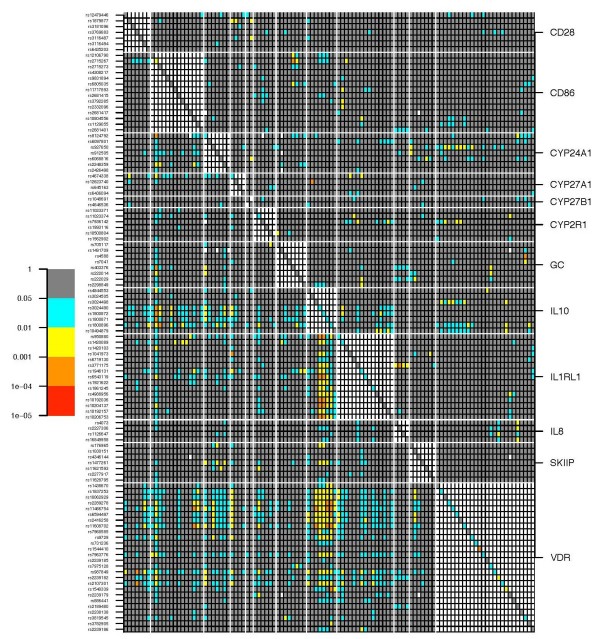
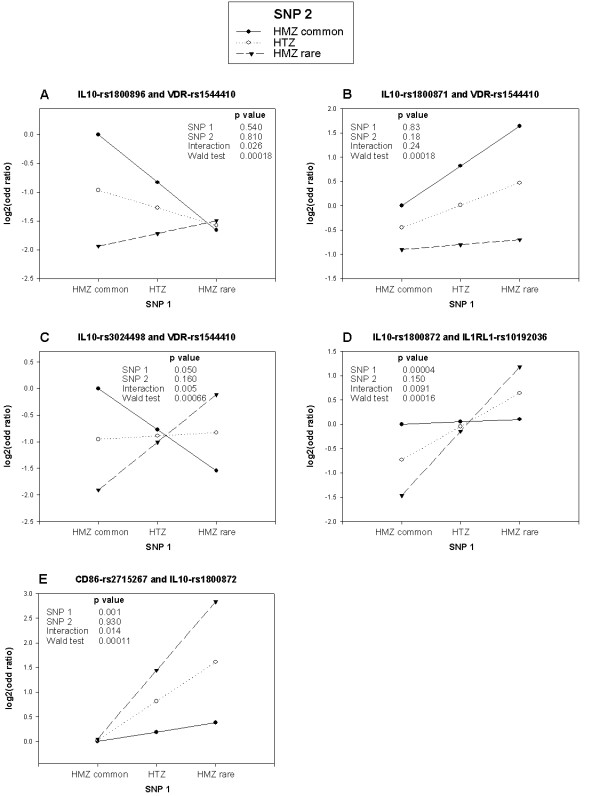
A number of SNPs in the IL10, CYP24A1, CYP2R1, IL1RL1 and CD86 genes were modestly associated with asthma and atopy (p < 0.05). Two-gene models testing for both main effects and the interaction were then performed using conditional logistic regression. Two-gene models implicating functional variants in the IL10 and VDR genes as well as in the IL10 and IL1RL1 genes were associated with asthma (p < 0.0002). In the replicate samples, SNPs in the IL10 and CYP24A1 genes were again modestly associated with asthma and atopy (p < 0.05). However, the SNPs or the orientation of the risk alleles were different between populations. A two-gene model involving IL10 and VDR was replicated in CAMP, but not in the other populations.
A number of genes involved in the vitamin D pathway demonstrate modest levels of association with asthma and atopy. Multilocus models testing genes in the same pathway are potentially more effective to evaluate the risk of asthma, but the effects are not uniform across populations.
维生素 D 受体(VDR)基因座的遗传变异与哮喘和过敏有关。我们假设维生素 D 途径中的其他基因的多态性与哮喘或过敏有关。
选择了 11 个候选基因进行这项研究,其中 5 个基因编码维生素 D 代谢途径中的蛋白质(CYP27A1、CYP27B1、CYP2R1、CYP24A1、GC),6 个基因是已知受维生素 D 转录调控的(IL10、IL1RL1、CD28、CD86、IL8、SKIIP)。对于每个基因,我们使用欧洲衍生的(CEU)HapMap 数据集选择了一组最大信息量的常见 SNP(tagSNP)。总共在一个通过哮喘患者确定的法裔加拿大家族样本中对 87 个 SNP 进行了基因分型(388 个核家族,1064 个人),并使用基于家族的关联测试(FBAT)程序进行了评估。然后,我们试图在四个独立样本中复制阳性发现:两个来自加拿大西部,一个来自澳大利亚,一个来自美国(CAMP)。
IL10、CYP24A1、CYP2R1、IL1RL1 和 CD86 基因中的一些 SNP 与哮喘和过敏有适度的关联(p<0.05)。然后使用条件逻辑回归对同时测试主要效应和相互作用的双基因模型进行了测试。IL10 和 VDR 基因以及 IL10 和 IL1RL1 基因中功能性变体的双基因模型与哮喘有关(p<0.0002)。在复制样本中,IL10 和 CYP24A1 基因中的 SNP 再次与哮喘和过敏有适度的关联(p<0.05)。然而,SNP 或风险等位基因的方向在不同人群之间有所不同。涉及 IL10 和 VDR 的双基因模型在 CAMP 中得到了复制,但在其他人群中没有得到复制。
参与维生素 D 途径的一些基因与哮喘和过敏有适度的关联。测试同一途径中基因的多基因模型可能更有效地评估哮喘的风险,但这些影响在不同人群中并不统一。