Cook Ian A, Hunter Aimee M, Abrams Michelle, Siegman Barbara, Leuchter Andrew F
UCLA Depression Research & Clinic Program, Semel Institute for Neuroscience and Human Behavior at UCLA, Los Angeles, CA, United States.
Psychiatry Res. 2009 Nov 30;174(2):152-7. doi: 10.1016/j.pscychresns.2009.04.011. Epub 2009 Oct 22.
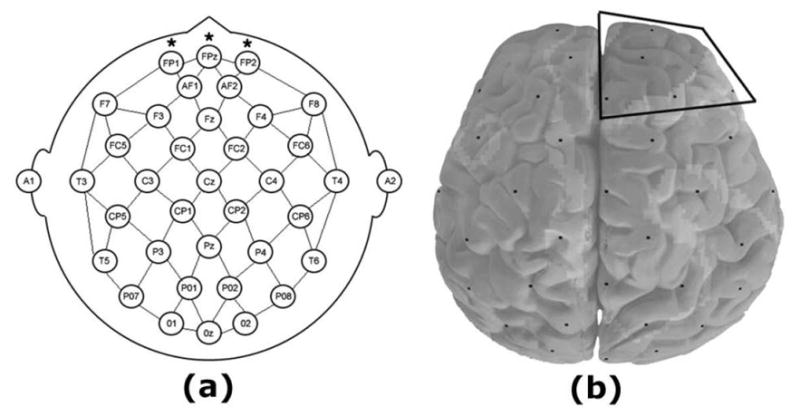
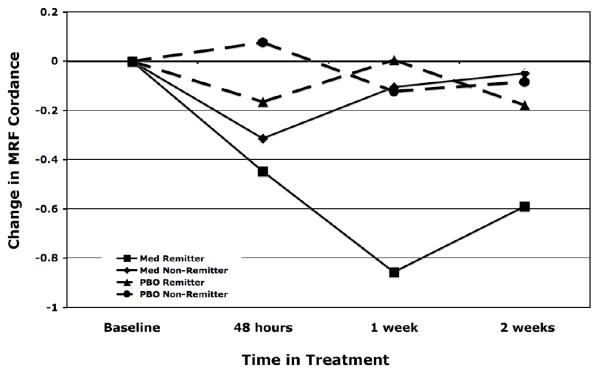
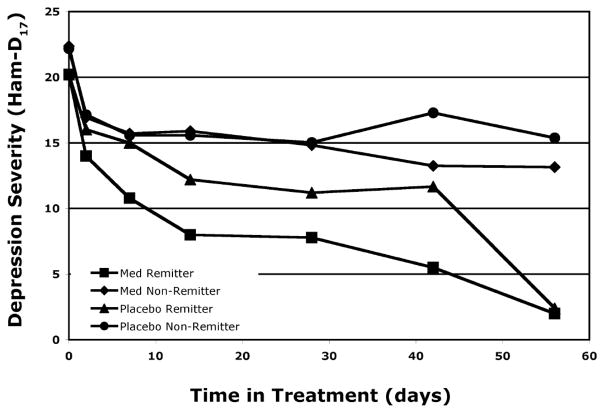
Prior investigations have reported that changes in the prefrontal electroencephalogram (EEG) precede symptom improvement from antidepressant medications, and could serve as a biomarker of treatment outcome in major depressive disorder (MDD). A new physiologically defined region of interest (ROI), overlying the midline and right frontal (MRF) cortical area, was examined here for a relationship between early decreases in theta-band cordance and remission. Subjects were 72 adults with unipolar MDD who had completed placebo-controlled antidepressant treatment trials, with 37 randomized to medication and 35 to placebo. We assessed changes in cordance and absolute and relative power in the MRF region at 48 h, 1 week, and 2 weeks after start of drug, as potential predictors of remission (final score on the 17-item Hamilton Depression Rating Scale of 5 or below. Out of 37 medication-treated subjects, 11 (30%) remitted versus 6 of 35 placebo subjects (17%). Change in MRF cordance 1 and 2 weeks after the beginning of treatment was significantly associated with remission in medication-treated subjects at 1 week, with receiver operating characteristic (ROC) analysis yielding 0.76 area under the curve. Decreases in MRF cordance at 1 week predicted remission with medication with 69% overall accuracy (90% sensitivity; 60% specificity). MRF cordance changes were not associated with remission with placebo. Absolute and relative power did not differentiate groups. These results suggest that remission may be predictable from physiologic measurements after 1 week of treatment, and that this region merits further investigation in the neurobiology of treatment response.
先前的研究报告称,前额叶脑电图(EEG)的变化先于抗抑郁药物治疗后症状的改善,并且可以作为重度抑郁症(MDD)治疗结果的生物标志物。在此研究中,对一个新的基于生理学定义的感兴趣区域(ROI)进行了检查,该区域覆盖中线和右额叶(MRF)皮质区域,以探讨θ波段一致性的早期降低与缓解之间的关系。研究对象为72名患有单相MDD的成年人,他们完成了安慰剂对照的抗抑郁药物治疗试验,其中37人随机分配接受药物治疗,35人接受安慰剂治疗。我们在开始用药后48小时、1周和2周评估了MRF区域的一致性、绝对功率和相对功率的变化,将其作为缓解的潜在预测指标(17项汉密尔顿抑郁量表最终得分≤5)。在37名接受药物治疗的受试者中,11人(30%)缓解,而35名接受安慰剂治疗的受试者中有6人(17%)缓解。治疗开始后1周和2周时MRF一致性的变化与药物治疗组受试者第1周的缓解显著相关,受试者工作特征(ROC)分析得出曲线下面积为0.76。第1周时MRF一致性的降低预测药物治疗缓解的总体准确率为69%(敏感性90%;特异性60%)。MRF一致性变化与安慰剂治疗的缓解无关。绝对功率和相对功率未能区分两组。这些结果表明,治疗1周后的生理测量结果可能预测缓解情况,并且该区域在治疗反应的神经生物学方面值得进一步研究。