Department of Psychiatry and Behavioral Sciences, Johns Hopkins University School of Medicine, Baltimore, MD 21224, USA.
J Pain. 2010 Feb;11(2):186-94. doi: 10.1016/j.jpain.2009.07.008. Epub 2009 Oct 22.
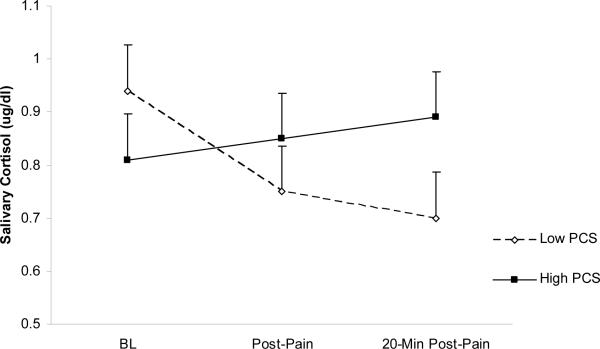
Pain catastrophizing is an important variable in the context of acute and chronic pain. The neurophysiological correlates of pain catastrophizing, however, have not been rigorously evaluated. We examined the relationship between trait-pain catastrophizing and morning salivary cortisol levels before and following a 45-minute laboratory pain-testing session in healthy, pain-free (n = 22), and temporomandibular disorder (TMD) participants (n = 39). We also examined whether TMD patients evidenced generalized hyperalgesia and hypercortisolism. Pain catastrophizing was associated with a flattened morning salivary cortisol profile in the context of pain testing, irrespective of pain status. Cortisol profiles did not differ between healthy and TMD participants. TMD was associated with mechanical hyperalgesia only at the masseter. These data are the first to show an association between pain catastrophizing and elevated salivary cortisol profiles in the context of standardized experimental pain testing. These findings in both healthy individuals and those with chronic orofacial pain suggest that aberrant adrenocortical responses to pain may serve as a neurophysiologic pathway by which pain catastrophizing enhances vulnerability for development of chronic pain and maintains and/or exaggerates existing pain and associated morbidity.
Neurophysiological mechanisms by which pain catastrophizing is related to acute and chronic pain recently have come under empirical study. Understanding of these mechanisms has the unique potential to shed light on key central-nervous-system factors that mediate catastrophizing-pain relations and therapeutic benefits associated with changes in catastrophizing and related cognitive processes.
在急性和慢性疼痛的背景下,疼痛灾难化是一个重要的变量。然而,疼痛灾难化的神经生理学相关性尚未得到严格评估。我们在健康、无痛(n=22)和颞下颌关节紊乱(TMD)参与者(n=39)中,检查了特质性疼痛灾难化与 45 分钟实验室疼痛测试前后早晨唾液皮质醇水平之间的关系。我们还检查了 TMD 患者是否表现出普遍的痛觉过敏和皮质醇增多症。疼痛灾难化与疼痛测试过程中早晨唾液皮质醇水平的平坦化有关,而与疼痛状况无关。皮质醇水平在健康参与者和 TMD 参与者之间没有差异。TMD 仅在咀嚼肌处与机械性痛觉过敏有关。这些数据首次表明,在标准化实验性疼痛测试中,疼痛灾难化与升高的唾液皮质醇水平之间存在关联。这些在健康个体和慢性或口腔面部疼痛患者中的发现表明,疼痛时肾上腺皮质反应异常可能是疼痛灾难化增强慢性疼痛易感性并维持和/或夸大现有疼痛及其相关发病率的神经生理途径。
疼痛灾难化与急性和慢性疼痛相关的神经生理机制最近受到了实证研究的关注。对这些机制的理解具有独特的潜力,可以揭示介导灾难化-疼痛关系的关键中枢神经系统因素,以及与灾难化和相关认知过程改变相关的治疗益处。