Kishida Y, Kawahara M, Teramukai S, Kubota K, Komuta K, Minato K, Mio T, Fujita Y, Yonei T, Nakano K, Tsuboi M, Shibata K, Atagi S, Kawaguchi T, Furuse K, Fukushima M
Department of Clinical Trial Design and Management, Graduate School of Medicine, Kyoto University, 54 Shogoin Kawahara-cho, Sakyo-ku, Kyoto 606-8507, Japan.
Br J Cancer. 2009 Nov 3;101(9):1537-42. doi: 10.1038/sj.bjc.6605348. Epub 2009 Sep 29.
Neutropenia is a common adverse reaction of chemotherapy. We assessed whether chemotherapy-induced neutropenia could be a predictor of survival for patients with non-small-cell lung cancer (NSCLC).
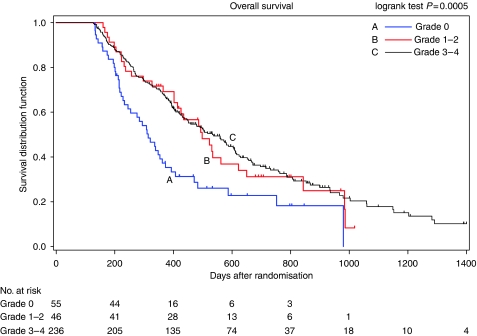
A total of 387 chemotherapy-naïve patients who received chemotherapy (vinorelbine and gemcitabine followed by docetaxel, or paclitaxel and carboplatin) in a randomised controlled trial were evaluated. The proportional-hazards regression model was used to examine the effects of chemotherapy-induced neutropenia and tumour response on overall survival. Landmark analysis was used to lessen the bias of more severe neutropenia resulting from more treatment cycles allowed by longer survival, whereby patients who died within 126 days of starting chemotherapy were excluded.
The adjusted hazard ratios for patients with grade-1 to 2 neutropenia or grade-3 to 4 neutropenia compared with no neutropenia were 0.59 (95% confidence interval (CI), 0.36-0.97) and 0.71 (95% CI, 0.49-1.03), respectively. The hazard ratios did not differ significantly between the patients who developed neutropenia with stable disease (SD), and those who lacked neutropenia with partial response (PR).
Chemotherapy-induced neutropenia is a predictor of better survival for patients with advanced NSCLC. Prospective randomised trials of early-dose increases guided by chemotherapy-induced toxicities are warranted.
中性粒细胞减少是化疗常见的不良反应。我们评估了化疗引起的中性粒细胞减少是否可作为非小细胞肺癌(NSCLC)患者生存的预测指标。
在一项随机对照试验中,共评估了387例初治且接受化疗(长春瑞滨与吉西他滨序贯多西他赛,或紫杉醇与卡铂)的患者。采用比例风险回归模型来检验化疗引起的中性粒细胞减少和肿瘤反应对总生存的影响。采用地标性分析以减少因生存时间较长允许更多治疗周期而导致的更严重中性粒细胞减少的偏差,即排除化疗开始后126天内死亡的患者。
1至2级中性粒细胞减少或3至4级中性粒细胞减少患者与无中性粒细胞减少患者相比,校正风险比分别为0.59(95%置信区间[CI],0.36 - 0.97)和0.71(95% CI,0.49 - 1.03)。疾病稳定(SD)时出现中性粒细胞减少的患者与部分缓解(PR)时未出现中性粒细胞减少的患者之间风险比无显著差异。
化疗引起的中性粒细胞减少是晚期NSCLC患者生存较好的预测指标。有必要开展以化疗引起的毒性为指导进行早期剂量增加的前瞻性随机试验。