Suppr超能文献

Toll 样受体 9 抑制可预防肝脏缺血再灌注损伤。

Toll-like receptor 9 inhibition confers protection from liver ischemia-reperfusion injury.

机构信息

Hepatopancreatobiliary Service, Memorial Sloan-Kettering Cancer Center, New York, NY 10065, USA.

出版信息

Hepatology. 2010 Feb;51(2):621-32. doi: 10.1002/hep.23365.

Abstract

UNLABELLED

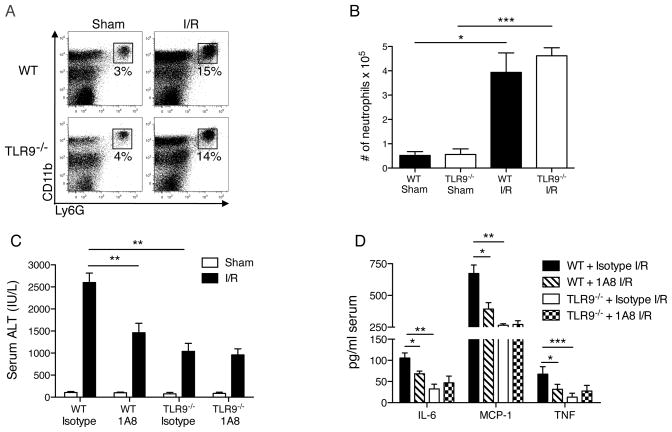
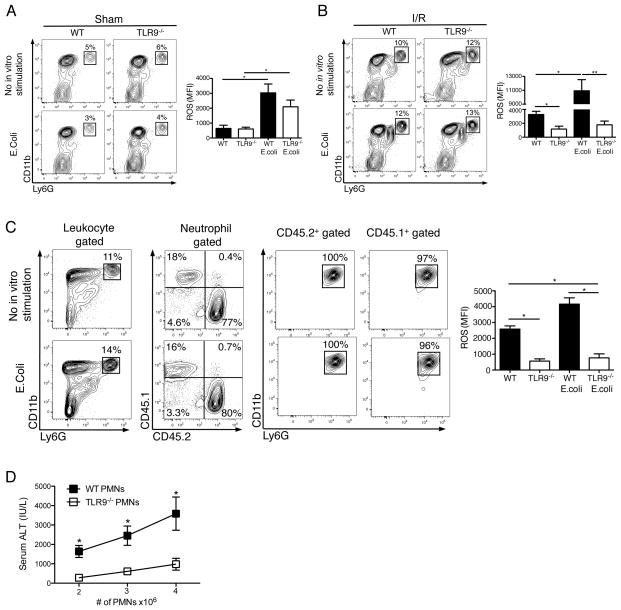
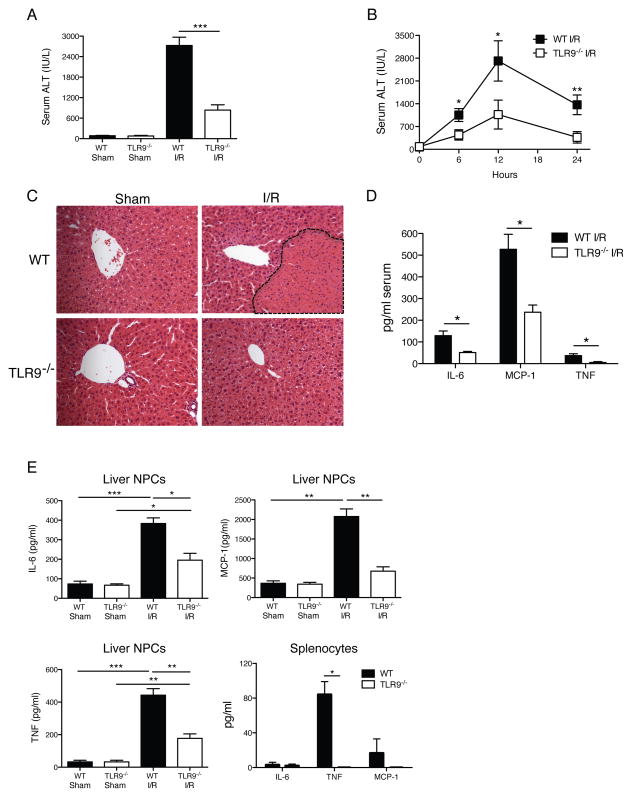
Endogenous ligands such as high-mobility group box 1 (HMGB1) and nucleic acids are released by dying cells and bind Toll-like receptors (TLRs). Because TLR9 sits at the interface of microbial and sterile inflammation by detecting both bacterial and endogenous DNA, we investigated its role in a model of segmental liver ischemia-reperfusion (I/R) injury. Mice were subjected to 1 hour of ischemia and 12 hours of reperfusion before assessment of liver injury, cytokines, and reactive oxygen species (ROS). Wild-type (WT) mice treated with an inhibitory cytosine-guanosine dinucleotide (iCpG) sequence and TLR9(-/-) mice had markedly reduced serum alanine aminotransferase (ALT) and inflammatory cytokines after liver I/R. Liver damage was mediated by bone marrow-derived cells because WT mice transplanted with TLR9(-/-) bone marrow were protected from hepatic I/R injury. Injury in WT mice partly depended on TLR9 signaling in neutrophils, which enhanced production of ROS, interleukin-6 (IL-6), and tumor necrosis factor (TNF). In vitro, DNA released from necrotic hepatocytes increased liver nonparenchymal cell (NPC) and neutrophil cytokine secretion through a TLR9-dependent mechanism. Inhibition of both TLR9 and HMGB1 caused maximal inflammatory cytokine suppression in neutrophil cultures and conferred even greater protection from I/R injury in vivo.

CONCLUSION

TLR9 serves as an endogenous sensor of tissue necrosis that exacerbates the innate immune response during liver I/R. Combined blockade of TLR9 and HMGB1 represents a clinically relevant, novel approach to limiting I/R injury.

摘要

未标记

死亡细胞释放的内源性配体,如高迁移率族蛋白 B1(HMGB1)和核酸,与 Toll 样受体(TLR)结合。由于 TLR9 通过检测细菌和内源性 DNA 位于微生物和无菌性炎症的交界处,我们研究了其在节段性肝缺血再灌注(I/R)损伤模型中的作用。在评估肝损伤、细胞因子和活性氧(ROS)之前,将小鼠进行 1 小时缺血和 12 小时再灌注。用抑制胞嘧啶鸟嘌呤二核苷酸(iCpG)序列处理野生型(WT)小鼠和 TLR9(-/-)小鼠后,肝 I/R 后血清丙氨酸氨基转移酶(ALT)和炎症细胞因子明显减少。肝损伤是由骨髓来源的细胞介导的,因为 WT 小鼠接受 TLR9(-/-)骨髓移植后可免受肝 I/R 损伤。WT 小鼠的损伤部分依赖于中性粒细胞中的 TLR9 信号,该信号增强了 ROS、白细胞介素 6(IL-6)和肿瘤坏死因子(TNF)的产生。在体外,坏死肝细胞释放的 DNA 通过 TLR9 依赖的机制增加了肝非实质细胞(NPC)和中性粒细胞的细胞因子分泌。TLR9 和 HMGB1 的联合抑制可最大程度地抑制中性粒细胞培养物中的炎症细胞因子,并在体内提供对 I/R 损伤的更大保护。

结论

TLR9 是组织坏死的内源性传感器,可加剧肝 I/R 期间的固有免疫反应。TLR9 和 HMGB1 的联合阻断代表了一种有临床意义的、新颖的方法来限制 I/R 损伤。
相似文献

2
HMGB1 plays a critical role in vascular inflammation and lesion formation via toll-like receptor 9.
Atherosclerosis. 2013 Dec;231(2):227-33. doi: 10.1016/j.atherosclerosis.2013.09.010. Epub 2013 Oct 2.
5
The novel TLR9 antagonist COV08-0064 protects from ischemia/reperfusion injury in non-steatotic and steatotic mice livers.
Biochem Pharmacol. 2016 Jul 15;112:90-101. doi: 10.1016/j.bcp.2016.05.003. Epub 2016 May 6.
8
The TLR9 Antagonist iCpG-ODN at Different Dosages Inhibits Cerebral Ischemia/Reperfusion Injury in Mice.
CNS Neurol Disord Drug Targets. 2017;16(5):624-633. doi: 10.2174/1871527316666170206150259.
10
Paeoniflorin protects against liver ischemia/reperfusion injury in mice via inhibiting HMGB1-TLR4 signaling pathway.
Phytother Res. 2018 Nov;32(11):2247-2255. doi: 10.1002/ptr.6161. Epub 2018 Jul 26.

引用本文的文献

1
Pattern recognition receptors: function, regulation and therapeutic potential.
Signal Transduct Target Ther. 2025 Jul 11;10(1):216. doi: 10.1038/s41392-025-02264-1.
2
Cytosolic nucleic acid sensing as driver of critical illness: mechanisms and advances in therapy.
Signal Transduct Target Ther. 2025 Mar 19;10(1):90. doi: 10.1038/s41392-025-02174-2.
3
Vinpocetine and Lactobacillus improve fatty liver in rats: role of adiponectin and gut microbiome.
AMB Express. 2024 Aug 2;14(1):89. doi: 10.1186/s13568-024-01731-2.
6
Innate Immune System in the Pathogenesis of Non-Alcoholic Fatty Liver Disease.
Nutrients. 2023 Apr 25;15(9):2068. doi: 10.3390/nu15092068.
7
Targeting Oxidative Stress with Polyphenols to Fight Liver Diseases.
Antioxidants (Basel). 2023 Jun 3;12(6):1212. doi: 10.3390/antiox12061212.
8
Responses of hepatic sinusoidal cells to liver ischemia-reperfusion injury.
Front Cell Dev Biol. 2023 Apr 4;11:1171317. doi: 10.3389/fcell.2023.1171317. eCollection 2023.
9
Gsk3β regulates the resolution of liver ischemia/reperfusion injury via MerTK.
JCI Insight. 2023 Jan 10;8(1):e151819. doi: 10.1172/jci.insight.151819.
10
Comprehensive overview of Nrf2-related epigenetic regulations involved in ischemia-reperfusion injury.
Theranostics. 2022 Sep 11;12(15):6626-6645. doi: 10.7150/thno.77243. eCollection 2022.

本文引用的文献

1
Bacterial DNA activates endothelial cells and promotes neutrophil adherence through TLR9 signaling.
J Immunol. 2009 Apr 1;182(7):4386-94. doi: 10.4049/jimmunol.0803044.
2
CD24 and Siglec-10 selectively repress tissue damage-induced immune responses.
Science. 2009 Mar 27;323(5922):1722-5. doi: 10.1126/science.1168988. Epub 2009 Mar 5.
3
Acetaminophen-induced hepatotoxicity in mice is dependent on Tlr9 and the Nalp3 inflammasome.
J Clin Invest. 2009 Feb;119(2):305-14. doi: 10.1172/JCI35958. Epub 2009 Jan 26.
4
TLR3 is an endogenous sensor of tissue necrosis during acute inflammatory events.
J Exp Med. 2008 Oct 27;205(11):2609-21. doi: 10.1084/jem.20081370. Epub 2008 Oct 6.
5
Use of Ly6G-specific monoclonal antibody to deplete neutrophils in mice.
J Leukoc Biol. 2008 Jan;83(1):64-70. doi: 10.1189/jlb.0407247. Epub 2007 Sep 20.
6
A novel role for HMGB1 in TLR9-mediated inflammatory responses to CpG-DNA.
Blood. 2007 Sep 15;110(6):1970-81. doi: 10.1182/blood-2006-09-044776. Epub 2007 Jun 4.
7
Toll-like receptor 9-dependent activation by DNA-containing immune complexes is mediated by HMGB1 and RAGE.
Nat Immunol. 2007 May;8(5):487-96. doi: 10.1038/ni1457. Epub 2007 Apr 8.
9
Toll-like receptors in systemic autoimmune disease.
Nat Rev Immunol. 2006 Nov;6(11):823-35. doi: 10.1038/nri1957.

文献AI研究员

20分钟写一篇综述,助力文献阅读效率提升50倍。

立即体验

用中文搜PubMed

大模型驱动的PubMed中文搜索引擎

马上搜索

文档翻译

学术文献翻译模型,支持多种主流文档格式。

立即体验