Shtir Corina J, Marjoram Paul, Azen Stanley, Conti David V, Le Marchand Loic, Haiman Christopher A, Varma Rohit
Department of Preventive Medicine, Division of Biostatistics, Keck School of Medicine, University of Southern California, Los Angeles, CA 90033, USA.
BMC Genet. 2009 Nov 10;10:71. doi: 10.1186/1471-2156-10-71.
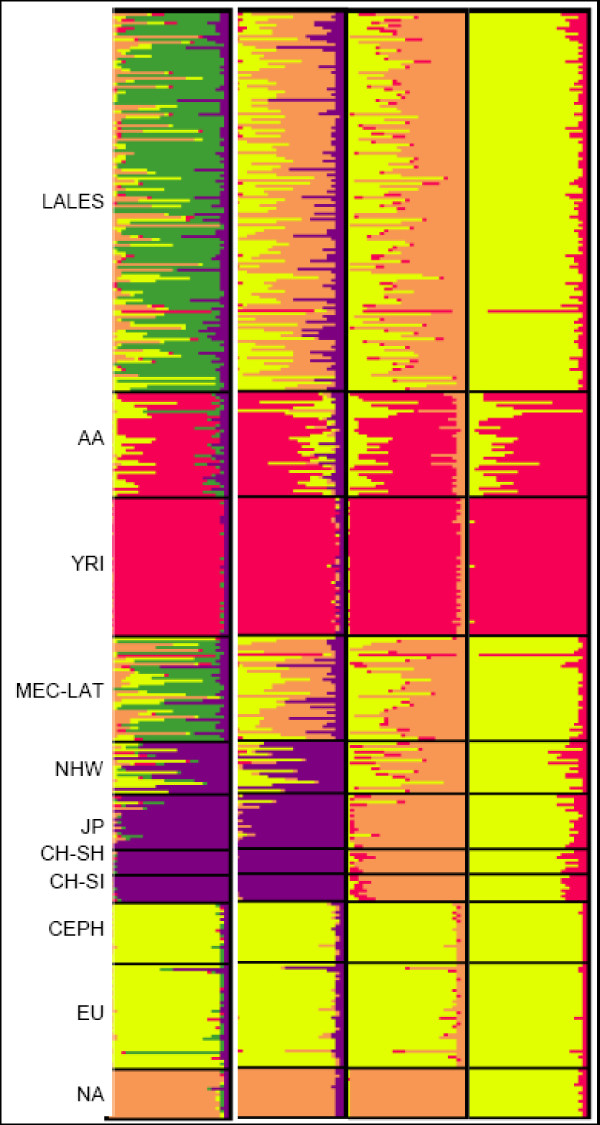
Population structure and admixture have strong confounding effects on genetic association studies. Discordant frequencies for age-related macular degeneration (AMD) risk alleles and for AMD incidence and prevalence rates are reported across different ethnic groups. We examined the genomic ancestry characterizing 538 Latinos drawn from the Los Angeles Latino Eye Study [LALES] as part of an ongoing AMD-association study. To help assess the degree of Native American ancestry inherited by Latino populations we sampled 25 Mayans and 5 Mexican Indians collected through Coriell's Institute. Levels of European, Asian, and African descent in Latinos were inferred through the USC Multiethnic Panel (USC MEP), formed from a sample from the Multiethnic Cohort (MEC) study, the Yoruba African samples from HapMap II, the Singapore Chinese Health Study, and a prospective cohort from Shanghai, China. A total of 233 ancestry informative markers were genotyped for 538 LALES Latinos, 30 Native Americans, and 355 USC MEP individuals (African Americans, Japanese, Chinese, European Americans, Latinos, and Native Hawaiians). Sensitivity of ancestry estimates to relative sample size was considered.
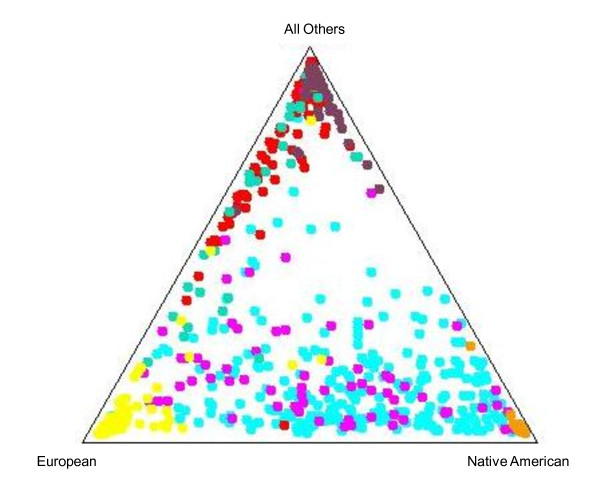
We detected strong evidence for recent population admixture in LALES Latinos. Gradients of increasing Native American background and of correspondingly decreasing European ancestry were observed as a function of birth origin from North to South. The strongest excess of homozygosity, a reflection of recent population admixture, was observed in non-US born Latinos that recently populated the US. A set of 42 SNPs especially informative for distinguishing between Native Americans and Europeans were identified.
These findings reflect the historic migration patterns of Native Americans and suggest that while the 'Latino' label is used to categorize the entire population, there exists a strong degree of heterogeneity within that population, and that it will be important to assess this heterogeneity within future association studies on Latino populations. Our study raises awareness of the diversity within "Latinos" and the necessity to assess appropriate risk and treatment management.
群体结构和混合对基因关联研究有很强的混杂效应。不同种族群体中年龄相关性黄斑变性(AMD)风险等位基因以及AMD发病率和患病率的频率存在差异。作为一项正在进行的AMD关联研究的一部分,我们研究了从洛杉矶拉丁裔眼研究(LALES)中抽取的538名拉丁裔的基因组血统特征。为了帮助评估拉丁裔群体继承的美洲原住民血统程度,我们从科里尔研究所采集了25名玛雅人和5名墨西哥印第安人的样本。通过南加州大学多族裔面板(USC MEP)推断拉丁裔群体中欧洲、亚洲和非洲血统的水平,该面板由多族裔队列(MEC)研究的样本、HapMap II中的约鲁巴非洲样本、新加坡华人健康研究以及中国上海的一个前瞻性队列组成。对538名LALES拉丁裔、30名美洲原住民和355名USC MEP个体(非裔美国人、日本人、中国人、欧裔美国人、拉丁裔和夏威夷原住民)的233个血统信息标记进行了基因分型。考虑了血统估计对相对样本量的敏感性。
我们发现了LALES拉丁裔近期群体混合的有力证据。观察到美洲原住民背景增加和相应欧洲血统减少的梯度,这是出生来源从北到南的函数。在最近迁入美国的非美国出生的拉丁裔中观察到最强的纯合子过剩,这反映了近期群体混合。鉴定出一组42个对区分美洲原住民和欧洲人特别有信息价值的单核苷酸多态性(SNP)。
这些发现反映了美洲原住民的历史迁移模式,并表明虽然“拉丁裔”标签用于对整个人口进行分类,但该群体内部存在很强的异质性,在未来对拉丁裔群体的关联研究中评估这种异质性将很重要。我们的研究提高了对“拉丁裔”内部多样性的认识以及评估适当风险和治疗管理必要性的认识。