University Children's Hospital, Tuebingen, Germany.
Diabetes Care. 2010 Feb;33(2):338-40. doi: 10.2337/dc09-1503. Epub 2009 Nov 10.
To predict the frequency of type 1 diabetes in childhood and adolescence (<15 years of age) in Germany for the next 20 years.
Data on diabetes onset has been collected by means of a registry in the federal German state of Baden-Württemberg (documentation period, 1987-2006; n = 5,108; completeness of data 98.1%).
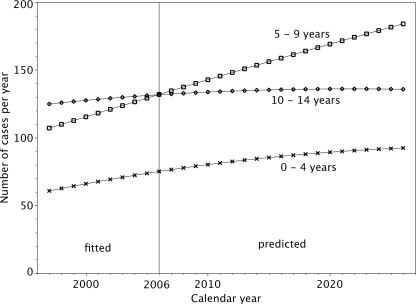
The current incidence rate (2000-2006) is 19.4 per 100,000 per year (95% CI 18.6-20.2). The annual incidence rate can be expressed as a square of a linear function of the calendar year X [y = (3.05 + 0.0778 x {X-1986})(2); r(2) = 0.90]. The highest increase per year was observed in the age-groups comprising 2- and 3-year-olds (12 and 13% per year, respectively). The incidence rate for the year 2026 is estimated to be 37.9 per 100,000 per year (95% CI 33.3-42.9).
The increase that we found in younger children is characteristic of a left shift toward an earlier age.
预测未来 20 年德国儿童和青少年(<15 岁)1 型糖尿病的发病频率。
糖尿病发病数据通过联邦德国巴登-符腾堡州的一个登记处收集(记录期间:1987-2006 年;数据完整性:98.1%;n=5108)。
当前的发病率(2000-2006 年)为每年每 10 万人 19.4 例(95%CI 18.6-20.2)。发病率可以用线性函数的平方表示,该函数与日历年度 X 有关 [y=(3.05+0.0778x{X-1986})(2);r(2)=0.90]。每年的增长率最高的是 2 岁和 3 岁的年龄组(分别为 12%和 13%)。预计 2026 年的发病率为每年每 10 万人 37.9 例(95%CI 33.3-42.9)。
我们在年龄较小的儿童中发现的发病率增加表明发病年龄提前。