The Johns Hopkins Bloomberg School of Public Health, Department of International Health, 615N Wolfe Street, E5545, Baltimore, MD 21205, United States.
Duke University, Thompson Writing Program, Durham NC 27708, United States.
Soc Sci Med. 2010 Feb;70(3):401-411. doi: 10.1016/j.socscimed.2009.09.021. Epub 2009 Nov 10.
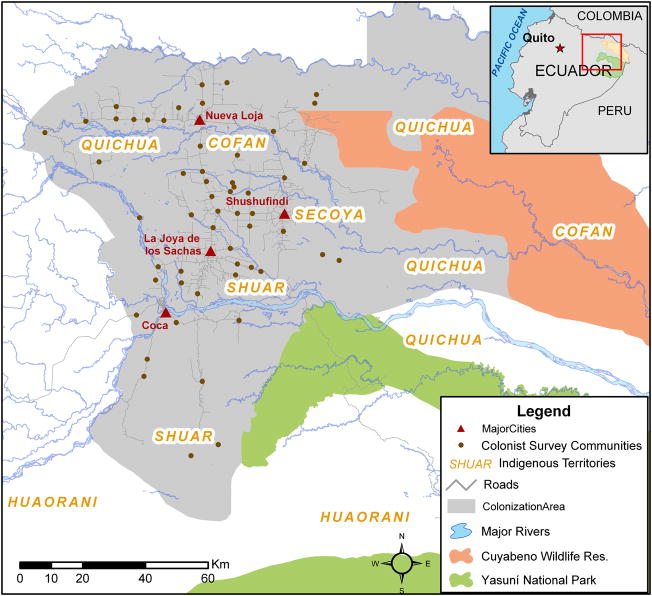
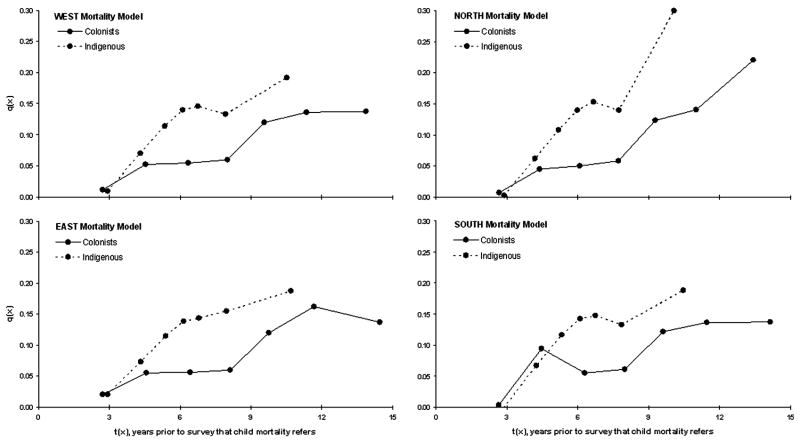
Rural populations living in the northern Ecuadorian Amazon (NEA) experience the highest health burden of any region in the country. Two independent studies of colonist and indigenous groups living in the NEA are used to compare their morbidity and mortality experiences. Colonist data are from a probability sample of land plots in 1999, while indigenous data are from a representative sample of the five largest ethnicities (Quichua, Shuar, Huaorani, Cofan, Secoya) collected in 2001. Poisson regression was used to compare morbidity. Results indicate clear differences in health between populations. Indigenous groups had 30% higher probability of mortality and 63% higher incidence rate of all-cause morbidity compared to colonists. Vector-borne, chronic, gastrointestinal, and diseases of unknown origin were particularly high among indigenous groups. Factors associated with morbidity varied: morbidity rates were similar for the two youngest age groups (0-4 and 5-9), but indigenous people aged 15-39 and 40+ had almost double the morbidity compared to colonists; larger households, later months of data collection and less pollution were associated with less morbidity in both groups; better infrastructure access (electricity and roads) was generally associated with lower morbidity in both groups; and associations of land use were different by group with more cultivation of perennials and fewer annuals associated with less morbidity for colonists, but more for indigenous groups. These results demonstrate the health disparities that exist among indigenous and non-indigenous populations even when living in the same geographic region. Land use itself exemplifies the cultural and contextual differences that are evident in health, since land use decisions are related to broader demographic and economic factors that influence overall ecological and human health. Ongoing population-environment and/or environment-health research needs to recognize the broader factors involved when studying relationships between population health, development and deforestation.
居住在厄瓜多尔亚马逊北部(NEA)的农村人口所承受的健康负担是该国任何地区中最高的。利用两项对居住在 NEA 的移民和土著群体的独立研究来比较他们的发病率和死亡率。移民数据来自 1999 年对土地的概率抽样,而土著数据则来自 2001 年对五个最大种族(克丘亚族、绍拉族、瓦劳族、科法恩族、塞科亚族)的代表性抽样。采用泊松回归来比较发病率。结果表明,不同人群之间的健康状况存在明显差异。与移民相比,土著群体的死亡率高出 30%,总发病率高出 63%。土著群体中特别高发的疾病有虫媒传染病、慢性病、胃肠道疾病和不明原因的疾病。与发病率相关的因素也有所不同:两个最年轻的年龄组(0-4 岁和 5-9 岁)的发病率相似,但 15-39 岁和 40 岁以上的土著人的发病率几乎是移民的两倍;家庭规模较大、数据收集较晚和污染程度较低与两组人群的发病率降低有关;两组人群基础设施的获取情况(电力和道路)较好与发病率降低有关;土地利用的关联也因群体而异,多年生作物种植的比例较高和一年生作物种植的比例较低与移民的发病率降低有关,但与土著群体的发病率升高有关。这些结果表明,即使居住在同一地理区域,土著和非土著人口之间也存在健康差距。土地利用本身体现了健康方面明显存在的文化和背景差异,因为土地利用决策与影响整体生态和人类健康的更广泛的人口和经济因素有关。在研究人口健康、发展与森林砍伐之间的关系时,需要开展持续的人口-环境和/或环境-健康研究,以认识到所涉及的更广泛因素。