Laboratory of Cellular and Molecular Biology, Center for Cancer Research, National Cancer Institute, National Institutes of Health, Bethesda, MD 20892, USA.
Immunol Rev. 2009 Nov;232(1):84-98. doi: 10.1111/j.1600-065X.2009.00840.x.
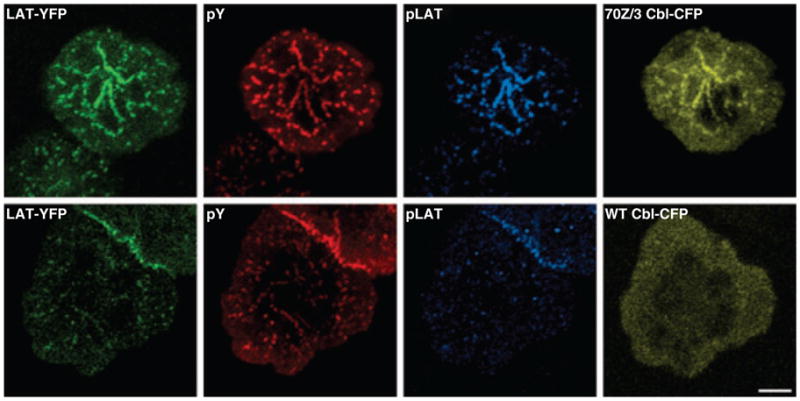
Although the critical role of T-cell receptor (TCR) microclusters in T-cell activation is now widely accepted, the mechanisms of regulation of these TCR-rich structures, which also contain enzymes, adapters, and effectors, remain poorly defined. Soon after microcluster formation, several signaling proteins rapidly dissociate from the TCR. Recent studies from our laboratory demonstrated that the movement of the adapters linker for activation of T cells (LAT) and Src homology 2 domain-containing leukocyte protein of 76 kDa (SLP-76) away from initial microcluster formation sites represents endocytic events. Ubiquitylation, Cbl proteins, and multiple endocytic pathways are involved in the internalization events that disassemble signaling microclusters. Several recent studies have indicated that microcluster movement and centralization plays an important role in signal termination. We suggest that microcluster movement is directly linked to endocytic events, thus implicating endocytosis of microclusters as a means to regulate signaling output of the T cell.
虽然 T 细胞受体 (TCR) 微簇在 T 细胞激活中的关键作用现在已被广泛接受,但这些 TCR 丰富结构(还包含酶、接头和效应物)的调节机制仍未得到明确定义。微簇形成后不久,几种信号蛋白迅速从 TCR 上解离。我们实验室的最近研究表明,激活 T 细胞的接头(Linker for activation of T cells,LAT)和 76 kDa 的含Src 同源 2 结构域白细胞蛋白(Src homology 2 domain-containing leukocyte protein of 76 kDa,SLP-76)的接头从初始微簇形成部位的移动代表了内吞作用。泛素化、Cbl 蛋白和多种内吞途径参与了分解信号微簇的内化事件。最近的几项研究表明,微簇的运动和集中化在信号终止中起着重要作用。我们认为微簇的运动与内吞作用直接相关,因此,内吞作用作为调节 T 细胞信号输出的一种方式,暗示了微簇的内吞作用。