Institute for Lung Diseases, Clinical Center of Serbia, Belgrade, Serbia.
World J Surg Oncol. 2009 Nov 12;7:87. doi: 10.1186/1477-7819-7-87.
beside the well known predominance of distant vs. loco-regional relapse, several aspects of the relapse pattern still have not been fully elucidated.
prospective, controlled study on 88 patients operated for non-small cell lung cancer (NSCLC) in a 15 months period. Stage IIIA existed in 35(39.8%) patients, whilst stages IB, IIA and IIB existed in 10.2%, 4.5% and 45.5% patients respectively.
stage I-IIIA, complete resection, systematic lymphadenectomy with at least 6 lymph node groups examined, no neoadjuvant therapy, exact data of all aspects of relapse, exact data about the outcome of the treatment.
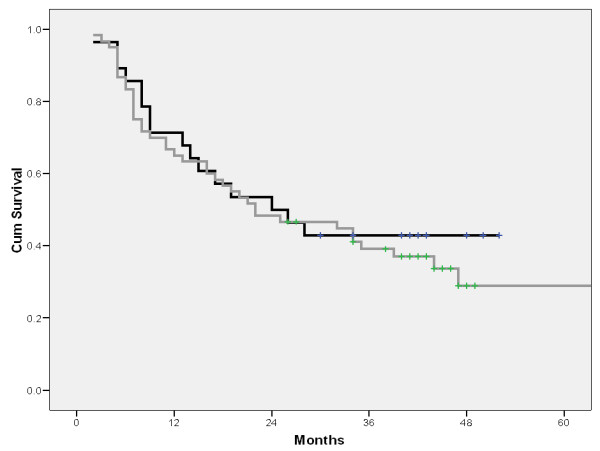
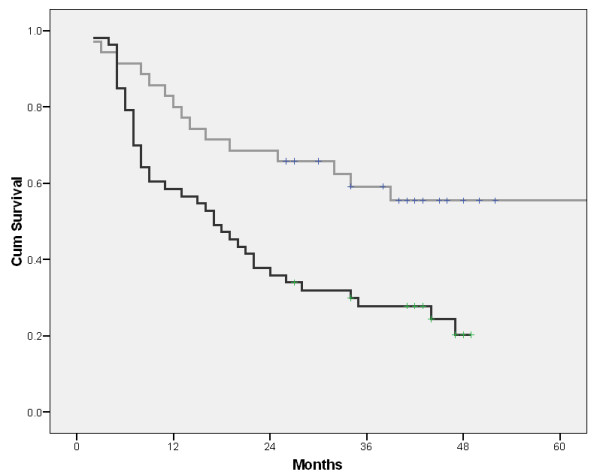
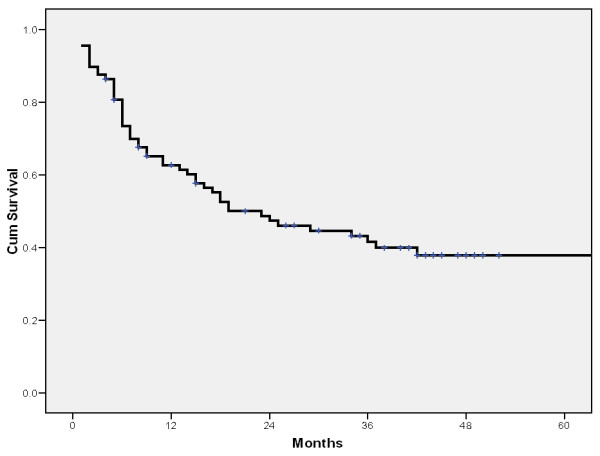
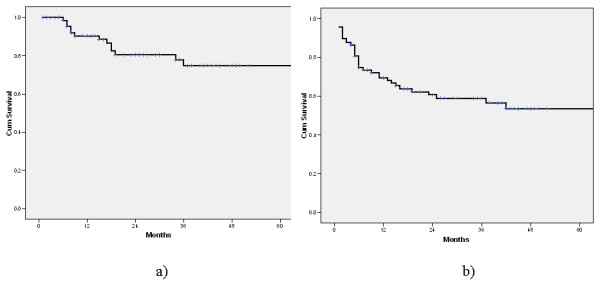
postoperative lung cancer relapse occurred in 50(56.8%) patients. Locoregional, distant and both types of relapse occurred in 26%, 70% and 4% patients respectively. Postoperative cancer relapse occurred in 27/35(77.1%) pts. in the stage IIIA and in 21/40(52.55) pts in the stage IIB. In none of four pts. in the stage IIA cancer relapse occurred, unlike 22.22% pts. with relapse in the stage IB. The mean disease free interval in the analysed group was 34.38 +/- 3.26 months.The mean local relapse free and distant relapse free intervals were 55 +/- 3.32 and 41.62 +/- 3.47 months respectively Among 30 pts. with the relapse onset inside the first 12 month after the lung resection, in 20(66.6%) pts. either T3 tumours or N2 lesions existed. In patients with N0, N1 and N2 lesions, cancer relapse occurred in 30%, 55.6% and 70.8% patients respectively. Radiographic aspect T stage, N stage and extent of resection were found as significant in terms of survival. Related to the relapse occurrence, although radiographic aspect and extent of resection followed the same trend as in the survival analysis, only T stage and N stage were found as significant in the same sense as for survival. On multivariate, only T and N stage were found as significant in terms of survival.Specific oncological treatment of relapse was possible in 27/50(54%) patients.
the intensified follow up did not increase either the proportion of patients detected with asymptomatic relapse or the number of patients with specific oncological treatment of relapse.
除了众所周知的远处与局部复发的明显差异外,复发模式的几个方面仍未得到充分阐明。
对 88 例非小细胞肺癌(NSCLC)患者进行前瞻性、对照研究,研究时间为 15 个月。35 例(39.8%)患者存在 IIIA 期,10.2%、4.5%和 45.5%的患者分别存在 IB、IIA 和 IIB 期。
I-IIIA 期,完全切除,系统淋巴结清扫,至少检查 6 个淋巴结组,无新辅助治疗,所有复发方面的准确数据,治疗结果的准确数据。
50 例(56.8%)患者术后发生肺癌复发。局部复发、远处复发和两者均有的复发分别占 26%、70%和 4%。35 例 IIIA 期患者中有 27 例(77.1%)、40 例 IIB 期患者中有 21 例(52.55%)术后发生癌症复发。在 IIA 期的 4 例患者中,无一例发生癌症复发,而 IB 期患者中有 22.22%发生复发。在分析组中,平均无病间隔时间为 34.38±3.26 个月。局部无复发生存期和远处无复发生存期分别为 55±3.32 个月和 41.62±3.47 个月。在 30 例复发发生在肺切除术后 12 个月内的患者中,20 例(66.6%)存在 T3 肿瘤或 N2 病变。在 N0、N1 和 N2 病变的患者中,癌症复发分别发生在 30%、55.6%和 70.8%的患者中。影像学 T 分期、N 分期和切除范围被认为与生存有关。与复发发生相关,虽然影像学 T 分期和切除范围与生存分析的趋势相同,但只有 T 分期和 N 分期与生存同样具有显著意义。多变量分析中,只有 T 分期和 N 分期与生存有关。对 50 例(54%)患者进行了具体的肿瘤学治疗。
强化随访并没有增加无症状复发患者的比例,也没有增加进行特定肿瘤学治疗的患者数量。